
Roaming charges and Brexit
For years, roaming inside Europe felt like one of those rare telecom wins that ordinary travellers actually noticed. You landed in Madrid, Paris, Rome or Zagreb, switched off airplane mode, and your UK mobile plan mostly behaved as if you were still at home. No panic. No strange €78 data bill. No “just one WhatsApp message” anxiety.
Then Brexit happened, and roaming quietly became political again.
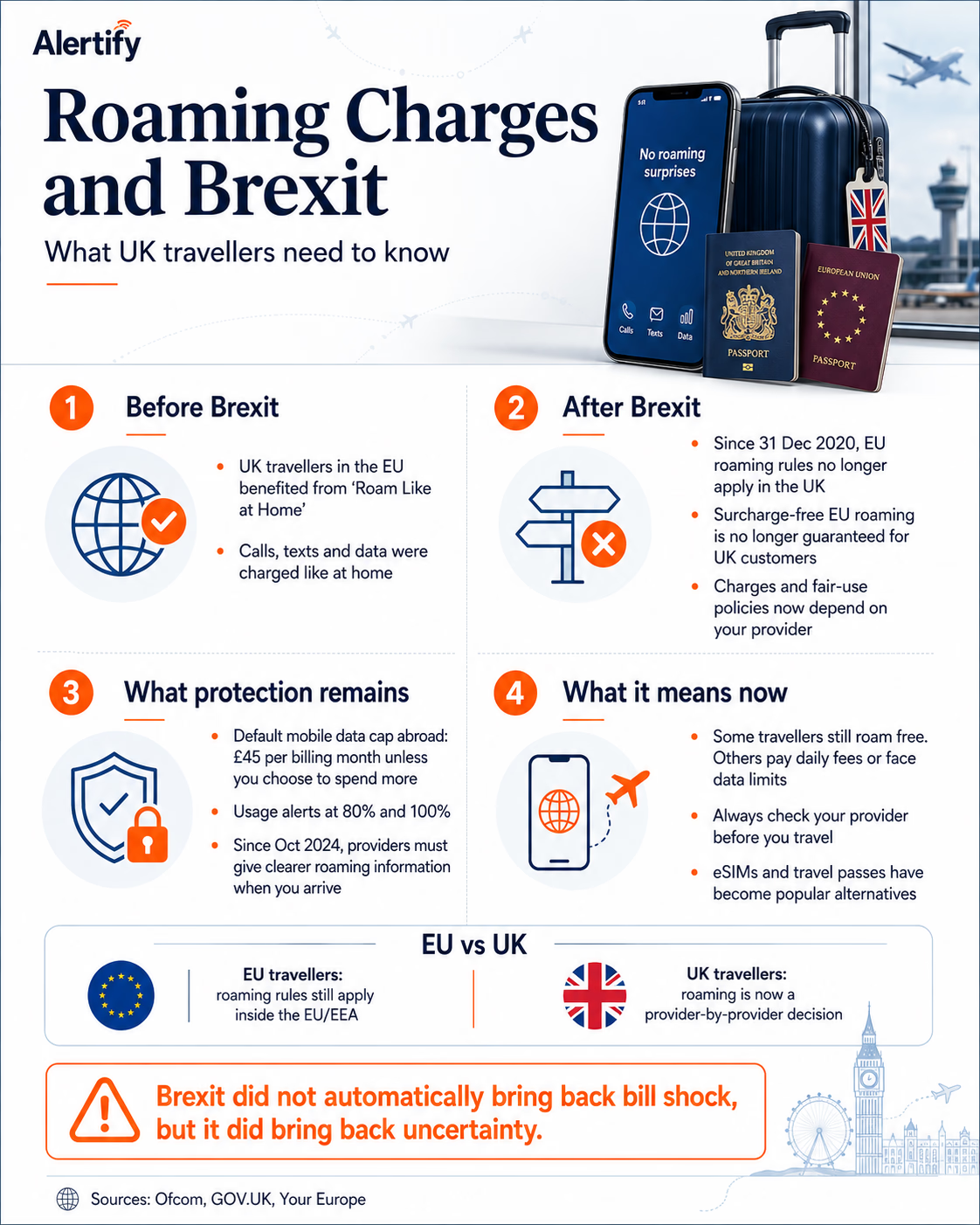
The important bit is simple: since 31 December 2020, EU roaming rules no longer apply to UK mobile providers. That means UK operators are no longer legally required to offer surcharge-free roaming in the EU, Norway, Iceland or Liechtenstein. Ofcom is very clear on this point: the amount UK providers can charge for roaming in those countries is no longer capped by EU rules.
That does not mean every UK traveller now pays roaming fees. It means the protection is no longer automatic. And that small legal change has created a messy market where one person gets free EU roaming, another pays a daily fee, and a third assumes they are covered until their phone bill proves otherwise.
The old deal is gone
Before Brexit, the EU’s “Roam like at home” system removed retail roaming surcharges for temporary travel inside the European Economic Area. EU residents could use calls, texts and data abroad in another EU country at domestic rates, subject to fair-use rules. The EU has since extended that framework until 2032, which means the system remains alive for EU consumers travelling within the bloc.
The UK is now outside that framework.
This is where the confusion starts. Many travellers still talk about “Europe roaming” as if it is one clean category. It is not. For an EU customer travelling from Germany to Spain, roaming is still protected by EU rules. For a UK customer travelling to Spain, it depends on the provider, the plan, the contract date, the fair-use policy and, sometimes, whether they upgraded at the wrong moment.
That is not exactly the seamless digital travel experience everyone likes to advertise.
What UK travellers face now
After Brexit, the UK government kept some consumer protections, but it did not preserve guaranteed free EU roaming. The government guidance says there is a £45 monthly default data roaming limit, unless the customer actively chooses to continue spending, and alerts should be sent at 80% and 100% of usage.
Ofcom also introduced new roaming protections from 1 October 2024. Providers must notify customers when they start roaming and give clear information about charges, fair-use limits, time limits and spending caps. The rules also address inadvertent roaming, which matters for people near borders or on coastlines where phones can connect to a foreign network without the user physically travelling there.
That is useful. But let’s be honest: a warning message is not the same thing as free roaming.
The market has shifted from “roaming is included by law” to “please read your provider’s terms before you fly.” Some operators include EU roaming in selected plans. Some charge around a daily fee. Some apply fair-use data caps. Some treat Ireland differently. Some bundle roaming into premium packages, which is convenient if you travel often but irritating if you only wanted a weekend in Lisbon.
This is where consumers feel the Brexit effect most clearly. Not necessarily in one huge shock bill, but in the return of friction.
Roaming is now a product feature
From a telecom perspective, Brexit did something interesting. It turned EU roaming from a regulatory guarantee into a commercial differentiator.
That is a big shift.
When free roaming was mandatory, operators could not really use it as a premium feature. Everyone had to offer it. Now, roaming has become part of plan design. Some brands use included roaming to look customer-friendly. Others push travellers toward add-ons, passes or premium tiers. For operators, that creates margin and segmentation. For users, it creates homework.
And this is exactly why the eSIM market has benefited.
The modern traveller no longer compares only “my operator versus another operator.” They compare their home plan against an eSIM app, a local SIM, a regional travel bundle, a bank perk, an airline add-on or a travel platform offer. The decision happens in the airport, in the booking flow, inside a fintech app, or five minutes after landing when Google Maps refuses to load.
That is the real post-Brexit roaming story. It is not only about the UK leaving an EU rulebook. It is about connectivity becoming unbundled from the traditional mobile contract.
The eSIM escape route
For UK travellers, eSIMs have become the obvious workaround. Not always the cheapest, not always the best for calls and SMS, but often the cleanest solution for mobile data.
Instead of paying a daily roaming charge for a short trip, a traveller can buy a country-specific or regional Europe eSIM. For heavy users, the economics are not always straightforward. A £2-per-day roaming fee might be perfectly acceptable for a three-day city break. But for a two-week trip, a family holiday, remote work, or multi-country travel, eSIM plans can quickly become more attractive.
The bigger advantage is psychological. Travellers like knowing the price before they go online. A 10 GB Europe eSIM feels more controllable than a roaming policy hidden behind plan conditions, fair-use limits and post-cap rates.
This is where travel eSIM providers, MVNOs and embedded connectivity players have an opening. They are not just selling gigabytes. They are selling certainty.
Not all “Europe roaming” is equal
The problem is that many travellers still do not understand how different the options are.
A home operator roaming pass might include calls, SMS and access to your regular allowance. A travel eSIM is usually data-only. A premium UK mobile plan may include generous EU roaming, but only within certain destinations and fair-use limits. A cheap eSIM may offer data at a good price, but with weaker support, unclear network priority or no easy refund path.
That is why roaming after Brexit has become less about one universal answer and more about trip context.
For a light user spending two days in Amsterdam, paying the operator’s daily fee may be fine. For a digital nomad moving between Portugal, Spain and France for a month, a regional eSIM or a provider with a more flexible Europe bundle could make more sense. For a business traveller, reliability and support matter more than saving £3. For families, hotspot rules and multiple devices become the real question.
The cheapest option is not always the smartest one.
Final thoughts
Brexit did not bring back the roaming horror stories of the early 2000s, at least not in the same way. Regulation, spending caps and Ofcom’s newer transparency rules make that less likely. But it did bring back something more subtle: uncertainty.
And uncertainty is bad travel technology.
The EU still treats roaming as part of the single market experience. The UK now treats it as a competitive feature left largely to providers. That gap creates room for mobile operators, eSIM providers, fintech apps, airlines and travel platforms to compete for the traveller before they leave, while they move, and when they land.
The winners will not simply be the brands shouting “cheap data.” The winners will be the ones that make roaming feel boring again: clear price, clear coverage, clear limits, no strange surprises.
That was the original promise of Roam like at home. After Brexit, UK travellers have to rebuild that simplicity one plan, one pass or one eSIM at a time.
sp;