RateHawk turns 10: Win Tech Prizes and Rewards
In an industry where platforms come and go quickly, hitting a 10-year milestone actually means something. In 2026, RateHawk marks a decade of building one of the more quietly influential B2B travel booking platforms, and the message behind the celebration is clear: this is less about looking back and more about setting the tone for what comes next.
The company, part of Emerging Travel Group, has spent the last ten years positioning itself as a backbone for travel professionals rather than a consumer-facing brand. That distinction matters. While most travel headlines revolve around OTAs fighting for consumer attention, RateHawk has been steadily growing behind the scenes, powering agencies, tour operators, and travel businesses with inventory, pricing, and booking infrastructure.
Now, with a decade behind it, the platform is leaning into a new narrative: not just enabling travel businesses, but “supercharging” them.
What 10 years actually built
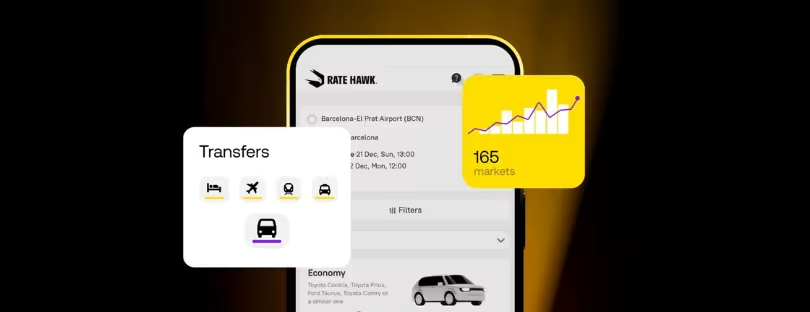
The anniversary messaging is heavy on energy metaphors, but underneath that language sits a more concrete reality. Over the past decade, RateHawk has expanded its global hotel inventory, added flights, transfers, and ancillary services, and invested heavily in API connectivity and booking tools.
That evolution mirrors a broader shift in the B2B travel space. Platforms are no longer just aggregators. They are becoming operating systems for travel businesses.
Felix Shpilman, CEO of Emerging Travel Group, framed it in familiar but telling terms. The focus has been on reliability, expansion, and continuous capability building. In other words, less about disruption and more about consistency at scale.
That approach has worked. At a time when many smaller B2B platforms struggle with fragmented supply or inconsistent pricing, RateHawk has leaned into stability and breadth. For travel agencies dealing with margin pressure and operational complexity, that reliability is often more valuable than innovation for its own sake.
Turning an anniversary into a growth lever
Rather than limiting the milestone to brand storytelling, RateHawk is turning its 10th anniversary into a partner-facing campaign.
The centerpiece is a “Super Lucky Draw” running from April 7 to May 4, 2026. The mechanic is simple and intentionally aligned with business behavior: the more bookings partners make, the higher their chances of winning.
It is not just a giveaway. It is a volume-driving strategy disguised as a celebration.
What partners actually get
The prize pool is designed to appeal to a broad range of travel professionals, blending practical business incentives with lifestyle rewards.
Key rewards include
- Tech: iPhones, Apple Watches, iPad, AirPods, MacBook
- Gift cards: Amazon, Apple, Uber
- Promo credits: $100 codes
- Loyalty points: equivalent to $100 value
- Travel perks: hotel vouchers
- Merchandise: power banks and branded items
In total, more than 100 prizes will be distributed, with weekly draws throughout the campaign period.
From a strategic perspective, this type of incentive structure is not new, but it is effective. It taps into a core truth of B2B travel: booking behavior is highly elastic when incentives are aligned with margins and volume targets.
Why this matters now
The timing of this campaign is not accidental. The B2B travel infrastructure space is becoming more competitive and more crowded.
Players like Hotelbeds, WebBeds, and Travelport have long dominated wholesale distribution and booking infrastructure. At the same time, newer API-driven platforms and fintech-integrated travel solutions are reshaping expectations around speed, flexibility, and integration.
RateHawk’s move signals a shift from “platform growth” to “platform consolidation.”
Instead of chasing new categories, the focus is increasingly on deepening partner engagement and increasing share of wallet within existing clients. Incentive campaigns like this are part of that playbook.
It is also worth noting how this aligns with broader industry trends. According to reports from Phocuswright and Skift Research, B2B travel platforms are entering a phase where differentiation is less about inventory size and more about usability, pricing consistency, and ecosystem integration.
In that context, loyalty and engagement campaigns are not just marketing tactics. They are retention strategies.
A subtle positioning play
There is another layer to this anniversary that is easy to miss.
By framing itself as a “supercharger” of travel businesses, RateHawk is positioning itself closer to infrastructure than marketplace. That is a subtle but important shift.
Marketplaces compete on supply and price. Infrastructure players compete on dependency.
The more a travel business relies on a platform’s tools, integrations, and workflows, the harder it becomes to switch. Over time, that creates a much stronger competitive moat than inventory alone.
This is exactly the direction the broader travel tech ecosystem is heading.
The bigger picture
What makes this anniversary interesting is not the campaign itself, but what it reveals about the state of the market.
B2B travel is no longer just about access to hotels or flights. It is about building systems that travel businesses can run on. And in that race, the winners will not necessarily be the loudest brands, but the ones that become operationally indispensable.
RateHawk is clearly betting on that model.
Beyond the celebration
If the first decade was about building supply and reach, the next decade will likely be about control and integration.
The question is not whether RateHawk can continue growing. It is whether it can evolve into a platform that partners cannot easily replace.
That is a much harder challenge.
Conclusion: from distributor to dependency layer
What RateHawk’s 10-year milestone really highlights is a broader shift in the travel tech ecosystem.
Platforms like Hotelbeds and WebBeds built their dominance on scale and distribution. Newer players are now competing on APIs, automation, and embedded workflows. The next phase is about something deeper: becoming the layer that travel businesses depend on to operate.
RateHawk is moving in that direction, but it is not alone.
Across the industry, there is a clear trend toward consolidation of tools, tighter integrations, and platform-led ecosystems. Research from Phocuswright consistently points to increasing demand for all-in-one solutions, while Skift has highlighted how travel sellers are prioritizing efficiency and margin optimization over pure inventory access.
In that environment, incentive campaigns like the Super Lucky Draw are not just celebratory. They are signals of a platform trying to lock in engagement at a critical moment in market evolution.
The next decade will not be won by who has the most hotels. It will be won by who owns the workflow.
And that is the real story behind RateHawk turning ten.