Play Introduces Photo-ID Verification for eSIM Activation
Getting an eSIM should be simple. In reality, it often isn’t. Many telecom operators still require customers to visit a store, complete lengthy identity checks, or navigate complicated online verification steps before activating a prepaid line.
In Poland, one operator is trying to change that.
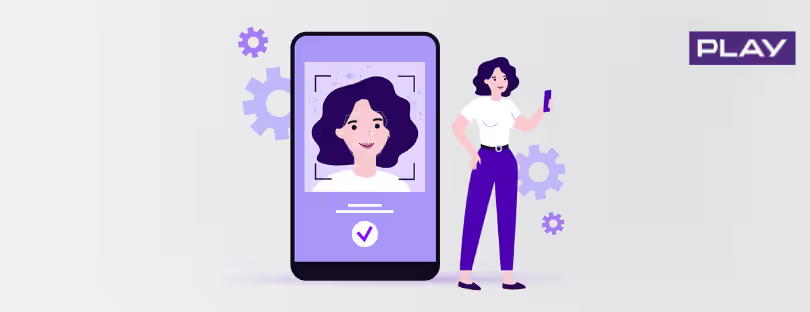
The Polish mobile operator Play has introduced a new remote authentication method that allows prepaid customers to purchase and activate an eSIM using just a photo of their ID card taken on a smartphone. The feature is integrated into the Play24 mobile app and is designed to make remote onboarding faster and more accessible.
It may sound like a small improvement. But in the telecom world, simplifying identity verification can make a significant difference in how easily customers can activate mobile services, especially prepaid connections.
Why Identity Verification Still Matters
In many European countries, telecom operators must verify a customer’s identity before activating a prepaid SIM or eSIM. These rules are part of anti-fraud and security regulations designed to prevent anonymous mobile connections from being used for illegal activity.
In practice, however, this requirement has often slowed down the customer experience.
Traditionally, customers had to verify their identity in one of several ways:
Visiting a retail store
Customers physically present their ID to staff who activate the SIM or eSIM.
Online banking verification
Some operators allow customers to confirm their identity through their bank login.
Digital identity platforms
Services like MyID in Poland connect banks and telecom providers to enable remote verification.
While these options work, they are not always convenient. Not every customer wants to log in through their bank account, and visiting a physical store defeats the purpose of a digital eSIM purchase.
This is exactly the gap Play is trying to close.
The New Photo-ID Verification Method
With the new system, customers can simply take a photo of their identity card using their smartphone camera and submit it through the Play24 mobile application.
The app then processes the verification and allows the prepaid eSIM purchase to proceed remotely.
The process removes several friction points that previously slowed down onboarding.
Everything happens inside the Play24 app
Customers do not need to visit a store or switch to another platform.
Smartphone camera replaces external verification tools
The user simply takes a photo of their ID card directly within the app.
Alternative to existing authentication methods
The new option sits alongside other verification methods such as electronic banking authentication and MyID.
Once verified, customers can activate promotional bundles including data, voice, SMS, and MMS packages.
For prepaid users, this means they can purchase connectivity and activate their line without ever interacting with a physical store.

Why This Matters for eSIM Adoption
Remote onboarding has become one of the most important factors in eSIM adoption.
The technology itself is designed to remove friction. An eSIM can be downloaded instantly, activated remotely, and used within minutes. But if identity verification still requires a store visit or complicated steps, that advantage disappears.
Operators across Europe are now looking for ways to streamline the process.
The move by Play shows how telecom providers are experimenting with simpler verification methods that match the digital nature of eSIM technology.
The goal is straightforward: make the activation process feel as seamless as downloading an app.
A Wider Trend in Telecom
Play is not the only operator exploring easier digital verification.
Across Europe, telecom companies are gradually moving toward remote identity solutions. Operators such as Deutsche Telekom and Orange already support various forms of video identification, digital ID checks, or bank-based verification.
Meanwhile, some markets are experimenting with automated document scanning and biometric verification.
Fintech companies helped popularize this model years ago. Opening a bank account via smartphone photo verification is now common across Europe, and telecom operators are slowly adopting similar systems.
The challenge for telecom providers is balancing convenience with regulatory compliance.
Unlike many digital services, telecom operators must follow strict national identity rules. That means new verification tools must still meet legal requirements while improving the customer experience.
Why This Matters for Travelers and Digital Services
Simplifying identity verification is particularly important for services that rely on remote distribution.
This includes travel connectivity, prepaid mobile services, and digital SIM activation.
In the travel eSIM market, for example, providers often bypass identity checks entirely by selling data-only plans that do not include voice services. This approach avoids regulatory requirements but limits the functionality of the connection.
Traditional operators, however, still need to verify identities when issuing full mobile subscriptions.
If telecom companies manage to streamline verification, they can unlock faster remote onboarding for prepaid services and expand digital distribution channels.
This could make it easier for customers to activate local eSIMs instantly while traveling.
What the Industry Is Learning
The telecom industry is slowly discovering that onboarding friction is just as important as network quality or pricing.
A fast activation process can directly influence customer acquisition.
If it takes ten minutes to verify identity instead of two days and a store visit, the barrier to entry disappears.
Operators are beginning to treat onboarding as part of the product experience rather than a regulatory formality.
This is exactly where Play’s new feature fits in.
What Comes Next for eSIM Authentication
Identity verification will remain a necessary part of telecom services. But the way it happens is clearly evolving.
Operators are experimenting with multiple approaches:
- Photo-based document verification
- Bank-based authentication systems
- Digital identity platforms
- Biometric verification and video identification
The goal is the same in every case: remove friction while maintaining compliance.
The Bigger Picture
Play’s new photo-ID authentication feature may look like a small operational update, but it reflects a broader shift in telecom onboarding.
Operators are realizing that if eSIM is supposed to be instant, the identity verification process must be just as fast.
Across Europe, telecom providers are gradually moving toward mobile-first verification tools that mirror the onboarding experience used by fintech apps and digital services.
If this trend continues, the next phase of eSIM adoption may not be driven by coverage or pricing, but by how quickly a user can activate a connection.
And in a market where convenience increasingly defines customer choice, the operators that simplify onboarding the most may ultimately win the race.