Oppo Watch X3: Titanium, eSIM, and the Quiet Power Shift in Premium Wearables
Oppo doesn’t usually make headlines in the same breath as Apple or Samsung in Western markets. But with the Watch X3, unveiled last week alongside the Find N6 foldable, it’s making a serious argument that the most compelling standalone smartwatch right now might not be coming from Cupertino or Seoul.
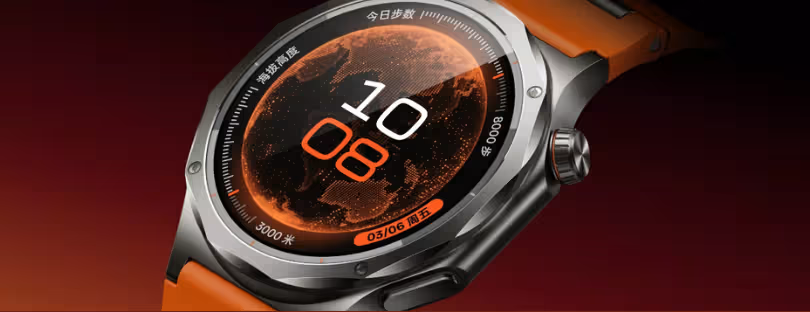
The Watch X3 is built from TC4 aerospace-grade titanium — the same alloy used in medical implants and aircraft structural components. Both the case and bezel use TC4 titanium, and Oppo says the result is a watch that’s 16% lighter and 6.4% thinner than its predecessor. At 43 grams without a strap, it’s genuinely wrist-friendly — and considering what’s packed inside, that’s no small engineering feat.
Built to Survive, Designed to Impress
The display is a 1.5-inch LTPO OLED panel protected by sapphire crystal. The new panel reaches a peak brightness of 3,000 nits — a 36% jump over last year’s model — maintaining readability in direct sunlight. Military-grade MIL-STD-810H certification and IP68/IP69 ratings round out a durability spec sheet that rivals watches twice the price.
With IP69, IP68, and 5ATM ratings, the Watch X3 can handle high-pressure water jets and deep submersion. The “bamboo joint” hybrid strap — alternating metal connectors within fluororubber — is a nice touch that keeps the premium aesthetic intact while maintaining flexibility.
Health Tracking That Goes Beyond Step Counts
The health suite is ambitious. Cuffless blood pressure risk assessment, ECG, blood oxygen, wrist temperature, and a 60-second health check analyzing 14 metrics with AI-generated insights. Sleep tracking includes stage detection and snore monitoring, and the watch offers medical-grade sleep apnea screening with sensitivity and specificity rates exceeding 90%.
Worth noting: the blood pressure feature is a risk assessment, not a clinical measurement. Oppo is using optical sensors and pulse wave analysis to flag elevated risk periods — a meaningful distinction that gets lost in marketing copy. The system is designed to identify patterns and suggest lifestyle changes, creating what the company calls a “discover-analyze-improve” loop. Useful, but not a replacement for an actual cuff.
There’s also CGM integration — not a built-in glucose sensor, but the ability to display readings from an external continuous glucose monitor directly on the watch face, which is more practical than it sounds for diabetics who are already carrying a CGM device.
eSIM as a Feature, Not an Afterthought
Here’s where the Watch X3 gets interesting from a connectivity standpoint. The watch includes an independent eUICC chip, allowing users to make calls, send messages, and access mobile data without a nearby smartphone. Connectivity covers 4G via eSIM, dual-band Wi-Fi, and Bluetooth 5.2, with NFC for transit cards and access control.
What makes Oppo’s implementation notable is how deeply integrated the standalone functionality is. Full smart functionality without a phone includes WeChat messaging, eSIM calling, voice assistant, Alipay payments, and real-time map navigation — and the watch can also function as a car key for compatible vehicles.
There’s also a dual-pairing feature: the Watch X3 can be connected to an Android smartphone and an Apple iPhone simultaneously. For the growing segment of professionals who carry both — not uncommon in business travel and digital nomad contexts — that’s a genuinely useful capability.
 Fitness, Battery, and the Numbers
 Fitness, Battery, and the Numbers
Over 100 sports modes, dual-frequency GPS (L1+L5 with BeiDou, Galileo, and GLONASS), VO2 max, lactate threshold, recovery time, and an AI coach — the fitness tracking stack is thorough. The fat-burning running mode with posture guidance is a nice addition for casual runners who don’t want to manage complex training plans manually.
Battery life is rated at 3 days under heavy use, 5 days in smart mode, and 16 days in long battery mode. With 7.5W charging, a full charge takes 75 minutes, and Oppo claims 24 hours of use from just 10 minutes on the charger.
Pricing and Availability
The Watch X3 launched in China on March 20 in three colorways. Gravity Black is priced at 2,599 yuan — approximately €338 at current exchange rates — while the Infinite Titanium variant comes in at 2,799 yuan, or around €364. Pricing for the Cosmos Star Orange edition hasn’t been confirmed. No global launch date has been announced yet, though a rebranded version — likely the OnePlus Watch 4 — is expected to bring the same hardware to international markets.
Where the Watch X3 Fits in a Crowded Market
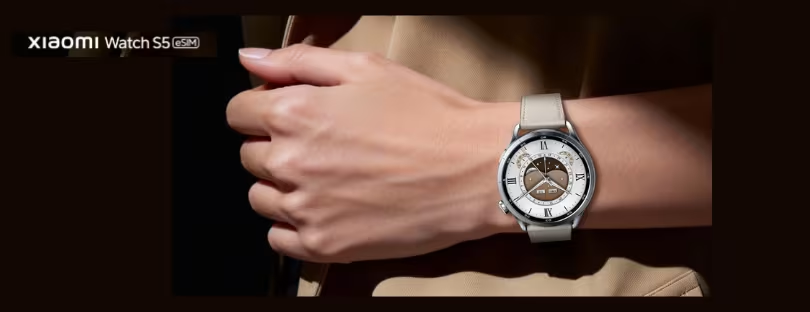
At €338–364, Oppo is positioning the Watch X3 squarely in the premium Android tier — below Apple Watch Ultra territory, but well above budget fitness trackers. The more relevant comparison is the OnePlus Watch 3 (currently around €340 in Europe), the Samsung Galaxy Watch Ultra (launched at €699), and to a lesser extent, Garmin’s mid-tier Forerunner line for the fitness-focused crowd. More about Xiaomi new smartwatch you can find here.
What’s striking is that Oppo is delivering titanium build, eSIM calling, and serious health sensors at a price point where Samsung’s Galaxy Watch 7 doesn’t even offer standalone LTE in all markets. Samsung is still preparing its answer — the Galaxy Watch Ultra 2, expected in summer 2026, is being positioned to reshape smartwatch connectivity with full 5G support, but it’s not here yet, and it’s going to cost significantly more.
The broader trend is clear: eSIM in wearables is moving from niche feature to baseline expectation for the premium segment. Apple has had it for years. Samsung is going deeper with 5G. And now Oppo — a brand that barely registers in most Western markets — is shipping a device where the eSIM experience is tightly woven into the product’s core identity, not bolted on.
The China-first strategy is the obvious caveat. WeChat integration, Alipay, BYD car key support — these features are built for a specific ecosystem. How much of that utility survives a global rebranding under OnePlus remains to be seen. Historically, Oppo/OnePlus global launches strip out some of the China-market software depth. Oppo Watch X3
But the hardware tells a different story. A sub-50g titanium smartwatch with eSIM, dual-phone pairing, and medical-grade sleep apnea screening at this price point is genuinely hard to argue with. If Oppo manages a clean global rollout — one that preserves the connectivity features and pairs with a broader carrier eSIM network — the Watch X3 could quietly become the most underrated wearable of 2026.