Japan is everywhere right now. From National Geographic covers to travel features in Vogue and Condé Nast Traveller, the country has firmly positioned itself as the destination for 2026.
But the real story is not hype. It is infrastructure under pressure.
As demand surges, Japan is becoming a live case study of what happens when one of the world’s most advanced transport systems meets global-scale tourism. And that is exactly where Omio’s expansion becomes interesting.
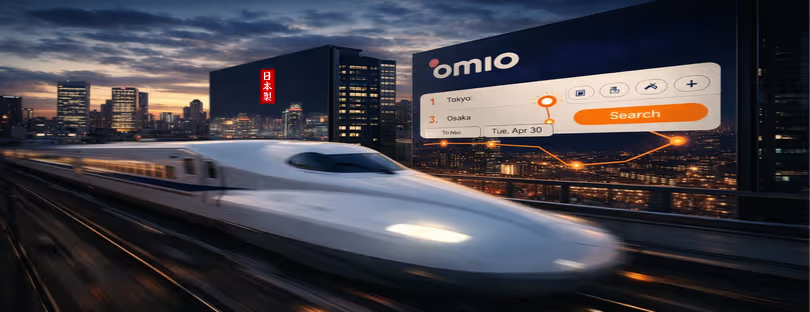
The company has launched in Japan as its 47th market, bringing the country’s fragmented transport ecosystem into one unified interface.
This is not just expansion. It is positioning.
Demand is rising fast. Complexity comes with it
Japan’s inbound tourism has crossed a critical threshold.
In 2025, the country welcomed over 40 million international visitors for the first time, according to Japan National Tourism Organization. That is a 15.8 percent increase year-on-year, with 2026 expected to push even higher.
The drivers are clear. A weaker yen, stronger airline capacity, and global cultural relevance have made Japan more accessible than ever.
But demand is uneven.
Locations like Mount Fuji and Kyoto are already facing overtourism pressures. Authorities are actively encouraging visitors to explore beyond these hotspots.
And that shifts the problem.
Not whether people come. But how they move.
One of the most advanced transport systems, still hard to navigate
Japan’s transport network is often described as seamless. In reality, it is highly sophisticated and layered.
You have the Shinkansen connecting major cities. Then multiple regional rail operators, each with different systems. Add buses, domestic flights, and ferry routes across thousands of islands.
For locals, this works perfectly.
For international travellers, it creates friction.
Different booking systems, varying ticket rules, language barriers, and the complexity of understanding passes like the Japan Rail Pass all add cognitive load. The system is efficient, but not intuitive for newcomers.
That gap is where platforms like Omio step in.
Omio’s approach: unify, not replace
Omio is not trying to change Japan’s transport system. It is trying to reorganize how travellers interact with it.
Through a single interface, users can now:
Available transport options
Book Shinkansen and regional trains
Compare long-distance buses
Access domestic flights
Explore ferry routes
Purchase Japan Rail Passes
The value is not just convenience. It is clarity.
Travellers can evaluate routes, prices, and travel times in one place, instead of navigating multiple disconnected systems. That changes how decisions are made, especially in a country where options are abundant.
Reducing friction for global travellers
The biggest barrier to travelling in Japan has never been infrastructure. It has been confidence.
Omio is clearly targeting that layer.
The platform supports 32 languages and 33 currencies, reducing small but critical frictions for international users. These details matter more than they seem, especially for first-time visitors.
Then there is planning.
With Omio Advance, travellers can book train tickets up to 12 months ahead. In a market where timing and availability are key, this shifts Japan closer to the structured planning model seen in Europe.
It turns uncertainty into predictability.
A strategic move in a competitive landscape
Japan is part of a broader expansion strategy. Omio is entering markets where transport is fragmented but demand is strong, including Southeast Asia and Brazil.
The company aims to reach 70 markets by 2028.
This puts it in competition with platforms like Trainline and Rome2Rio, as well as regional ecosystems that bundle transport into broader services.
But Omio is not positioning itself as a super app.
It is positioning itself as the interface layer for global mobility.
That is a different game.
Naren Shaam, Founder and CEO of Omio, said:
“Japan is the gold standard of modern mobility. Its high-speed rail, dense regional networks, domestic aviation and ferry systems operate at a scale and precision that few countries can match. Bringing this ecosystem onto Omio is a defining moment for our platform. It reflects our ambition to organise the world’s most advanced transport networks within one intelligent interface, making seamless multimodal travel the default for global travellers.”
What does this signal for travel tech?
The bigger shift here is structural.
Travel is moving from access to orchestration.
Flights and hotels are already optimized. Ground transport, especially in complex markets, is still fragmented. That is where the next layer of competition is happening.
Not in inventory.
In integration.
Omio’s Japan launch reflects this shift. It does not introduce new transport. It makes existing systems easier to navigate.
And in high-demand destinations, that becomes a competitive advantage.
Conclusion: the battle is for the decision layer
The real takeaway is not that Omio entered Japan.
It is how it entered. Omio Japan launch
This is a move toward owning the decision layer of travel. The place where users compare options, evaluate trade-offs, and choose how to move.
Players like Trainline focus on rail dominance. Rome2Rio focuses on discovery. Regional apps focus on ecosystem lock-in.
Driven by wanderlust and a passion for tech, Sandra is the creative force behind Alertify. Love for exploration and discovery is what sparked the idea for Alertify, a product that likely combines Sandra’s technological expertise with the desire to simplify or enhance travel experiences in some way.