Sweden’s New Wellness Trend: Northern Lights Therapy
Sweden has long been admired for its calm, clean landscapes and its almost intuitive understanding of wellbeing. But now the country is leaning into something even more extraordinary: a national “prescription” for nature experiences that includes what may be the world’s most awe-inducing wellness remedy — the Aurora Borealis. Yes, Sweden is officially making the Northern Lights part of its health-forward storytelling. And honestly, the timing couldn’t be more perfect. northern lights travel
Interest in “northern lights travel” is skyrocketing, with more than 60% of global travelers listing the aurora as the number one natural wonder they want to witness. Layer that with a rare solar maximum currently in progress — which boosts both the brightness and frequency of auroral displays — and Sweden suddenly stands out as one of the most reliable, accessible, and scientifically compelling places to get your dose of arctic light therapy.
Sweden’s new campaign, featuring the Swedish Prescription video, reframes the aurora as a kind of celestial wellness session. It’s playful, yes, but also grounded in real research. And in a world where stress levels remain stubbornly high, the idea of traveling north for a scientifically backed mood lift feels surprisingly modern.
Abisko: A Natural Aurora Observatory
If Sweden has a wellness “capital,” Abisko is the quiet star at its center. Tucked deep inside Swedish Lapland, this small village consistently ranks among the best places on Earth to see the Northern Lights — not because of marketing hype, but because of its unique microclimate. The skies here are famously clear, shielded from coastal moisture by surrounding mountains, creating what aurora chasers often call a “blue hole” in the sky.
Visitors regularly report moments that feel almost spiritual. “The time in Abisko was calming and beautiful,” says Chris Brown from Louisiana, who recently visited with Lights Over Lapland.
“Seeing the Aurora was an experience we will never forget and left us with a deep awe of nature.”
His description mirrors what psychologists increasingly acknowledge: awe isn’t just a pleasant emotion — it’s physiologically restorative.
The Science of Awe: Why the Aurora Resets the Human Mind
Researchers have been studying awe for years, but it’s only recently become a mainstream wellness topic. Vast natural spectacles like the Northern Lights activate what scientists call “expanded perception,” a state where stress hormones decrease and feelings of clarity, gratitude, and emotional openness increase.
“Seeing the Northern Lights is a great way to connect with the night sky, and my research suggests that this connection is beneficial for our mental health and happiness,”
says Dr. Chris Barnes of the University of Derby. Sweden’s new wellness positioning is tapping directly into this science: what if one of the world’s best natural antidotes to stress isn’t a supplement or a treatment, but a sky glowing green above an Arctic lake?
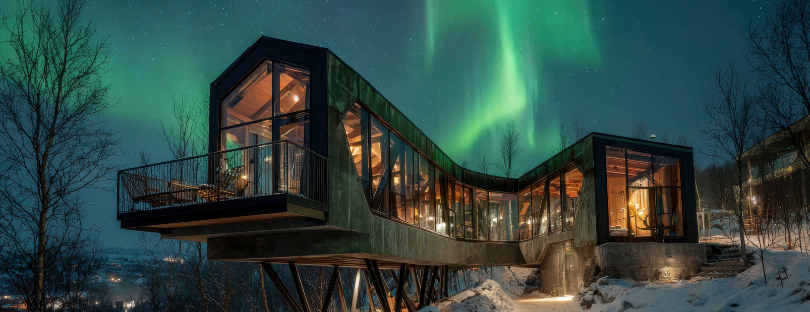
In northern Sweden, those green ribbons appear up to 200 nights per year — and with the solar maximum underway through roughly 2026, the consistency will be even better. Travelers often combine their sky-gazing evenings with sauna sessions, hot-tub soaking, snowshoe walks, stays in glass-roof cabins, or even silent reindeer sled rides, all of which add layers of calm to an already powerful sensory experience.
Why “Prescribing” Nature Works
A recent YouGov survey for Visit Sweden found that two-thirds of people would consider visiting nature if it were prescribed by a doctor — a clear sign that travelers are hungry for guidance, not just inspiration. Yet only a small percentage had ever received such advice.
This is where the Swedish Prescription comes in: a curated list of scientifically supported Swedish wellness activities, from forest bathing and cold plunges to fika and aurora watching. It’s playful, yes, but it opens a serious conversation about how travel can be a tool for preventing burnout. And as travelers increasingly choose destinations with emotional and mental wellbeing benefits, Sweden is positioning itself at the intersection of tourism, nature, and health.
Quick Travel Tips: Northern Lights Essentials
• Where to stay: Abisko Mountain Lodge, STF Abisko Turiststation, and Icehotel in Jukkasjärvi for a mix of comfort and bucket-list drama.
• Getting there: Fly to Kiruna, then drive or take the Arctic Circle Train to Abisko (about 1.5 hours).
• Guided tours: Lights Over Lapland and Visit Abisko offer photography tours, night-sky hikes, and aurora chases.
• Best timing: September–March, with peak reliability during December–March. Solar maximum continues boosting visibility through 2026.
• Tickets & passes: Train tickets via Vy Sweden; guided tours should be booked in advance during winter.
How Sweden Fits Into the Global Northern Lights Trend
Northern Lights travel is no longer niche — it’s one of the most competitive tourism segments globally, shared by destinations like Norway, Finland, Iceland, Canada, and Alaska. Each has a unique angle: Iceland offers proximity and geothermal landscapes, Norway has fjords and coastal cruises, and Finland leans heavily into glass igloos and design-forward cabins.
Sweden’s advantage is different. It blends reliability (thanks to Abisko’s microclimate) with a softer, more reflective angle on wellness. Instead of racing from one photo spot to another, Sweden frames the aurora as part of a slower, culturally rooted experience — a night sky you settle into, not chase at speed.
Reliable industry sources like the NOAA Space Weather Prediction Center and the Swedish Institute highlight that solar activity will remain unusually high over the next two years. For travelers, that means more opportunities. For destinations, it means competition will intensify — and Sweden’s wellness-first storytelling may be precisely what sets it apart.
Conclusion
Sweden’s reframing of the Northern Lights as “arctic light therapy” isn’t just clever marketing. It reflects a broader tourism pivot: people want travel that restores them, not drains them. While other northern destinations often compete on spectacle or adventure, Sweden is carving out a lane where nature meets emotional wellbeing. The timing is strategic, supported by solid science, strengthened by a rare solar peak, and aligned with what modern travelers increasingly seek — genuine awe.
For a world exhausted by noise, Sweden is quietly offering a prescription that feels both ancient and entirely new: look up, breathe in, and let the sky do the rest.