MTN has introduced something that feels less like another tariff refresh and more like a structural shift in how mobile and home connectivity are bundled and managed.
Called MTN Pi, the new product suite combines mobile plans, home internet, and account management into a single ecosystem, controlled through a dedicated app. On the surface, it looks like a flexible, month-to-month offering. But underneath, it’s a clear move toward platform-style telecom.
And MTN is pushing hard to get people in early. New customers can access up to 20GB per month for just R1 during the first three months. For home broadband users, cheaper packages come with unlocked speeds over the same period.
That’s not just a promotion. It’s a user acquisition strategy.
One account, multiple lines, real control
At the core of MTN Pi is a simple idea: households don’t want fragmented connectivity anymore.
Instead of juggling separate contracts, SIMs, and billing setups, Pi allows a single administrator to manage up to 10 lines under one account. That includes both mobile plans and home internet, all visible in one place.
Each line can have its own data allocation, making it easier to control usage across family members. Think parents managing kids’ data, or even shared setups across small teams or households.
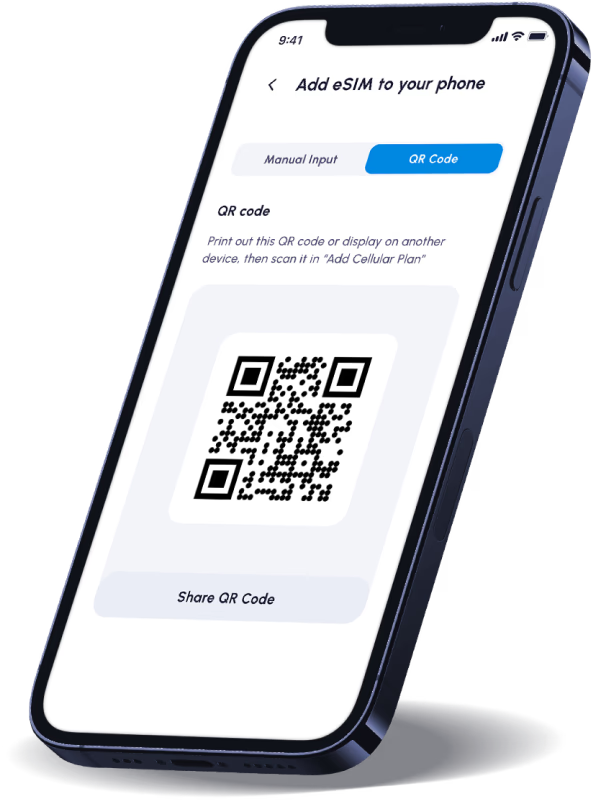
The onboarding process is fully digital. Users sign up via the app or website, choose a plan, set up payment, and complete RICA. Existing numbers can be ported in, or new ones can be issued.
From a user experience perspective, this is clearly designed to reduce friction. From a business perspective, it’s about locking users into an ecosystem rather than a single product.
eSIM-first mobile, SIM-based home broadband
MTN Pi’s mobile service is built around eSIM, which is an important signal.
It removes the need for physical SIM cards, simplifies onboarding, and aligns with where the industry is heading globally. At the same time, home internet packages still rely on physical SIMs, which reflects the current limitations of hardware like routers.
This hybrid approach shows where telecom is today: transitioning, but not fully there yet.
Pricing that targets flexibility, not just volume
The mobile plans are straightforward:
MTN Pi Mobile Data Packages
Package
Price
5GB*
R99*
10GB*
R149*
20GB*
R199*
40GB
R299
80GB
R399
* On promotion for R1 per month for the first three months.
MTN Pi Mobile Voice Add-Ons
Voice Add-On
Price
300 minutes
R79
500 minutes
R129
2000 minutes
R199
MTN Pi Home Internet Packages
Data Cap
Speed
Price
200GB*
25Mbps*
R399
500GB*
50Mbps*
R499
1TB
Best-effort
R699
* Lower-tier packages get best-effort speeds for the first three months.
Like MTN’s earlier MyMTN Choice products, these are data-first plans where voice is optional. That reflects a broader shift in user behavior, where messaging apps and VoIP reduce the importance of traditional voice bundles.
One interesting detail is portability. These home internet packages are not fixed to a specific location. Users can take their router with them and stay connected wherever MTN has coverage.
That blurs the line between home broadband and mobile connectivity even further.
Family discounts and ecosystem thinking
MTN is also incentivising multi-line usage with discounts of up to 20% when adding multiple mobile or home internet lines.
This is where the real strategy becomes clear.
The more services a household adds, the more valuable the ecosystem becomes. And the harder it is to leave.
This is not just about pricing. It’s about building a telecom environment that behaves more like a subscription platform.
How does this compare to existing MTN products?
MTN Pi sits alongside existing offerings like SuperFlex, which includes unlimited calls and SMS with capped data.
The difference is philosophical.
SuperFlex is still structured like a traditional telecom product. Pi is structured like a platform. It prioritises modularity, shared management, and digital control.
It’s closer to how fintech apps or streaming platforms operate than classic mobile plans.
The bigger shift: telecom is becoming a managed service
What MTN is doing here reflects a much broader industry trend.
Operators are moving away from standalone products and toward integrated, user-managed ecosystems. This is happening globally, driven by three forces:
eSIM adoption is removing physical barriers
App-based control is becoming the default interface
Households demanding simpler, consolidated billing and management
We’ve seen similar moves from players experimenting with family plans, shared data pools, and app-first experiences. But MTN Pi pushes this further by combining mobile and home connectivity into one controllable layer.
According to GSMA Intelligence and multiple operator reports, the next phase of telecom growth will not come from selling more SIMs. It will come from increasing the value per user through bundled, managed services.
MTN Pi fits directly into that model.
Where this could go next
If MTN continues developing Pi, there are a few obvious directions:
Deeper automation (AI-driven data allocation or recommendations)
Integration with smart home and IoT devices
More dynamic pricing based on usage patterns
Expansion into business or SMB connectivity management
At that point, Pi stops being a product suite and becomes a connectivity operating system.
Conclusion
MTN Pi isn’t just another tariff launch. It’s a signal of where telecom is heading.
The shift is subtle but important. Instead of selling connectivity as a product, operators are starting to package it as a managed experience. One app, one account, multiple services, full control.
Compared to traditional operators and even many digital-first MVNOs, MTN is moving closer to a platform model that mirrors what we’re seeing in fintech and subscription ecosystems.
The real competition won’t be about who offers the cheapest gigabyte. It will be about who owns the user interface, the data layer, and the relationship with the household.
And in that context, MTN Pi is not just a new offer.
It’s an early version of what telecom might look like when it finally behaves like software.
Driven by wanderlust and a passion for tech, Sandra is the creative force behind Alertify. Love for exploration and discovery is what sparked the idea for Alertify, a product that likely combines Sandra’s technological expertise with the desire to simplify or enhance travel experiences in some way.