Mobile Money at $2T: Growth Is Exploding, Usage Still Isn’t
Something significant just happened in global finance, and it didn’t come from a bank.
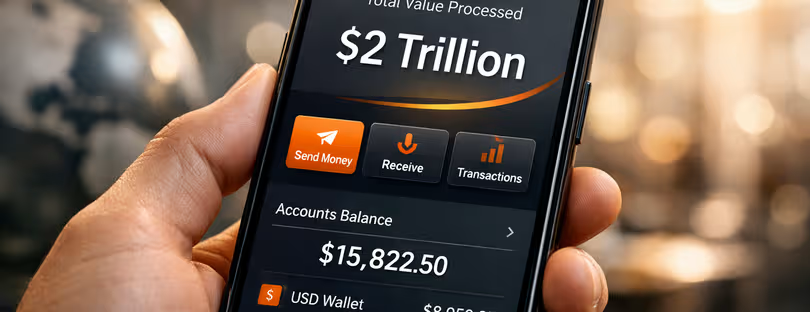
According to the GSMA’s State of the Industry Report on Mobile Money 2026, more than $2 trillion flowed through mobile money wallets in 2025. That milestone matters not just because of the number, but because of the speed behind it. It took 20 years for the industry to process its first trillion. The second came in just four.
That’s not gradual growth. That’s acceleration, and it signals a deeper shift in the evolution of financial systems globally.
From workaround to infrastructure
Mobile money started as a workaround. A practical solution for people without access to traditional banking. Today, it looks much closer to a parallel financial system.
The report shows 2.3 billion registered accounts worldwide, with 268 million added in 2025 alone. But the real shift is not just access. Its usage and value. Transactions are getting bigger, more frequent, and more embedded in everyday life.
Vivek Badrinath, GSMA Director General, comments:
“Mobile money has become one of the world’s most impactful financial services. What began as a simple way to move money has evolved into a global financial ecosystem, reshaping how hundreds of millions of people manage their financial lives. The market is reaching new heights and greater maturity. Adoption and regular use are surging, and value is scaling even faster than volume, with more than $2 trillion flowing through mobile money in 2025 – doubling from the first trillion in just four years.”
That’s the key transition. Mobile money is no longer filling gaps. It is becoming infrastructure.
Usage is rising, but not evenly
There is clear progress, but also clear friction.
Active 30-day accounts grew by 15% to 593 million, with most growth coming from Sub-Saharan Africa. Monthly usage reached 25.7%, the highest level since 2021.
But that still means nearly 75% of accounts remain inactive in a given month.
That gap matters. It highlights a core issue: access does not automatically translate into trust or habit. Fraud concerns persist in several markets, and transaction taxes are pushing some users back toward cash.
So while the system is expanding, it is not yet fully embedded in everyday financial behavior.
 Financial services are layering on top
 Financial services are layering on top
Mobile money is also evolving beyond payments.
Providers are increasingly offering adjacent services directly within wallets. Credit remains the most widely available feature, closely followed by savings products. Insurance is growing fast, with the number of providers offering it increasing by one third in 2025.
This changes the role of mobile money entirely.
It is no longer just a way to move funds. It becomes a tool for managing financial life, especially in markets where traditional banking is limited or inaccessible.
In practice, that means entire financial ecosystems are being compressed into a mobile interface.
Regulation is starting to support growth
Regulation is no longer just a barrier. In many cases, it is becoming an enabler.
More than 60% of mobile money providers say frameworks around interoperability, KYC, and consumer protection are supporting their operations. Interoperability, in particular, is critical for scaling usage across networks and regions.
But challenges remain.
Cross-border data transfer regulations continue to limit expansion, with 24% of providers citing them as a constraint. And the gender gap remains significant. In most countries surveyed, women are still less likely to own and actively use mobile money accounts.
This is not just a social issue. It is a growth constraint for the entire ecosystem.
More than payments: a resilience layer
Mobile money is also proving its value beyond everyday transactions.
It is increasingly used for rapid payouts during crises, especially in remote or underserved regions. Whether it is humanitarian aid or emergency response, the ability to distribute funds instantly has become critical.
But this also raises the stakes.
As systems scale, so do risks. Fraud prevention, consumer protection, and digital literacy are no longer optional. They are essential to maintaining trust and long-term adoption.
Conclusion
Mobile money is no longer a niche solution. It is quietly becoming a foundational layer of global finance.
Compared to traditional banking, it moves faster and reaches further, but still lacks the same level of stability and trust in some markets. Compared to fintech platforms like Revolut, Nubank, or Apple Pay, it is less polished, but far more essential in regions where banking infrastructure is limited.
What makes this moment different is not just the $2 trillion milestone. It is the shift in how value is created and distributed. Financial systems are no longer defined only by banks or fintech apps. They are increasingly shaped by mobile networks, APIs, and embedded services.
The next phase will not be about adding more users. It will be about deepening usage, improving trust, and connecting these systems across borders.
Because mobile money is no longer competing with traditional finance.
It is building something alongside it.