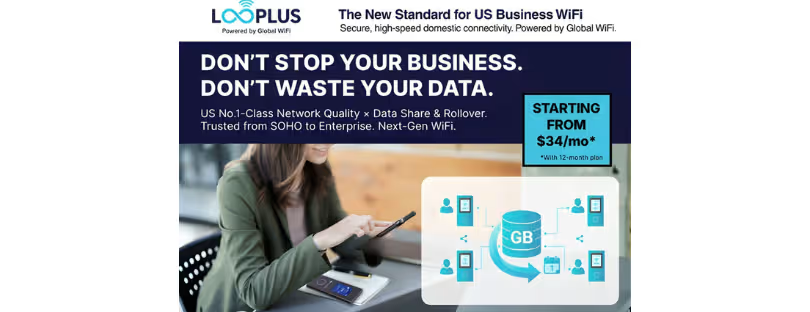
LOOPLUS Brings Shared, Rollover Business Data to the U.S.
Most telecom launches still revolve around the same promise. Faster speeds. Broader coverage. Slightly better pricing.
LOOPLUS, launched by Vision USA Corp., goes in a different direction. It doesn’t try to outperform existing networks. It questions how business connectivity is structured in the first place.
Instead of treating mobile data as something that resets every month, LOOPLUS treats it as something that can be retained, shared, and reused. That sounds simple, but it directly challenges one of the most persistent inefficiencies in telecom.
And for businesses managing multiple devices, teams, and travel patterns, that inefficiency adds up fast.
Why traditional models no longer fit
The U.S. business connectivity model hasn’t changed much in decades. Companies still sign long-term contracts, assign fixed data plans per device, and often purchase hardware that quickly becomes outdated.
At the same time, the way businesses operate has completely shifted.
Teams are no longer centralized. Employees move between offices, homes, and client sites. Data usage fluctuates depending on travel, projects, and seasonality. Some months require heavy usage. Others barely use the allocated data at all.
Yet the billing logic remains fixed.
Unused data expires. Overages get expensive. Devices sit idle or underutilized. And IT teams end up managing hardware instead of focusing on connectivity performance.
LOOPLUS is built around that mismatch.
Data that doesn’t disappear
At the core of LOOPLUS is Smart Data Rollover.
Unused data carries forward instead of expiring at the end of the billing cycle. If a company pays for data in January and doesn’t use all of it, that balance remains available in February and beyond.
It’s a simple concept, but one that removes a core frustration businesses have had for years.
More importantly, it changes how companies think about usage. Data is no longer something you try to “consume before it’s gone.” It becomes something you can plan around.


One pool instead of dozens of plans
The second layer is Shared Data Pooling.
Instead of assigning data limits to individual devices, LOOPLUS allows companies to create a centralized pool that all devices draw from.
In practice, this aligns much better with how teams actually use connectivity.
Some employees need more data in a given month. Others need less. A centralized pool allows for variation without forcing every device into the same structure.
A sales team traveling heavily will naturally consume more. Office-based staff will consume less. The system adjusts without manual intervention.
This is not entirely new in enterprise telecom, but it’s rarely implemented as the default model combined with rollover. That combination is where the efficiency gains become more noticeable.
Multi-network access without switching providers
LOOPLUS also uses Cloud SIM technology to connect across major U.S. networks including Verizon, AT&T, and T-Mobile.
The device automatically selects the strongest available signal based on location.
This removes another long-standing constraint in business connectivity: reliance on a single carrier.
Coverage becomes dynamic rather than fixed. Businesses don’t need to choose one network and accept its limitations in certain areas.
The same device also works internationally in more than 160 countries, activating connectivity on a pay-per-day basis without requiring SIM swaps or additional setup.
For companies with global operations or frequent travel, this removes another layer of friction.
Connectivity without owning hardware
One of the more structural changes in LOOPLUS is the Device-as-a-Service model.
Businesses don’t purchase the hardware. The device is included as part of the subscription, with maintenance, updates, and replacement handled by the service.
This eliminates several hidden costs that typically sit outside the connectivity plan.
Device procurement
Lifecycle management
Battery degradation
Obsolescence
Instead of treating hardware as an asset that depreciates, it becomes part of the service layer.
This approach is increasingly common across enterprise IT, and telecom is gradually moving in the same direction.
Flexible contracts instead of long commitments
LOOPLUS offers 3, 6, and 12-month contract options, with plans starting at USD 34 per month for 20 GB on a 12-month plan and scaling up to 300 GB.
This flexibility stands in contrast to traditional multi-year carrier agreements.
For businesses, especially those operating on project-based timelines, shorter commitments reduce risk. Connectivity can scale up or down depending on operational needs rather than contractual obligations.
Where it fits in the current market
LOOPLUS is entering a competitive space dominated by major U.S. carriers and a growing number of global connectivity platforms.
Operators like Verizon, AT&T, and T-Mobile already offer pooled data and enterprise mobility solutions. At the same time, eSIM and remote provisioning technologies, driven by companies such as Thales, G+D, and Kigen, are reshaping how connectivity is delivered and managed.
But most existing solutions still operate within a traditional structure.
Monthly billing cycles remain fixed
Rollover is limited or conditional
Hardware is often owned or financed
Carrier dependency still exists
What LOOPLUS does differently is combine multiple shifts into one model.
Data that accumulates
Pooling as a core feature
Multi-carrier connectivity
Hardware delivered as a service
It’s not a completely new concept, but it is a more integrated version of where the market is already heading.
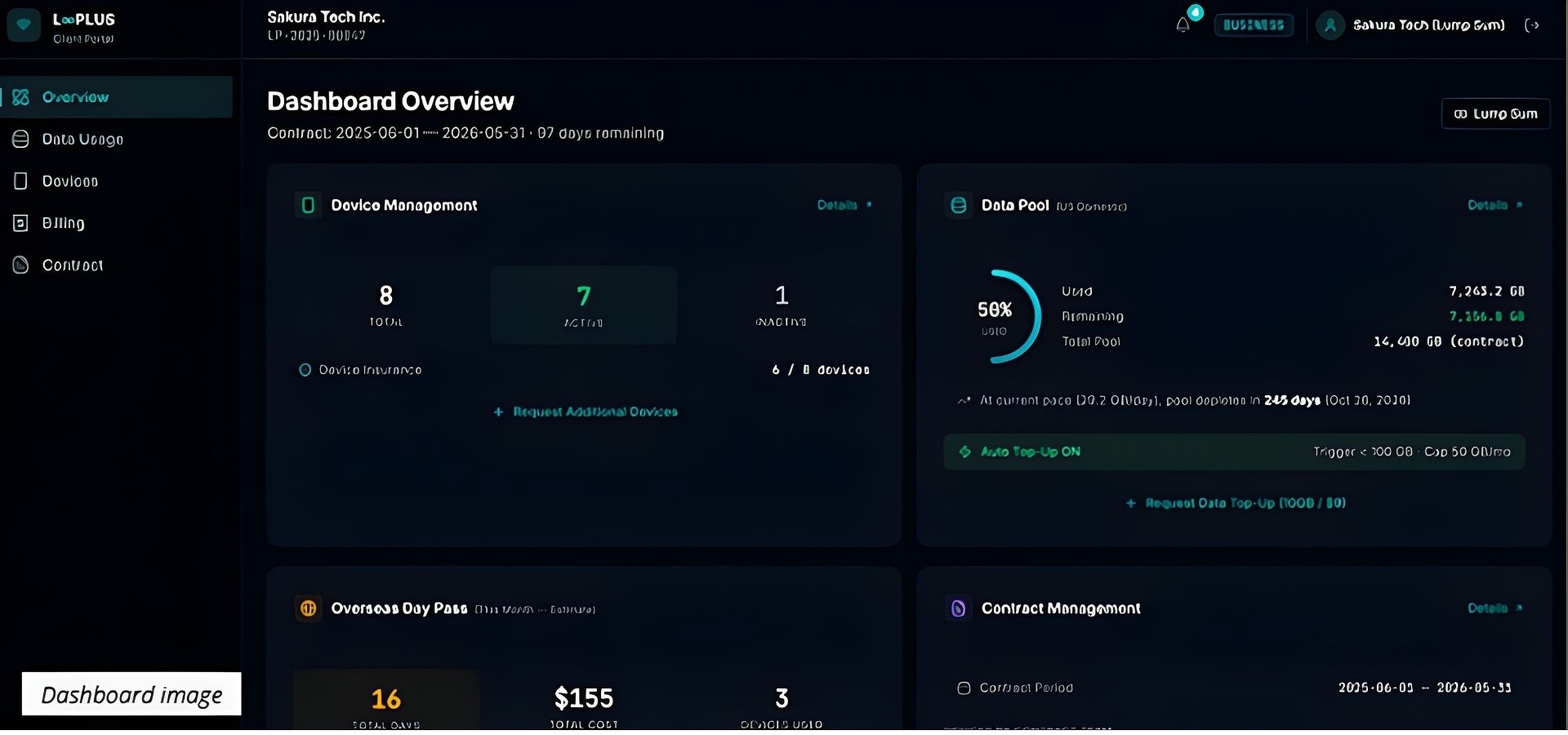
A product built around real usage patterns
The use cases Vision highlights reflect typical business scenarios.
A distributed sales team shares a single data pool, adjusting naturally to travel patterns
A construction company deploys connectivity for a temporary project and returns devices afterward
An executive uses the same device across domestic and international travel without switching SIMs
These are not niche examples. They represent common operational challenges.
The underlying theme is flexibility.
And that’s where traditional telecom models often fall short.
The partner ecosystem play
Vision USA is also building a channel partner network, targeting distributors, resellers, MSPs, and enterprise mobility partners.
That approach aligns with how enterprise connectivity products typically scale.
Rather than relying solely on direct sales, they integrate into existing business ecosystems. For partners, the combination of recurring revenue and differentiated positioning makes it easier to move beyond commoditized data plans.
Conclusion about LOOPLUS business data rollover in the USA
LOOPLUS is not trying to win the usual telecom battle around speed or coverage. It’s addressing something less visible but arguably more important.
How connectivity is structured, priced, and managed.
Across the industry, there is a clear shift underway. eSIM adoption is accelerating. API-based connectivity platforms are gaining traction. Enterprises are moving toward more flexible, software-defined models.
Reliable sources like the GSMA and Ericsson Mobility Reports have consistently pointed to this transition, highlighting the move toward more dynamic, programmable connectivity.
LOOPLUS fits into that broader trend.
It reflects a market that is slowly moving away from rigid monthly plans toward models that align with actual usage.
The real question is not whether this approach works. It’s how quickly businesses start expecting this level of flexibility as the standard, and how fast traditional carriers adapt when that expectation becomes the norm.