Airhub’s Lifetime eSIM Changes How Frequent Travelers Connect
Airhub has just rolled out a new product on its platform that looks simple on the surface but could seriously change how frequent travelers and corporate mobility programs think about connectivity: Lifetime eSlM plans.

Instead of buying, installing, and managing a new eSIM every single time someone travels, Airhub is introducing a model where the eSIM itself becomes permanent. You buy it once. You keep it forever. And you top it up whenever and wherever you travel.
This isn’t built for one-off tourists scrolling comparison blogs at the airport gate. It’s clearly designed for resellers, corporates, and partners who serve people who travel a lot and hate friction. Think consultants, sales teams, airline crew, remote workers, and travel agencies that want to simplify connectivity without turning into telecom operators.
Let’s break down how it works, why it matters, and where it fits in the broader eSIM market.
What exactly is a lifetime eSIM?
At its core, the Lifetime eSIM is a permanent digital SIM profile. It does not expire. It does not come with bundled data. And it does not get replaced.
Once installed, it stays on the device for life.
Whenever the user travels, they simply log into the platform, select that same eSIM, and purchase a local or regional data plan. The data activates on the existing eSIM. No new QR codes. No new installations. No confusion.
For corporates and resellers, this is important. It turns the eSIM into an asset rather than a disposable product.

Who this product is really for
Airhub has been very deliberate here. This is not a consumer-first SKU. It is built specifically for:
- Corporate travel programs
- Enterprise mobility teams
- Resellers and distributors
- Travel agencies and B2B partners
- Companies managing fleets of devices
Instead of issuing new eSIMs for every trip or employee, a company can issue one lifetime eSIM per traveler or device, and then centrally or individually manage top-ups.
From an operational standpoint, this removes a massive amount of admin friction.
How to purchase a lifetime eSIM
Visit the eSIM store
Partners start by visiting the eSIM Store on the platform. There, they will see three categories:
- Premium eSIM
- Standard eSIM
- Lifetime eSIM
The Lifetime eSIM is its own clearly separated option, which already signals that this is a different type of product, not just another data bundle.
Select the lifetime eSIM
There is one Lifetime eSIM plan available, and its simplicity is intentional:
- No data included by default
- Valid for lifetime, no expiry
- Supported globally
This eSIM is designed to sit quietly on a device until data is added. It does nothing until it is topped up.
That makes it ideal as a long-term connectivity layer rather than a short-term plan.
Complete the purchase
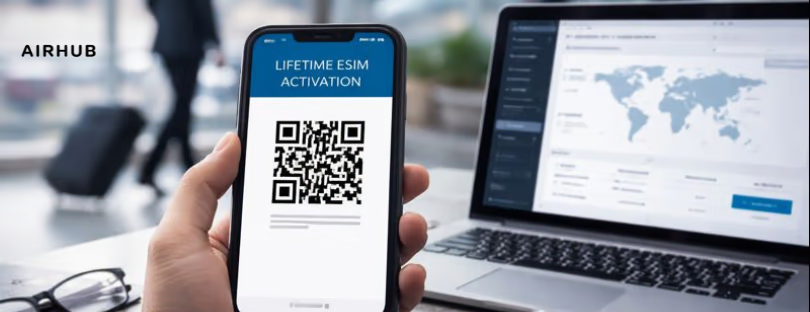
Once payment is completed, the user instantly receives:
- A QR code for eSIM installation
- The ICCID number
The eSIM can be installed immediately using the QR code, just like any other eSIM. From that moment on, the device is “lifetime-ready.”
 How top-ups work when traveling
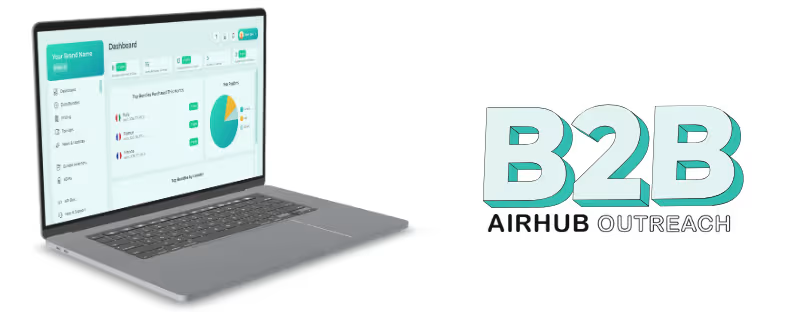 How top-ups work when traveling
This is where the model really shines.
When the user travels to a supported country, they simply:
- Log in to the platform
- Select the already installed Lifetime eSIM
- Purchase a local or regional data plan
The data activates on that same eSIM. There is no reinstallation process and no new QR code scanning.
For frequent travelers, this removes one of the most annoying parts of eSIM usage: managing multiple profiles and remembering which one is active.
For companies, it means fewer support tickets and fewer user errors.
Why this matters for corporates and resellers
From a business perspective, the Lifetime eSIM unlocks several things at once.
First, it allows partners to position connectivity as a long-term benefit, not a trip-by-trip add-on. A company can issue a “company eSIM” once and then simply fund or approve data when needed.
Second, it creates predictability. Devices are pre-provisioned. Travelers are ready before they travel. There is no last-minute scramble.
Third, it enables simpler messaging. Instead of explaining roaming rules, local SIMs, and installation steps repeatedly, partners can say: “You already have the eSIM. Just top up.”
That simplicity is incredibly valuable at scale.
The real benefits for frequent travelers
One installation, done forever
Install once and forget about it. No more juggling multiple eSIM profiles or deleting old ones.
Lifetime validity
Unlike many eSIMs that expire after 6 or 12 months, this one stays active indefinitely.
Global readiness
The same eSIM works worldwide, with destination-based top-ups.
Flexible data plans
Users choose local or regional plans depending on where they are going.
No QR code fatigue
No rescanning. No reinstalling. No “which QR code was this again?” moments.
For anyone who travels multiple times per year, this is a real quality-of-life upgrade.

How does this compare to other players
Most consumer eSIM providers still operate on a disposable model. Each trip usually means a new eSIM or a plan that expires after a set period. Some brands allow top-ups, but often only within the validity window of the original eSIM.
A few global providers offer long-validity profiles, but they are typically consumer-facing, limited in flexibility, or tied to specific regional bundles.
What Airhub is doing differently is:
- Separating the eSIM profile from the data
- Making the profile lifetime-valid
- Building it specifically for B2B distribution
This aligns with broader trends in the industry. GSMA discussions around eSIM lifecycle management and enterprise IoT SIMs have been moving in this direction for years. Analysts from firms like Kaleido Intelligence and Juniper Research have repeatedly highlighted that enterprise eSIM use cases demand persistence, not disposability.
Airhub is essentially applying those enterprise principles to human travel use cases.
Where this fits in the bigger eSIM trend
The eSIM market is maturing. Early growth was driven by novelty and price comparison. The next phase is about usability, lifecycle management, and integration.
Lifetime eSIMs fit neatly into that evolution.
As more companies manage distributed teams and mobile workforces, connectivity stops being a “travel extra” and becomes infrastructure. Products like this reflect that shift.
We are likely to see more platforms experiment with persistent eSIM identities, especially as travel, work, and mobility continue to blur.
Final take
Airhub’s Lifetime eSIM is not flashy, and that’s exactly why it matters.
It removes friction instead of adding features. It simplifies instead of bundling. And it treats connectivity as a long-term layer rather than a disposable product.
Compared to consumer-first eSIM brands that still optimize for single trips, this feels closer to where the market is actually heading, especially for corporates and frequent travelers. If anything, it highlights how much room there still is for smarter eSIM models beyond simple data pricing.
For partners looking to offer connectivity without turning into a telecom brand, this is a quietly powerful move, and one that fits very neatly into the broader direction of enterprise eSIM strategy that industry analysts have been pointing toward for years.