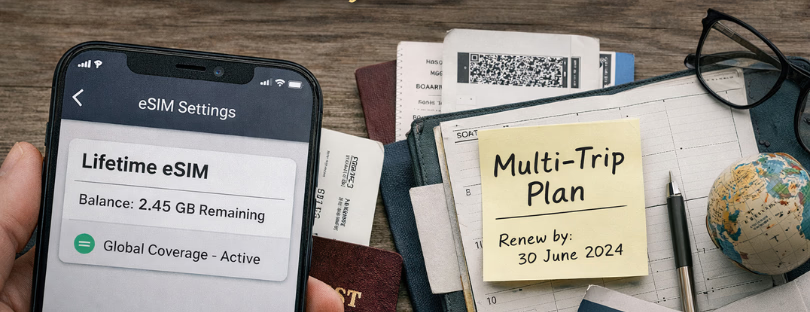
Lifetime eSIM vs Multi-Trip Plans: What Works for B2B
If you manage travel connectivity for a team, you already know the real enemy is not “coverage.” It’s admin drag.
One employee flies to Germany for 36 hours. Another is in Dubai for a week. A third does three micro-trips in a month, then nothing for two months. You can buy data for all of that, sure. The question is whether your plan design fits how business travel actually behaves.
This is where the industry keeps shrugging and saying, “it depends.” I’m not doing that today.
Here’s the clean split:
Multi-trip plans (annual packs, recurring subscriptions, 30 to 90 day regionals you keep rebuying) are great when travel patterns are predictable and you want a budget line item that stays neat.
Lifetime eSIM concepts (non-expiring eSIM profile plus balance that persists between trips, often pay as you go) win when reality is messy, which is most corporate travel.
And yes, “lifetime” is marketing. What matters is the mechanics: does the eSIM profile stay installed and does value carry over between trips without starting a new countdown clock.
Multi-trip plans sound like B2B, but they behave like retail
Multi-trip plans typically come in three flavors:
You buy a fixed package with a long validity window like 365 days, and use the data whenever. Airalo, for example, sells global packages explicitly labeled with 365-day validity.
You subscribe to a monthly bundle that renews automatically. GigSky offers subscription-style plans that renew monthly, quarterly, or annually. Holafly has been pushing hard into this “global plan” lane too, framing it as one eSIM you keep active via subscription.
You get an annual plan that refills monthly allowances. Ubigi documents annual plans like “X GB per month for 12 months.”
All of those can work for corporate travel. The catch is that they are still built around a calendar, not behavior. They assume you can predict usage, or at least accept waste as the cost of simplicity.
They also often introduce sneaky timing rules. Some providers start validity when you activate. Some start it when you arrive in a covered country. Some apply top-ups in ways that do not truly extend the original plan. Those details matter at scale because your team is not reading the fine print; you are.
Where lifetime eSIM wins decisively
Lifetime style eSIM products are not about romance. They are about removing the “buying cycle.”
The cleanest model I’ve seen is account based balance with a reusable profile, where value sits in an account and survives between trips. Surfroam’s OneBalance positioning is exactly that: one shared prepaid balance tied to an account, usable across destinations, with a non expiring profile and “top up once per year” style mechanics to keep the balance active.
That single design choice changes everything for B2B:
Admin reality check
- No repurchasing dance before every trip
- No “this plan expires in 12 days, use it or lose it” panic
- No forecasting gymnastics for short, irregular travel
- Fewer support tickets from staff who landed and realized their plan was not active
The finance logic
- Less breakage, because unused value can carry into the next trip
- Easier cost allocation when you treat connectivity like a pooled utility rather than trip by trip micro procurement
- Better fit for long gaps between travel, which is common for sales, leadership, field ops, and partner visits
The ops logic
- One install, then you stop touching the device
- Less user training, less room for human error
- Easier to standardize across the team
This is the decisive point: if your company’s travel looks like spikes and gaps, lifetime mechanics beat multi-trip bundles because they eliminate both “expiry waste” and “procurement overhead” in one move.

When multi-trip plans still win
I’m not pretending lifetime is always superior. It’s superior in the situations that create the most pain.
Multi-trip plans win when you want a predictable monthly cost and a predictable minimum service level per traveler, even if that means some waste.
Multi-trip is the better choice if
- Your travelers move constantly and consume a steady amount of data every month
- You want a simple allowance policy like “25GB per month per traveler”
- You need to bundle extras that feel corporate, like packaged subscriptions or other benefits
This is why subscription-style offerings are accelerating. GigSky’s subscription framing is straightforward for frequent travelers. Holafly’s newer global plan pitch is even more aggressive, positioning the category as moving toward borderless, software-based mobile service rather than trip-based travel packs.
Also, if you are comparing a lifetime pay-as-you-go model versus a carefully priced annual bundle, the annual bundle can be cheaper per GB for consistently heavy users. The math is boring, but in procurement, boring is good.

Similar players and what the market is signaling right now
Zoom out and you can see three lanes forming:
The travel retail pack leaders (think global and regional packages with fixed validity like 30 days or 365 days). Airalo is a clear example of the “validity labeled package” approach.
The subscription lane (recurring monthly service). GigSky is explicit here. Holafly is leaning into “one eSIM, keep it running” with a global plan narrative that looks increasingly like a consumer-friendly MVNO layer.
The lifetime and balance wallet lane (persistent value, reusable profile). Surfroam’s OneBalance is a strong example, built around an account balance that carries across destinations and trips.
Underneath all of this is the broader eSIM standardization machine that makes scalable provisioning possible in the first place. GSMA maintains the core eSIM specifications that the ecosystem builds on, which is why you can even talk about reusable profiles and remote management as normal product features now.
The trend I’m watching: travel eSIM brands are inching away from “sell a trip” and toward “own the relationship.” Subscriptions and lifetime balances are both relationship products. They reduce churn because the user does not reinstall and rechoose every time.
For B2B buyers, that is a gift, as long as the management layer, invoicing, and support match your needs.
Conclusion
If you are buying for a business, stop framing this as “how much data do we need?” and start framing it as “how often do we want to touch this problem?”
If your travel is irregular, multi-destination, and full of gaps, lifetime mechanics are the grown-up answer. A persistent eSIM profile plus carryover balance is what actually works because it cuts two costs at once: wasted value from expiry and wasted time from repeat procurement. Models like Surfroam’s account-based balance, with a non-expiring profile, are structurally better for that reality.
If your travel is constant and predictable, multi-trip and subscription plans can be cleaner, especially if you want a fixed monthly allowance and a simple policy story. GigSky’s subscription structure and Holafly’s push toward a global monthly plan show where the market is heading.
My real conclusion: for most B2B teams, “lifetime” is not a nice-to-have. It’s the only model that matches the chaos of real business travel. Subscriptions are the second-best option, but only if your usage is steady enough to justify the monthly burn. Everything else is retail packaging with a corporate label.