Italy–Austria–Germany Rail Corridor Takes Shape With Frecciarossa
Something meaningful is starting to take shape in European rail, and it goes beyond faster trains or new domestic routes. Trenitalia is now actively testing cross-border Frecciarossa services that aim to connect Italy directly with Austria and Germany, opening a corridor that has long been discussed but rarely executed at this level. Italy Austria Germany high-speed rail
At first glance, this looks like a standard expansion. In reality, it signals a deeper shift. European rail is slowly moving from a collection of strong national systems into something closer to a unified network.
This project brings together Ferrovie dello Stato, Deutsche Bahn, and ÖBB. That level of coordination matters more than the trains themselves. It shows that operators are finally aligning around shared corridors, not just national priorities.
The plan includes up to four daily services between Italy and Germany, with Munich as the key northern hub.
The Routes That Reshape Travel
Two main routes define this expansion.
The Milan to Munich journey is expected to take around six and a half hours. Along the way, it connects cities like Brescia, Verona, Trento, Bolzano, and Innsbruck. These stops are not incidental. They reflect a rail-first logic, linking regional economic centers that are often underserved by aviation.
The Rome to Munich route extends the concept further south, running roughly eight and a half hours with additional stops in Florence and Bologna. This creates a direct spine through Italy into central Europe.
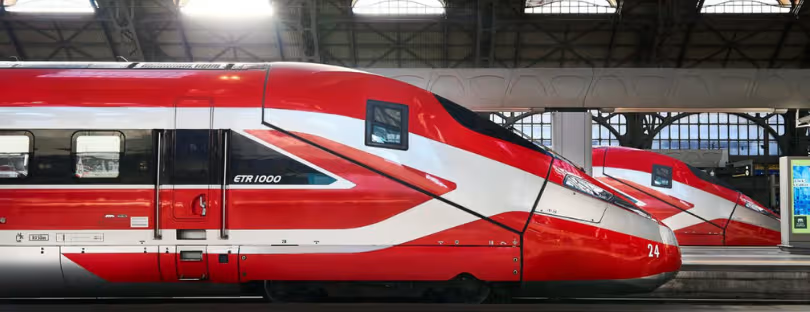
Both routes will be operated using the Frecciarossa 1000, Trenitalia’s flagship high-speed train capable of reaching 300 km/h. Domestically, it is already proven. Internationally, the challenge is different.
Because in Europe, crossing borders is still one of the hardest parts of rail.
Interoperability Is the Real Test
The biggest obstacle here is not speed or demand. It is compatible.
Rail infrastructure across Europe still operates with different signaling systems and power standards. That means trains cannot simply move across borders without adjustments. This has historically slowed down international rail expansion.
That is exactly why Trenitalia is running technical trials now.
The goal is to ensure that Frecciarossa trains can operate seamlessly across Austrian and German networks. The Brenner Pass route plays a critical role here, acting as one of the most important north-south transit corridors in Europe.
If this works, it removes one of the key structural barriers that has limited cross-border rail for decades.
Beyond Munich: A Longer-Term Corridor
This project is not limited to Milan and Rome.
Trenitalia has already outlined plans to extend the corridor further south to Naples by 2028, with a long-term ambition of connecting Italy directly to Berlin. That changes the scale entirely.
At that point, this is no longer a route. It becomes a European corridor linking southern Italy with central and northern Europe through a single, high-speed system.
That is where rail starts to compete directly with aviation, not just on sustainability but on practicality.
Why the Timing Makes Sense
This expansion comes at a moment when the European Union is actively pushing for a shift from air to rail, particularly for short and medium-haul routes.
Sustainability is one driver, but not the only one. There is also growing pressure to improve infrastructure resilience and reduce reliance on aviation for intra-European travel.
At the same time, traveler behavior is evolving.
A six-hour train journey between Milan and Munich becomes competitive when you consider airport transfers, security checks, boarding times, and delays. Rail offers city-center to city-center travel with fewer friction points.
For many travelers, especially business and frequent travelers, that trade-off is starting to make sense.
SNCF and Renfe are also expanding high-speed networks and opening their markets to competition. Trenitalia itself has already entered the French market, challenging incumbents on key routes.
Meanwhile, Deutsche Bahn continues to strengthen its cross-border connections into neighboring countries, and ÖBB has built one of the most effective night train networks in Europe.
What we are seeing is a shift toward a more competitive and interconnected rail ecosystem. Operators are no longer confined to their domestic markets. They are actively entering each other’s territories.
That is a major change.
The EuroLink Ambition
This expansion is part of the broader EuroLink project, which aims to create seamless rail connections between Italy and central Europe.
For years, European rail has struggled with fragmentation. Strong national systems existed, but cross-border travel often felt disconnected and inefficient.
EuroLink is an attempt to fix that by aligning infrastructure, operations, and partnerships across multiple countries.
If successful, it changes how rail is perceived. Not as a patchwork of national services, but as a coherent network.
What Happens Next
Technical trials are already underway, and if everything progresses as planned, services could launch by late 2026 or early 2027.
That timeline places this rollout right at a critical moment for European mobility. Aviation is under increasing pressure to decarbonize, while rail is under pressure to scale and deliver on its promise.
The next two years will be decisive.
Conclusion
What Trenitalia is building here is not just a new route. It is a test of whether European rail can finally operate as a system rather than a collection of parts.
Operators like Deutsche Bahn and ÖBB have already demonstrated that cross-border rail can work when coordination is strong. Night trains and regional high-speed links have proven demand exists. But long-distance, seamless high-speed corridors are still limited.
This project moves directly into that gap.
It also changes the competitive dynamics with airlines. Routes like Milan to Munich or Rome to Munich have long been dominated by aviation, largely because rail alternatives were fragmented or inefficient. Once rail becomes predictable, frequent, and integrated, that advantage begins to weaken.
The broader trend is clear. Europe is gradually building a rail network that can compete with air travel, not just complement it.
But the outcome will depend less on technology and more on execution. Interoperability, scheduling, pricing, and passenger experience will determine whether travelers actually switch.
If Trenitalia and its partners get this right, this will not just be another expansion. It will be part of a structural shift in how Europe moves.
Driven by wanderlust and a passion for tech, Sandra is the creative force behind Alertify. Love for exploration and discovery is what sparked the idea for Alertify, a product that likely combines Sandra’s technological expertise with the desire to simplify or enhance travel experiences in some way.