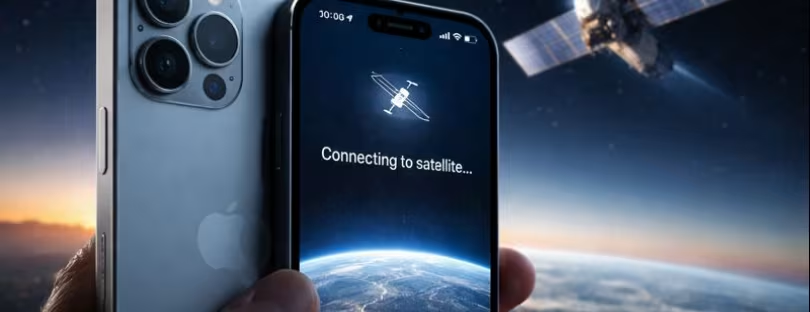
Apple and SpaceX may be preparing the biggest shift in iPhone connectivity yet
Apple is once again looking beyond terrestrial networks. According to multiple reports, Apple is in active discussions with SpaceX to bring Starlink’s Direct to Cell satellite technology to the iPhone 18 Pro. If the talks turn into a commercial agreement, this would move satellite connectivity on the iPhone from emergency-only scenarios to something far more ambitious.

For travelers, remote workers, digital nomads, and anyone who has ever lost signal in a rural or mountainous area, this could be a genuine turning point. Not a backup feature you hope never to use, but real connectivity when there is simply no mobile network around.
From emergency SOS to everyday satellite connectivity
Apple took its first serious step into satellite communications in 2022 with Emergency SOS via satellite. That service, built on the Globalstar network, allows users to send short text messages in life-threatening situations when there is no cellular or Wi-Fi coverage.
It was a smart move and a strong safety story, but also a limited one by design. Messages are short, usage is constrained, and the experience is clearly framed as last resort connectivity.
What is now being discussed is very different.
Starlink’s Direct to Cell technology aims to treat satellites like mobile towers in orbit. The idea is simple but powerful. Your phone connects directly to a low Earth orbit satellite using its existing antennas, without bulky external hardware or special add-ons. No dish. No backpack terminal. Just your phone, as it is.
If integrated into the iPhone 18 Pro, this would theoretically enable standard text messages, voice calls, and even mobile data sessions in areas with no terrestrial coverage at all.
How Starlink Direct to Cell actually works
Starlink’s Direct to Cell system uses low Earth orbit satellites equipped with cellular payloads that operate in standard LTE bands. In practice, this means the satellite behaves like a base station in space, broadcasting signals that compatible smartphones can already understand.
This is the crucial difference compared to older satellite phone systems.
Traditional satellite phones rely on specialized hardware and proprietary protocols. Direct to Cell flips that model by adapting the satellite to the phone, not the other way around. For Apple, which designs hardware with extreme attention to size, battery life, and antenna placement, this approach is far more realistic than asking users to carry additional equipment.
The implication is clear. Dead zones become far less relevant. Deserts, oceans, national parks, mountain ranges, and sparsely populated regions suddenly become connected, at least at a basic level.

Why this matters strategically for Apple
Apple is not pursuing satellite connectivity for novelty. This is about long-term control over the connectivity experience.
Relying entirely on mobile carriers has always been a compromise. Coverage gaps, roaming agreements, throttling, and inconsistent quality are all outside Apple’s control. Satellite connectivity changes that balance.
A partnership with SpaceX and Starlink would give Apple a powerful differentiator at the high end of the smartphone market. It would also reduce dependence on traditional carriers in critical scenarios, while opening the door to new service models.
This direction is not new. Bloomberg previously reported that Apple was exploring 5G NTN connectivity, which allows standard cellular technology to communicate directly with satellites. At the time, three paths were on the table. Extend the Globalstar partnership, work through mobile carriers, or strike a deal with Starlink.
The fact that Starlink is now reportedly in active discussions suggests Apple may be leaning toward the most scalable option.
How Apple compares to other players right now
Apple is not alone in this race, but it is playing it differently.
Samsung has already demonstrated satellite messaging capabilities on select devices through partnerships with satellite providers, though availability and functionality remain limited. Huawei has gone further in China, offering satellite calling features on some flagship phones, tightly integrated into the domestic ecosystem.
Meanwhile, Qualcomm has been pushing Snapdragon Satellite as a platform-level solution, aiming to enable satellite messaging across multiple Android manufacturers. The difference is that Apple controls its hardware, software, and services end-to-end.
Starlink, for its part, has already announced partnerships with carriers like T-Mobile to support Direct to Cell services. Those deals focus on extending carrier coverage rather than replacing it. Apple’s entering the picture would elevate satellite connectivity from a carrier add-on to a core device feature.

What this could mean for travelers and roaming
For Alertify readers, this development hits close to home.
Satellite-based connectivity challenges the entire logic of roaming. If your phone can connect directly to a satellite for basic services, the value proposition of expensive roaming add-ons starts to weaken, at least for messaging and emergency communication.
This does not mean roaming disappears overnight. Satellite bandwidth is limited, latency is higher than terrestrial networks, and data-heavy usage will still favor ground-based infrastructure. But as a fallback layer, satellite connectivity changes expectations.
Travelers may soon expect coverage everywhere, not just in cities and along highways. That expectation will put pressure on carriers, eSIM providers, and device makers alike.
Conclusion: satellite connectivity is becoming a baseline, not a bonus
Apple’s reported talks with SpaceX are not about adding a flashy feature to the iPhone 18 Pro. They signal a broader industry shift where satellite connectivity is moving from niche to necessary.
When Apple introduced Emergency SOS, it reframed safety as a core smartphone feature. Extending that capability to everyday communication reframes connectivity itself. Always available, regardless of geography.
Compared to competitors, Apple is positioning satellite access as a seamless extension of the existing mobile experience, not a separate mode. That aligns with broader trends across the industry, from carrier satellite partnerships to chipset-level NTN support.
Whether Apple ultimately chooses Starlink, expands its Globalstar relationship, or blends multiple satellite partners remains to be seen. What is clear is that the era of absolute dead zones is coming to an end.
For travelers, remote professionals, and anyone who values reliable connectivity on the move, that shift may matter more than any incremental camera upgrade ever could.