How to beat roaming costs with an eSIM
If you’ve ever opened your roaming bill after a trip and felt your stomach drop like you were back on that turbulence-heavy landing, welcome to the club. Roaming shock isn’t a rare phenomenon—it’s practically a travel tradition at this point. The good news? It doesn’t have to be. Not anymore.

eSIMs have quietly become the cheat code of modern travel. And no, you don’t need to be a tech person to use one. You just need a smartphone made after 2018 and the desire not to donate half your travel budget to your mobile operator.
Let’s sit down, grab an espresso (or something stronger, depending on your last roaming bill), and talk about how to beat roaming costs once and for all with an eSIM.
First: Why roaming is still ridiculously expensive
Here’s the thing: roaming charges are basically a legacy business model. Operators negotiate with international networks, pay wholesale rates, and then pass those rates—plus their markup—on to you. Sometimes that markup looks suspiciously like a whole extra vacation.
The more you travel, the more painful it gets. A bit of Google Maps here. Uploading a photo there. Opening WhatsApp “just for a second.” Suddenly, you’re €7 deep per megabyte, and your trip has barely started.
Roaming is a convenience tax. Operators know you want to stay connected the moment you land. But eSIM? It flips the script.
So what exactly is an eSIM?
Quick version:
It’s a digital SIM card built into your phone. No plastic. No swapping trays. No losing your home SIM in the hotel sink (we’ve all been there).
Longer version:
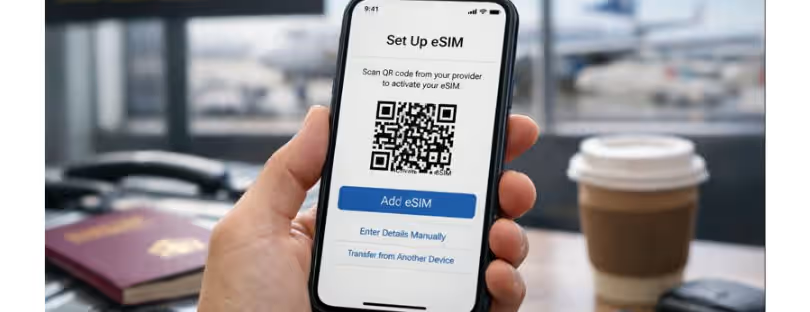
eSIM lets you add a mobile plan instantly by scanning a QR code or downloading an app. You can keep your regular number active for calls/SMS while using the eSIM for data abroad. Two networks. One device. Zero drama.
It’s the simplest travel upgrade you can make—right after packing lighter.
Why eSIMs destroy roaming fees
1. Local prices without the local hassle
Traditional SIM cards give you the best price… but require finding a shop, showing your passport, waiting in line, and doing your best to explain what “data only please” means in a language you don’t speak.
eSIM gives you the same price category—local or regional data—but without the admin marathon. You buy it online, activate it in 30 seconds, and it just… works.
2. Total price transparency
An operator may say things like “€4.99/day for unlimited roaming,” but read the small print:
- “Unlimited” might be 500MB.
- And “day” might end at midnight local time.
- And “Fair Use Policy applies.” (Translation: not actually unlimited.)
eSIMs show you the exact amount of data and the exact price. No surprises. No asterisks. No 14-page legal PDF explaining what “unlimited” doesn’t include.
3. You choose the provider—not your home operator
Roaming ties you to one operator. eSIM marketplaces give you competition. Airalo vs. Airhub vs. Nomad vs. Yesim vs. Holafly vs. aloSIM… and so on. When brands compete, you win.
4. Multi-country coverage
If you’re doing a multi-destination trip—like Italy → Switzerland → France—traditional roaming gets messy fast.
eSIM travel plans often cover regions:
- Europe
- Asia
- Americas
- Global passes (for the true nomads)
One plan. Multiple borders. No SIM swapping. No “network changed” panic notifications.
5. No physical SIM swapping
No more tiny trays. No more paper clips. No more “Where did I put the SIM I need when I go home?”
With eSIM, you just toggle between plans in settings like it’s Wi-Fi.
6. It’s safer
Losing your physical SIM abroad is a nightmare. Your number is basically your digital identity—bank logins, 2FA, everything.
Keeping your physical SIM safe inside your phone while using a digital travel SIM reduces risk massively.

How to pick the perfect eSIM for your trip
Not all eSIMs are created equal. But choosing the right one isn’t complicated—you just need to focus on four things.
1. Where you’re going
Coverage is the #1 rule. If you’re visiting one country, choose a country-specific plan. They’re usually the cheapest.
If you’re hopping around, get a regional plan so you’re not juggling multiple data packs.
2. How much data you actually use
People consistently underestimate this.
Google Maps alone can eat 100–200MB per day if you’re navigating a lot.
Here’s a simple travel data map:
- Light traveler (messages, maps, emails): 1–3GB
- Moderate traveler (social media, browsing, photos): 3–5GB
- Heavy traveler (videos, hotspotting, TikTok… be honest): 5–10GB+
When in doubt, go one tier higher. It’s still cheaper than roaming.
3. Network quality
Most eSIMs partner with big local operators. But not all operators are equal.
Before buying, check:
- Which network it uses (e.g., Turkcell, Orange, AIS, Claro)
- Reviews from other travelers
- Whether 5G is supported (in many places, it is)
4. Validity length
A 7-day eSIM is great if you’re doing a quick getaway.
For digital nomads or business travelers, 30-day or 60-day plans make more sense.

How to activate an eSIM (it’s as simple as it sounds)
The process usually takes less than a minute:
- Buy your plan online.
- You get a QR code or an activation link.
- Scan it using your phone’s eSIM menu.
- Switch “Data” to your new eSIM.
- Keep your home SIM active for calls/SMS if you need them.
- That’s it—you’re connected.
Pro tip:
Activate the eSIM before you travel while you’re still connected to Wi-Fi. It will go live when you land.
Real ways eSIM saves you money
Let’s make it brutally practical. Here’s what you avoid by switching:
❌ €70–€150 roaming bills
Using your home network abroad is the most expensive way to get data. Always.
❌ €10 tourist SIMs with 1GB of actual usable data
Local shops love to sell you “tourist packs.” They’re fine… but rarely great value.
❌ Paying for unused day passes
If a roaming day ends at midnight and you landed at 23:30, congratulations—you just paid a full day for 30 minutes of scrolling.
❌ Buying multiple SIMs for multiple countries
With a regional eSIM, you buy once and travel freely.
Now compare that to a €5–€25 eSIM pack that covers your entire trip.
It’s not even close.
 The only “downsides” (and why they’re not dealbreakers)

Yep, eSIM isn’t perfect. Let’s keep it real.
1. Not every phone supports it
But almost all modern iPhones, Samsungs, Pixels, OPPOs, One Plus and Xiaomi models do.
2. No phone number for calls
Most travel eSIMs are data-only (there are exceptions, of course). But honestly?
We don’t use phone numbers anymore abroad.
WhatsApp, Viber, FaceTime, Telegram… Everything works with data.
3. Some airports have weak reception
This affects digital activation. Solution?
Install the eSIM before your trip. Always.
Final thought: You can eliminate roaming costs forever
We’re at the point where roaming charges only exist because people haven’t switched to alternatives. eSIMs are fast, flexible, and—most importantly—fairly priced.
Whether you’re a weekend traveler, a business frequent flier, or a digital nomad hopping between continents, the formula is the same:
An eSIM + Wi-Fi = permanent roaming freedom.
Your phone works. Your bank apps work. Your maps work.
And you return home with souvenirs—not a bill that makes you consider selling them on eBay.
If you’re still roaming the old way, now’s the time to stop.
Your wallet will genuinely thank you.