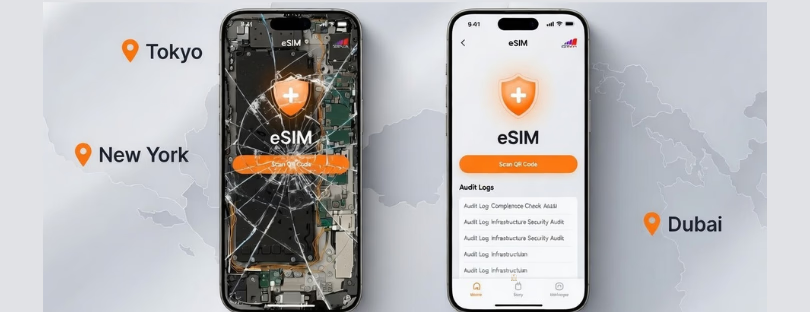
Most traveleSIM apps look identical. Clean UI. Instant QR. “Secure activation.” A few taps and you’re online in Tokyo, New York, or Dubai. how secure are eSIM providers
But here’s the uncomfortable truth: two eSIM providers can sell you the same country plan, on the same network, at roughly the same price — and operate on completely different security architectures underneath.
You won’t see that difference in the App Store description. You won’t see it on the pricing page. You only see it when something goes wrong.
And that’s where this market quietly separates into very different categories.
Security is not encryption, it’s governance
Let’s clear something up first.
All legitimate eSIM provisioning is built on strong cryptographic foundations defined by the GSMA remote SIM provisioning standards. Profile downloads are encrypted. Secure channels exist. At a protocol level, this ecosystem is not amateur.
But encryption is the baseline. Not the differentiator.
The real question is not:
Is the download encrypted?
The real question is:
Who controls the lifecycle?
Who operates the subscription management infrastructure? Who owns the operator profiles? Who has administrative access? Who logs changes? Who is accountable when something breaks?
Security in eSIM is not a feature. It is an operational philosophy.
Then some providers position themselves around predictability rather than price leadership. FairPlay is a good example of this performance-oriented philosophy. When a provider talks about “predictable unlimited” and infrastructure stability rather than headline discounts, it reflects a different risk posture. Predictability in connectivity implies tighter traffic management, clearer policy enforcement, and less marketing-driven ambiguity. That does not automatically make one model superior, but it signals that security and network control are part of the brand narrative rather than hidden layers.
Three security archetypes in the market
After reviewing more than 120 providers across travel, enterprise, and white-label ecosystems, the market roughly falls into three structural models. None of them are automatically “bad,” but they carry different security implications.
Marketing-led travel brands
These are the fastest-growing players in the consumer travel segment.
Their priorities:
frictionless onboarding
simple UX
rapid country expansion
competitive pricing
Security is present, but typically invisible and not heavily emphasized. Identity verification is often minimal. Account protections vary widely. Backend architecture is rarely explained.
For a leisure traveler spending five days abroad, this may be perfectly sufficient. For a corporate travel program or regulated sector, it may not be.
The risk is not necessarily weak encryption. It has limited transparency and limited governance visibility.
On the consumer side, globally scaled brands like Yesim demonstrate how speed and accessibility drive adoption. Their focus is seamless global activation across millions of users, and that requires simplification. At that scale, security architecture must balance friction with usability. The question is not whether such platforms are secure, but how much backend governance detail they choose to expose publicly. Scale does not equal weakness, but transparency levels can vary significantly between consumer-optimized and governance-optimized models.
Aggregator marketplaces
These platforms source connectivity from multiple mobile network operators or wholesale partners. They often act as a distribution layer sitting on top of someone else’s subscription management stack.
Their advantages:
wide coverage
flexible pricing models
rapid deployment
Their security complexity:
more integration layers
more API dependencies
more operational handoffs
When something goes wrong, responsibility can become fragmented. Does the marketplace control the SM-DP+? Or is that operated by a partner? Who holds the keys? Who audits internal access?
The more intermediaries in the chain, the more important clear accountability becomes.
Opacity is not insecurity. But opacity increases uncertainty.
Infrastructure-first platforms
These are providers that either operate or tightly control their subscription management infrastructure and position security as a core differentiator, not a marketing afterthought.
You will often see:
reference to GSMA compliance frameworks
structured access controls
role-based enterprise dashboards
audit logs
incident response processes
clearer disclosure of operational ownership
These platforms tend to serve enterprise, IoT, or regulated industries alongside travel use cases.
They are usually not the cheapest option. And that is rarely accidental.
Enterprise-oriented platforms such as SureSIM illustrate what governance-first positioning looks like in practice. Their messaging is not centered on “cheap unlimited data” or instant QR speed. It is centered on lifecycle visibility, administrative control, and structured deployment environments. That signals a fundamentally different target customer. When a provider leads with auditability and operational oversight rather than destination bundles, you are no longer looking at a travel convenience brand. You are looking at infrastructure thinking.
Ownership defines accountability
This is the most important security question in eSIM, and almost no one talks about it publicly.
Who owns the stack?
If a provider cannot clearly answer:
Who operates the SM-DP+
Where keys are stored
How administrative access is controlled
How fraud is monitored
How incidents are handled
Then you are not buying infrastructure. You are buying a distribution interface.
In telecom, key custody and subscription management are critical control points. The GSMA Security Accreditation Scheme exists precisely because the ecosystem recognizes how sensitive these layers are.
In practical terms, ownership determines response speed. Ownership determines auditability. Ownership determines whether accountability is internal or outsourced.
That is not visible in a promotional banner.
Fraud and identity are the quiet battleground
Travel eSIM is intentionally designed to reduce friction. That is part of its appeal.
But reduced friction increases the importance of fraud controls.
SIM-related fraud, including SIM swapping, has been extensively documented by European and global cybersecurity bodies. While eSIM provisioning introduces technical safeguards, account-level vulnerabilities still exist if identity, recovery flows, and access controls are weak.
Ask simple questions:
Is multi-factor authentication enforced? Are password resets hardened? Are suspicious profile transfers monitored? Is there anomaly detection on activation behavior?
The answers differ significantly between providers.
Enterprise-grade platforms usually cannot afford ambiguity here. Consumer-first brands sometimes rely on simpler models because their average risk exposure is lower.
That difference matters when the scale increases.
Cloud maturity is a differentiator
Most modern eSIM platforms operate in cloud environments. That is not a weakness in itself. It can be a strength if implemented properly.
But cloud governance maturity varies.
Serious providers invest in:
hardware-backed key management
strict IAM policies
separation of duties
monitored change management
formal compliance alignment
Less mature providers may rely heavily on third-party infrastructure without deeply communicating how it is secured.
You cannot see this from a landing page. But it defines resilience.
As eSIM becomes embedded into fleets, payment devices, healthcare deployments, and cross-border enterprise travel programs, these distinctions stop being theoretical.
They become procurement criteria.
IoT evolution is raising the bar
The conversation is also shifting because of IoT eSIM standards evolution.
Newer GSMA IoT specifications are designed for lifecycle management at scale. That implies more standardized provisioning flows, more control visibility, and more structured governance.
In other words, the industry itself is pushing toward higher operational discipline.
As IoT and enterprise connectivity expectations spill over into travel ecosystems, even consumer-facing brands will feel pressure to strengthen transparency and compliance posture.
Security maturity is no longer optional for providers that want long-term credibility.
What strong signals look like
If you are evaluating an eSIM provider and security matters to you, focus on signals that are difficult to fake.
Strong signals include:
clear explanation of infrastructure ownership
reference to a recognized telecom assurance framework
enterprise-grade admin controls
transparent incident communication
visible fraud and account protection features
Weak signals include:
vague “military-grade encryption” language
No clarity on backend operators
Inability of support teams to answer structural questions
Security claims disconnected from operational detail
Encryption is the minimum. Governance is the differentiator.
What becomes clear when comparing enterprise platforms like SureSIM, large-scale global travel brands such as Yesim, and performance-positioned providers like FairPlay is that security emphasis follows business model logic. Infrastructure-first players highlight governance. Mass-market travel brands prioritize seamless onboarding. Performance-focused providers emphasize stability and predictability. The architecture behind each reflects those priorities. The mature buyer understands that security posture is rarely accidental. It is aligned with the revenue strategy.
The market is splitting, and most people don’t notice
In 2022, the battle in the travel eSIM was covered.
In 2024, it was pricing and unlimited plans.
In 2026, it will increasingly be accountability.
You can already see it happening. Enterprise buyers are asking harder questions. Regulators are scrutinizing telecom-related fraud more closely. Industry research continues to analyze provisioning risks and architectural trust boundaries.
The providers who understand that security is lifecycle governance — not just encrypted download — will position themselves as infrastructure.
The others will compete on discount codes.
For a solo traveler on a weekend city break, these differences may never surface. For a corporate travel manager, IoT fleet operator, fintech startup, or regulated enterprise, they are foundational.
The uncomfortable reality is this:
Two eSIM apps can look identical. One operates as infrastructure. The other operates as a storefront.
And as connectivity becomes embedded in more critical systems, the market will increasingly reward the former.
Security in eSIM is no longer about whether the profile downloads safely.
It is about whether the entire lifecycle is governable, auditable, and accountable.
Driven by wanderlust and a passion for tech, Sandra is the creative force behind Alertify. Love for exploration and discovery is what sparked the idea for Alertify, a product that likely combines Sandra’s technological expertise with the desire to simplify or enhance travel experiences in some way.