Hilton Introduces AI Planner to Transform Hotel Booking
Artificial intelligence is quickly becoming the new travel assistant. From itinerary generators to automated booking tools, AI is quietly reshaping how people plan trips. Now one of the world’s largest hotel groups is taking a step deeper into that transformation.
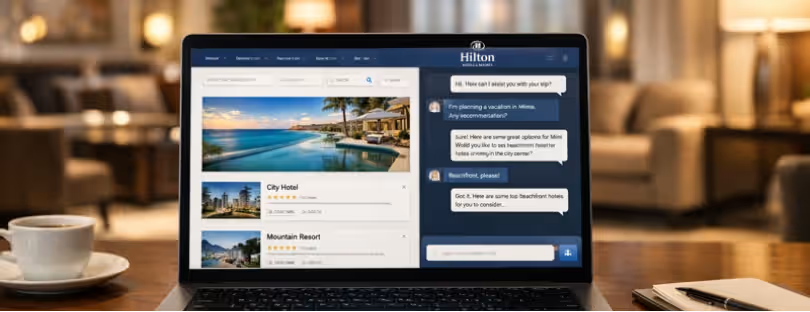
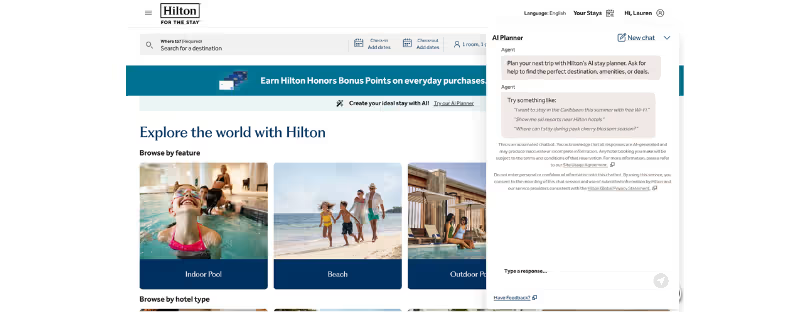
Hilton Worldwide Holdings has introduced the Hilton AI Planner, a generative AI powered digital concierge designed to help travelers explore destinations, compare hotels, and plan their stays more intuitively. The tool is currently in beta testing on Hilton’s website and represents the company’s latest attempt to modernize the digital travel experience.
For travelers, it promises something simple but powerful. Instead of navigating dozens of filters and search menus, they can simply ask a question.
For the hospitality industry, it signals something bigger. AI is moving from experimental feature to core infrastructure for travel planning.
A conversational way to plan travel
The Hilton AI Planner is built around conversational intelligence. Travelers can interact with the tool much like they would with a digital assistant, asking questions about destinations, amenities, or hotel options.
Instead of typing “hotel in Barcelona with pool and city view,” a traveler might ask:
Where should I stay in Barcelona if I want a hotel near the beach but also close to the historic center?
The AI Planner then analyzes Hilton’s global portfolio and returns tailored suggestions, highlighting relevant properties and features.
This approach replaces traditional filter based searches with something closer to a dialogue. Travelers can refine their request in real time, explore amenities, compare properties, and move naturally toward a booking decision.
For many users, this may feel closer to speaking with a concierge than navigating a booking engine.
A response to the AI travel boom
The launch arrives at a moment when AI-powered travel planning is rapidly gaining momentum.
Over the past year, travelers have increasingly turned to generative AI tools such as:
- OpenAI’s ChatGPT
- Google’s Gemini
- Microsoft’s Copilot
to research destinations, compare hotels, and build itineraries.
Hotels and travel platforms have noticed.
Instead of letting third party AI tools control the discovery process, many travel companies are now building their own AI layers directly into booking platforms. The goal is clear: keep the traveler inside their ecosystem from inspiration to booking.
Hilton’s AI Planner fits directly into this trend. By embedding conversational planning directly into hilton.com, the company can guide travelers through the entire decision journey without them leaving the site.
Part of Hilton’s long-term technology strategy
The AI Planner is not Hilton’s first attempt to digitize the guest experience.
Over the past decade the company has built a reputation as one of the most technology-focused hotel brands. Several innovations have already reshaped how guests interact with hotels.
Some of the most notable include:
Digital Key
Guests can unlock their hotel room using their smartphone through the Hilton Honors app, removing the need for a physical key card.
Connected Room
Guests can control room features such as lighting, temperature and entertainment directly from their phone.
Confirmed Connecting Rooms
Families and groups can confirm connecting rooms during booking, something that historically required manual coordination with hotel staff.
According to Hilton, the AI Planner represents the next stage of this digital ecosystem.
“For decades, Hilton has been at the forefront of hospitality innovation – from the award-winning Hilton Honors app to the most widely available Digital Key and the industry-first Confirmed Connecting Room,”
said Michael Leidinger, senior vice president & chief information officer at Hilton.
“The launch of the Hilton AI Planner marks another step forward in our journey to reimagine the travel experience for Hilton guests. This is just the beginning and a preview of where we’re going, as we continue to focus on providing thoughtful, purposeful innovation that empowers travelers.”
Why hotels are investing in AI planning tools
From a technology perspective, the Hilton AI Planner is relatively straightforward. But strategically, it reflects a deeper shift in how travel companies think about digital platforms.
Travel planning has traditionally been fragmented.
A traveler might discover a destination on social media, research hotels on a search engine, compare options on an online travel agency, then finally book on a hotel website.
AI has the potential to compress that entire process.
If a hotel group can provide:
- inspiration
- discovery
- recommendations
- comparison
- booking
Inside one conversational interface, it dramatically increases the chances that the traveler will book directly.
This is especially important for large hotel brands competing with online travel agencies like Booking Holdings and Expedia Group, which dominate the early stages of travel discovery.
AI planning tools may allow hotel companies to reclaim some of that influence.
The beta approach
For now, Hilton is rolling out the AI Planner cautiously.
The tool is currently being tested with a limited portion of website visitors. This “test and learn” approach allows the company to study real user behavior before expanding access.
During the beta phase Hilton will analyze:
- how travelers phrase questions
- what types of recommendations they request
- where users still need traditional search tools
These insights will be used to refine the AI system and expand its capabilities.
Over time, the planner could potentially evolve beyond hotel discovery to include:
- itinerary planning
- local experience recommendations
- loyalty program integration
- in stay digital concierge features
If successful, it could become the central interface for Hilton’s entire digital ecosystem.

AI concierges are becoming a hospitality trend
Hilton is far from alone in experimenting with AI driven travel tools.
Across the hospitality industry, major brands are exploring similar concepts.
Marriott International has been investing in AI powered customer service and recommendation engines.
Accor has also introduced AI assistants to help travelers navigate its hotel portfolio and loyalty platform.
Even travel platforms outside hospitality are moving in the same direction. Online travel companies and airlines are developing AI planning interfaces designed to replace traditional search experiences.
The underlying logic is simple. If travelers begin planning trips through conversational AI, whoever controls that interface gains enormous influence over where those travelers ultimately book.
What this means for travelers
For travelers, tools like the Hilton AI Planner could remove much of the friction from travel research.
Instead of navigating complex booking engines, travelers can describe their preferences in natural language and receive curated suggestions.
For example:
- hotels near specific attractions
- properties suited for families or remote work
- destinations matching a particular style of trip
The experience becomes less about searching and more about discovering.
At the same time, it raises new questions about how recommendations are shaped. Unlike traditional search results, AI driven suggestions may prioritize properties or experiences in ways that are not always transparent.
As AI planning tools become more common, transparency and recommendation logic will likely become an important conversation across the travel industry.
Conclusion
Hilton’s AI Planner is more than just another digital feature. It reflects a broader shift in how travel companies are rethinking the planning process.
For years, travelers relied on search engines and booking sites to piece together a trip step by step. AI is beginning to compress that journey into a single conversation.
Large hospitality brands clearly see the opportunity. By embedding AI planning directly into their platforms, companies like Hilton aim to control more of the discovery experience and strengthen direct relationships with travelers.
The trend extends well beyond one hotel group. Across the industry, AI is rapidly becoming the interface through which travel decisions are made.
Research from organizations such as Phocuswright and Skift Research suggests that AI driven travel discovery will become one of the defining shifts in digital travel over the next decade.
If that prediction proves accurate, tools like the Hilton AI Planner may represent the early blueprint of how travelers plan trips in the future.
Instead of searching for hotels, travelers may simply start a conversation. And increasingly, the travel industry is racing to make sure that conversation happens on their platform.