Hilton Expands to 200+ Lifestyle Hotels Across EMEA
Hilton is not just expanding in EMEA. It is repositioning what growth in hospitality actually looks like.
The company is set to push its lifestyle portfolio beyond 200 properties across Europe, the Middle East, and Africa, combining existing hotels with a rapidly growing pipeline. More importantly, it has now crossed a symbolic threshold. Over 100 lifestyle hotels are already operating in the region.
That matters because lifestyle used to be treated as a niche. Hilton is turning it into a core growth engine.
Simon Vincent, executive vice president and president, EMEA, Hilton, said,
“Our Lifestyle and Collection brands continue to be a powerful growth engine for Hilton, combining distinctive, locally rooted experiences with the scale and strength of our platform. Having surpassed 100 lifestyle hotels trading across EMEA, we expect to more than double our presence in the years ahead. Today’s seven signings, including the first Motto by Hilton in France and Tapestry Collection by Hilton in Germany, reflect both the breadth of opportunity and the strong confidence owners have in Hilton.”
The keyword here is not “lifestyle.” It is “confidence.”
Lifestyle is no longer niche. It is infrastructure
For years, lifestyle hotels sat somewhere between boutique independence and big-brand standardization. They were interesting, but hard to scale.
That constraint is disappearing.
Hilton’s portfolio has more than doubled in three years, driven heavily by conversions. That is the signal. Owners are not just building new lifestyle hotels. They are actively moving existing assets into these brands.
Why? Because the model solves a very real tension.
Owners want distribution, loyalty programs, and predictable performance. Guests want something that feels local, not standardized. Lifestyle brands like Tapestry Collection and Curio Collection sit right in the middle of that.
They allow hotels to keep their identity while plugging into Hilton’s commercial engine.
And that engine is not small. Hilton Honors now has nearly 250 million members. That is distribution power most independent hotels simply cannot replicate.
The latest signings show how broad the play has become
Hilton’s newest additions are spread across very different markets. That is intentional.
New lifestyle hotels across Europe
- Motto by Hilton Paris La Villette
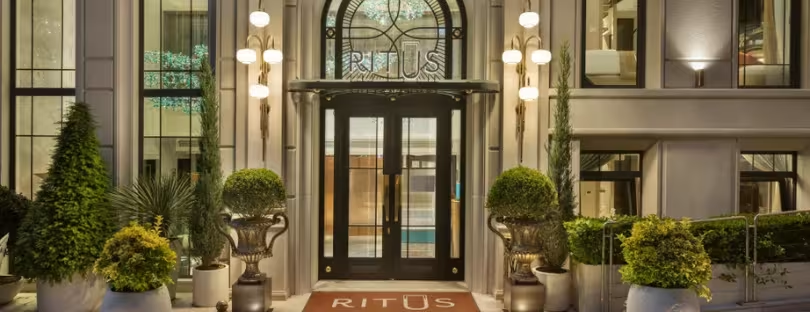
A 153-room new-build set to open in 2028, marking the brand’s debut in France. Focused on compact, flexible rooms and social spaces built around local integration. - Hotel Ventura Saint-Tropez, Tapestry Collection by Hilton
Opening this summer in one of the most recognizable leisure destinations in Europe, with 97 rooms, balconies, and a strong leisure focus. - Quiete Taormina Naxos, Tapestry Collection by Hilton
Launching in 2026 with 103 rooms overlooking the Bay of Capo Taormina, combining resort, wellness, and event positioning. - Cologne City Centre, Tapestry Collection by Hilton
The brand’s entry into Germany will open in 2027 with 183 rooms near key cultural landmarks. - Cork City Centre, Tapestry Collection by Hilton
A hybrid concept with extended-stay options, targeting both business and leisure demand. - Hotel Paris Vaugirard, Tapestry Collection by Hilton
A conversion of a Haussmann-style building, reinforcing Hilton’s focus on heritage assets. - New Continental Plymouth, Tapestry Collection by Hilton
A historic 1865 property is being repositioned into a modern lifestyle offering.
This is not a single format rollout. It is a flexible system applied across urban, resort, and secondary markets.
Hilton is building a layered lifestyle system
What stands out is not just growth, but structure.
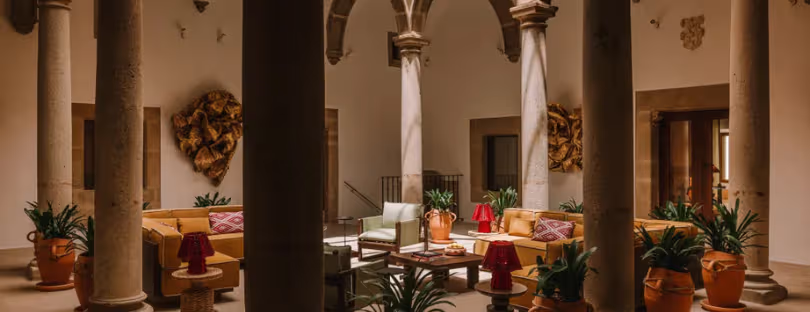
Curio Collection has doubled in five years, focusing on one-of-a-kind properties with strong storytelling. Tapestry Collection has expanded even faster, doubling in three years and entering new regions like Sub-Saharan Africa and Türkiye.
Canopy by Hilton now has more than 30 properties in the pipeline or operating, targeting neighborhood-driven experiences in major cities.
Tempo by Hilton, introduced to EMEA only recently, is already building presence, including a Middle East debut in Riyadh.
And then there is the partnership with YOTEL under the Select by Hilton brand, which signals another move into design-led, tech-forward hospitality.
This is not a random expansion. It is segmentation.
Hilton is effectively building multiple entry points into the same trend, each targeting a slightly different traveler and use case.
The real shift is happening behind the scenes
It is easy to focus on design, food concepts, or “local experiences.” That is not where the real change is happening.
The shift is in distribution.
Independent lifestyle hotels have always had a visibility problem. Big chains have always had an authenticity problem. Hilton is closing that gap.
By allowing hotels to remain distinctive while connecting them to a global booking and loyalty system, it is turning lifestyle into something that can scale consistently.
That is a structural advantage.
And it aligns with broader travel trends. According to Deloitte and STR, lifestyle and boutique segments continue to outperform traditional hotel categories in Europe, particularly in ADR growth and occupancy resilience.
In other words, this is not just branding. It is economics.
Where Hilton stands versus competitors
Hilton is not the only player moving in this direction.
Marriott has built strong momentum with Autograph Collection and Tribute Portfolio. Accor is scaling aggressively through Ennismore and brands like 25hours and Mama Shelter. Hyatt continues to expand The Unbound Collection and Caption.
But Hilton’s approach is slightly different.
Instead of relying on one or two flagship lifestyle brands, it is building a full stack. Multiple brands, different price points, different formats, all connected to the same system.
That creates a network effect.
More brands attract more owners. More owners increase geographic coverage. More coverage strengthens loyalty engagement.
And that loop reinforces itself.
Conclusion
Hilton’s lifestyle expansion is not really about lifestyle.
It is about redefining scale.
The industry used to treat individuality and scale as opposites. You could have one or the other. Hilton is trying to prove you can have both.
By turning lifestyle into a structured, multi-brand system connected to a powerful distribution engine, it is effectively industrializing something that used to be fragmented.
Competitors are moving in the same direction, but Hilton’s advantage is clarity. It is not experimenting with lifestyle. It is committing to it as a core model.
And if that model continues to work, lifestyle hotels will stop being a category.
They will become the default.