
FairPlay Flex lands quietly but confidently in the eSIM market
If you spend enough time around digital nomads, remote workers, or people who treat airports like second offices, you start hearing the same frustration again and again. Connectivity is either too expensive, too complicated, or too fragile for how modern travel actually works. FairPlay Flex enters this conversation without flashy slogans or influencer noise, but with something far more interesting: a pricing model that adapts to how you actually use data as you move across borders.

FairPlay’s Flex plans are not built for the occasional tourist checking maps twice a day. They are clearly designed for people who live online while living on the road. Think long stays, unpredictable data usage, multiple countries in a single month, and zero patience for topping up or swapping profiles.
What FairPlay Flex actually is, without the marketing fog
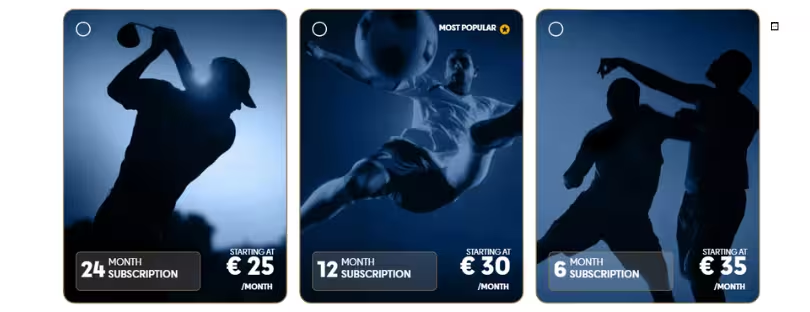
At its core, FairPlay Flex is a long-term eSlM subscription model available in 6, 12, or 24-month commitments. Pricing starts at €25 per month for the 24-month plan, €30 for 12 months, and €35 for 6 months. That already puts it in a different category than most pay-as-you-go travel eSIMs.
What makes it interesting is how data usage is handled. Every month starts at a base level of 5 GB. As you consume more data, the plan automatically moves you through higher tiers in 15 GB steps. Once you cross more than 50 GB in a month, the plan locks into an unlimited flat rate until the end of that billing cycle. Depending on the subscription length, that unlimited cap lands at €85, €90, or €95 for the month.
The important detail here is the reset behavior. Every new month, usage starts again at the lowest price level. There is no penalty for heavy usage in one month followed by light usage in the next. That elasticity is rare in the travel connectivity market.
Designed for people who do not know their data needs in advance
Most eSIM plans force you to predict your future data consumption. That works fine for a weekend city break. It completely fails for digital nomads whose workload changes weekly or even daily.
FairPlay Flex assumes you do not know how much data you will need. Some months, you might be on video calls every day. Other months, you might be exploring offline, hopping between cafés, or relying on Wi-Fi. Instead of forcing you into overpaying or running out, the system adapts automatically.
This approach feels closer to postpaid mobile logic than traditional travel eSIM logic. It reflects how telecom pricing works in mature domestic markets, just extended across borders.
Coverage that reflects real travel patterns
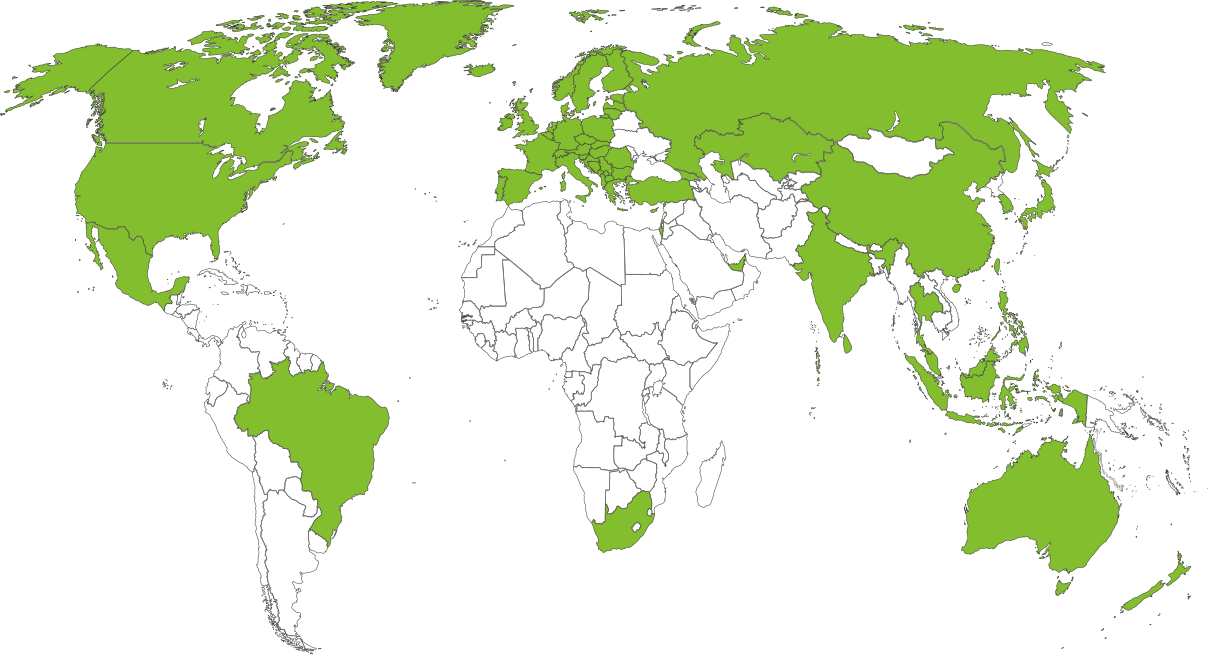
FairPlay currently supports 135+ destinations under one single gIobal eSIM. That matters more than the number itself. The key point is that the coverage is seamless across borders, meaning you do not need to switch plans when crossing into another country within the supported zone.
For digital nomads moving through Europe, Southeast Asia, parts of Latin America, and popular remote-work hubs, this removes a significant amount of friction. One eSIM, one profile, one billing logic.
Network access is positioned as premium, with 5G where available and the highest possible speeds on local networks. In practice, this usually means partnerships with tier-one operators rather than secondary roaming routes, although FairPlay does not publicly disclose all carrier partners.
Unlimited Day Passes for short, intense travel bursts
Alongside Flex, FairPlay also offers Unlimited Day Passes for shorter trips. These are clearly aimed at business travelers, conference attendees, or holiday travelers who want zero compromises for a fixed period.
Pricing is straightforward. Three days for €25, seven days for €50, or fourteen days for €75. All passes offer unlimited data at maximum available speeds. There is no fair use wording highlighted in the core offer, which is notable in a market where unlimited often comes with quite a few asterisks.
From a positioning perspective, this complements Flex well. Long-term nomads stay on subscription. Short-term travelers drop in, use aggressively, and leave.
One eSIM, one world, fewer decisions
The phrase “one eSIM across 135+ destinations” might sound generic, but for nomads, it is actually the product. Every additional profile, QR code, or activation step increases the risk of failure at the worst possible moment.
FairPlay leans heavily into simplicity. One eSIM, activated once, reused across trips and borders. That aligns with a broader industry trend where convenience is overtaking raw price as the main differentiator, especially among professionals who value time over marginal savings.
How FairPlay Flex compares to similar players
Compared to classic travel eSIM brands like Airalo, Nomad, or GigSky, FairPlay Flex plays a different game. Those providers optimize for short-term plans, fixed bundles, and predictable margins. FairPlay optimizes for long-term relationships and variable usage.
In comparison to newer “unlimited” offers on the market, FairPlay’s model feels more transparent. Many unlimited eSIMs rely on heavy throttling after undefined thresholds. FairPlay openly defines where unlimited kicks in and how pricing behaves before that point.
Against global roaming subscriptions like those from traditional telecom operators or niche MVNOs, FairPlay is more flexible geographically and easier to activate. There is no local SIM dependency, no residency requirement, and no physical logistics.
The bigger trend this signals in travel connectivity
FairPlay Flex fits into a clear market shift. Travel connectivity is moving away from disposable data bundles toward subscription-based, adaptive pricing models. Digital nomads are not tourists. They are temporary residents of the internet.
According to GSMA Intelligence and multiple analyses from firms like Analysys Mason and Kaleido Intelligence, eSIM adoption among frequent travelers and remote workers is accelerating precisely because it enables this kind of flexibility. Users want plans that follow them, not the other way around.
FairPlay is not alone in seeing this shift, but it is one of the few executing it cleanly at a consumer-facing level without enterprise complexity.
Conclusion: FairPlay Flex feels like a grown-up eSIM product
FairPlay Flex does not try to be cheap in the headline sense. It tries to be fair in usage, predictable in behavior, and boring in the best possible way. For digital nomads, that is exactly what trust looks like.
In a market crowded with short-term deals, confusing unlimited claims, and constant reactivation cycles, FairPlay’s approach feels closer to how mobile connectivity should work in 2026. One profile, adaptive pricing, clear thresholds, and no punishment for changing usage patterns.
As subscription-based travel connectivity continues to evolve, FairPlay Flex sits at an interesting intersection between telecom logic and nomad reality. It will not replace budget eSIMs for casual trips, but for people who live online across borders, it quietly sets a higher standard.