Cerqle Showcases eSIM Orchestration Platform at MWC
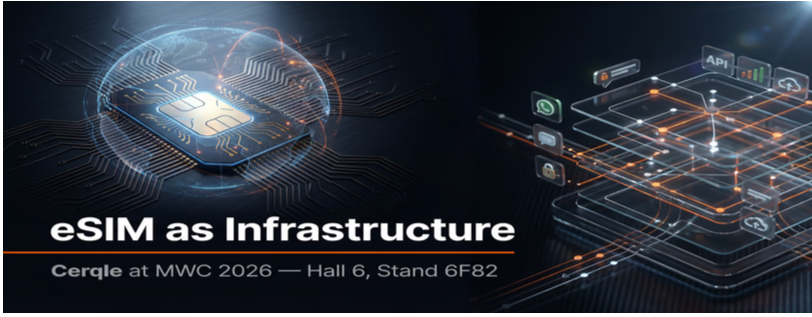
For years, eSIM has been marketed as convenient. No plastic SIM, no airport kiosks, instant activation. At Mobile World Congress, Cerqle is presenting a broader proposition: eSIM as infrastructure.
From Hall 6, Stand 6F82, the company is positioning its platform not as a retail travel offer, but as a stack that OEMs, fintech apps, IoT players, and digital platforms can build on. The shift is subtle but important. Instead of asking how to sell more data bundles, the question becomes how to embed programmable connectivity into products and services.
That aligns with where the industry is moving.
The SimiGo Blueprint
Rather than presenting slides alone, Cerqle is showcasing SimiGo as a live white-label example. The purpose is practical: demonstrate that the infrastructure works end-to-end.
The common friction for organizations entering connectivity is well known:
- Carrier-by-carrier negotiations
- Multiple API integrations for billing, provisioning, and messaging
- Separate dashboards for customer engagement and support
- Fragmented lifecycle management
Cerqle’s model is to collapse those layers into one operational environment.
The ambition is not to reinvent radio networks or eSIM standards. It is to reduce vendor sprawl.
The Orchestration Layer
At the foundation sits orchestration powered by Telmobil Inc. This layer abstracts global carrier relationships and remote SIM provisioning into a single programmable backend covering more than 190 countries.
Technically, this follows established GSMA frameworks such as SGP.22 and the evolving SGP.32 model, which shifts eSIM from consumer QR logic toward scalable, IoT-oriented lifecycle control.
In practical terms, orchestration means:
- Remote profile download and activation
- Suspension and reallocation of profiles
- Carrier abstraction under one API
- Zero-touch provisioning for devices
These capabilities are increasingly expected in enterprise deployments. Cerqle is packaging them in a way that emphasizes deployment speed and integration simplicity.
Engagement and Connectivity in One Flow
On top of orchestration, Cerqle layers its communication stack, branded as “One Flow.” Messaging channels including WhatsApp, Telegram, SMS, email, Instagram, Facebook Messenger, Snapchat, and AI-driven support are unified into a single interface.
The significance is operational, not cosmetic.
In many organizations, connectivity management and customer communication live in separate systems, often under separate vendors. Cerqle combines them. Connectivity events can trigger engagement flows. Support interactions can be linked directly to provisioning logic.
That integration is not technologically unprecedented. But it is commercially relevant. Vendor consolidation can reduce internal complexity for enterprises.
How It Compares to Travel eSIM Brands
Consumer-facing travel providers such as Yesim focus on retail distribution, coverage depth, and competitive pricing. Marketplace-oriented platforms like Airhub concentrate on aggregation and reseller enablement.
Cerqle’s positioning sits below that retail layer. It is not competing for direct traveler acquisition. It is targeting the infrastructure tier that enables brands to launch connectivity products of their own.
That distinction matters.
Retail travel eSIM margins are under pressure due to transparency and aggregation. Infrastructure margins depend on integration depth, enterprise contracts, and lifecycle control. The economics are different.
Cerqle is clearly betting on the second model.

Is It Unique?
The core components are not exclusive. GIobal eSIM orchestration exists. CPaaS platforms exist. White-label connectivity exists.
What differentiates Cerqle is the consolidation of those components into a unified commercial offer with a working proof point in SimiGo. Instead of selling APIs separately from engagement tooling, it presents a vertically integrated stack.
The strategic bet is straightforward: in a fragmented market, simplification becomes differentiation.
That does not mean there is a proprietary protocol no one else has. It means the company is focusing on integration efficiency rather than retail price competition.
The Broader Industry Context
The market is entering a second phase of eSIM adoption.
Phase one was retail acceleration. Travel connectivity brands scaled rapidly, capitalizing on QR activation and global coverage aggregation.
Phase two is orchestration consolidation. Enterprises, OEMs, and digital platforms are exploring embedded connectivity. The question is no longer just “Which eSIM plan should I buy?” but “How do I integrate global connectivity into my ecosystem?”
GSMA standard evolution supports this shift. SGP.32 expands programmable remote SIM provisioning in IoT environments. Analysts from firms such as Counterpoint and Juniper Research project continued enterprise growth in eSIM-enabled devices.
In this environment, orchestration layers gain strategic weight.
Cerqle’s positioning fits that macro trend.
Execution Will Decide
Infrastructure platforms are evaluated differently than retail brands. The criteria are less about marketing reach and more about:
- SLA reliability
- Carrier depth and redundancy
- Security compliance and certificate management
- API maturity
- Enterprise reporting and cost predictability
Trade show messaging cannot fully demonstrate those factors. They are proven in long-term deployments.
Cerqle’s model is credible in structuhttps://alertify.eu/aeris-expands-iot-platform-with-global-esim-orchestration-and-operator-control/re. Whether it becomes defensible will depend on performance and partner adoption over time.
Conclusion: A Coherent Strategic Move
Cerqle is not presenting a radical reinvention of eSIM technology. It is presenting a coherent integration strategy aligned with where connectivity is heading.
By combining orchestration, engagement tooling, and a live white-label deployment model, the company is positioning connectivity as an embedded infrastructure layer rather than a standalone retail product.
That reflects a broader shift in the telecom ecosystem. As connectivity becomes programmable and integrated into apps, devices, and services, platforms that reduce integration friction may gain relevance.
The real differentiation will not come from the “Connectivity OS” label itself. It will come from measurable enterprise execution.
At MWC 2026, Cerqle is signaling that it wants to compete in the infrastructure tier of the eSIM market. In a landscape increasingly defined by orchestration rather than plastic, that is a strategically sound direction.