Digi IX25 Launch: 5G Router with eSIM and Edge AI
If you’ve ever looked at how industrial connectivity is actually deployed in the field, you’ll know it’s rarely elegant. Cabinets are overcrowded. Routers sit next to switches, gateways, and edge compute boxes. Each piece adds cost, failure risk, and operational overhead.
That’s the context behind Digi International’s latest launch. The new Digi IX25 is not just another industrial router. It’s a deliberate attempt to collapse multiple layers of infrastructure into a single, rugged platform.
And that matters more than it sounds.
Why this launch actually matters
Industrial and enterprise connectivity teams are dealing with three converging pressures right now:
- Scaling deployments across thousands of distributed sites
- Meeting stricter compliance and security requirements
- Preparing for private LTE and 5G environments
At the same time, the physical reality hasn’t changed. Space is limited. Conditions are harsh. And downtime is expensive.
The Digi IX25 is designed to sit right in that tension. Instead of adding another device to the stack, it replaces several.
You get routing, switching, edge compute, and eSIM-based connectivity in one box.
What Digi IX25 brings to the table
At a hardware level, this is a rugged industrial router built for real-world environments. We’re talking operation from -40 °C to +75 °C, with certifications like C1D2, ATEX, E-Mark, and MIL-STD-810H. This is clearly aimed at utilities, oil and gas, transport, and critical infrastructure.
But the more interesting story is in how the platform is structured.
Integrated networking
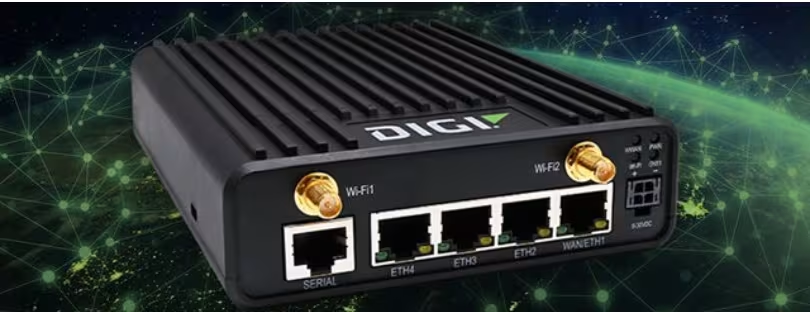
Four Gigabit Ethernet ports remove the need for external switches.
Fewer devices mean fewer failure points and simpler installs.
Multi-generation cellular support
LTE, 5G RedCap, and full 5G eMBB across different SKUs.
One platform that evolves with network availability.
TAA-compliant architecture
Western cellular modules for supply chain assurance.
Designed for government and regulated industries.
This is less about raw performance and more about long-term deployment logic. Standardize once, deploy everywhere, and upgrade over time.
eSIM finally becomes operational, not just technical
One of the most relevant pieces for Alertify readers is the eSIM implementation.
The IX25 supports GSMA SGP.32 standards and comes with bootstrap connectivity preloaded. That means:
- Devices can connect immediately out of the box
- No physical SIM handling
- Remote carrier provisioning at scale
This is what eSIM was always supposed to enable in IoT and enterprise environments. Not just flexibility, but actual operational simplicity.
In practice, this removes one of the biggest bottlenecks in large deployments: logistics. No more shipping SIMs, coordinating installs, or dealing with local carrier fragmentation.

Edge compute moves into the router
Another shift here is the integration of edge computing directly into the router itself.
The IX25 runs a quad-core processor and supports Linux containers, allowing companies to deploy applications directly on the device.
Typical use cases
- SCADA integration
- Telemetry processing
- Edge analytics
- Custom industrial applications
It also supports platforms like AWS IoT Greengrass and Microsoft Azure IoT.
This is part of a broader trend. Instead of sending everything to the cloud, more processing is happening locally. It reduces latency, cuts bandwidth costs, and enables faster decision-making.
In industries where milliseconds matter, that’s not optional anymore.
AI enters network operations
The most forward-looking piece of the IX25 ecosystem is not actually the hardware. It’s how it’s managed.
Digi Remote Manager (DRM) now includes AI-driven capabilities through its MCP server. In simple terms, this allows teams to:
- Query device fleets using natural language
- Automate workflows
- Generate configuration insights
- Streamline troubleshooting
It also enables integration with enterprise AI tools like Claude and other large language models.
This is a subtle but important shift. Network management is moving from manual configuration to assisted intelligence.
And for companies managing thousands of endpoints, that could be transformative.
Built for private networks, not just public carriers
Another key angle is private LTE and 5G support.
The IX25 is designed to work with:
- CBRS spectrum
- FirstNet
- Anterix spectrum
This gives enterprises the option to build their own secure wireless networks instead of relying entirely on public operators.
For sectors like utilities and critical infrastructure, this is becoming increasingly important. Connectivity is no longer just about coverage. It’s about control, resilience, and security.

The bigger picture
What Digi is doing here fits into a much larger shift in connectivity.
The market is moving from fragmented, hardware-heavy deployments toward integrated, software-defined infrastructure.
You can see similar strategies across the industry:
- Cisco is pushing edge-native networking and secure access service edge (SASE)
- Cradlepoint (part of Ericsson) is combining 5G routers with cloud management and edge capabilities
- Sierra Wireless (now Semtech) has been building integrated IoT connectivity platforms
Digi’s angle is slightly different. It’s leaning heavily into simplicity and consolidation.
Instead of building ecosystems across multiple products, it’s trying to reduce the number of moving parts altogether.
Where this fits in the eSIM and IoT evolution
From an eSIM and connectivity perspective, this launch reinforces a few clear trends:
- eSIM is becoming standard in enterprise deployments, not optional
- Zero-touch provisioning is now expected, not a differentiator
- Multi-carrier flexibility is critical for resilience
According to the GSMA and industry forecasts, eSIM adoption in IoT is accelerating rapidly, especially in sectors like utilities, automotive, and logistics. Digi IX25 industrial 5G router with eSIM
At the same time, Juniper Research has highlighted that enterprise IoT connections will continue to grow at double-digit rates through the decade, driven by exactly these types of deployments.
Devices like the IX25 are essentially the infrastructure layer enabling that growth.
Final Thoughts about Digi IX25 industrial 5G router with eSIM
The Digi IX25 is not about flashy features. It’s about reducing complexity in environments where complexity is expensive.
That’s what makes it relevant.
Compared to players like Cradlepoint or Cisco, Digi is not trying to win on ecosystem scale or enterprise dominance. It’s focusing on a more practical promise: fewer devices, simpler deployments, and tighter control.
And in industrial connectivity, that’s often what wins.
The real story here is not the router itself. It’s the direction the market is heading.
Connectivity is becoming infrastructure. Invisible, embedded, and expected to just work.
And the companies that succeed will not be the ones adding more layers. They’ll be the ones removing them.