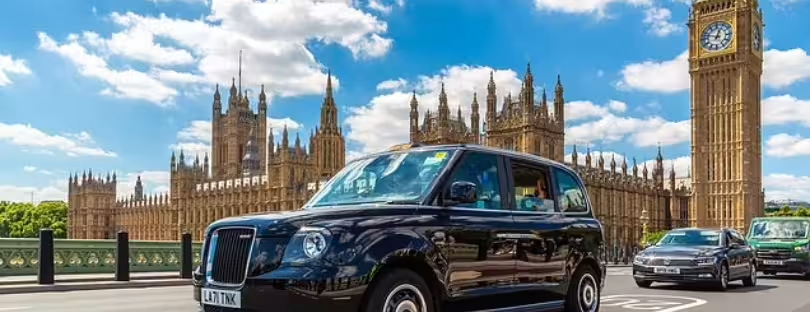
London’s taxi market is no stranger to disruption. From ride-hailing giants to evolving passenger expectations, black cab drivers have spent the past decade adapting to a system that often feels fragmented. Now, a new platform is trying to simplify that complexity and, more importantly, shift control back to drivers. curb flow london
Curb has officially launched Curb Flow in London, a driver-first platform designed to unify ride demand from multiple sources into a single interface. The idea is simple but powerful. Instead of switching between apps or relying on a single source of trips, drivers can access multiple demand streams in one place, increasing their chances of finding consistent fares throughout the day.
At its core, this is not just another app. It is an attempt to rewire how taxi demand is distributed in one of the world’s busiest urban transport environments.
One platform, multiple demand streams
Curb Flow aggregates ride requests from different channels, including Curb’s own consumer app and integrations with platforms like Uber. More providers are expected to join over time, effectively turning the platform into a demand marketplace rather than a closed ecosystem.
For drivers, the flexibility is key. They can choose which demand sources to accept trips from, opt in or out at any time, and are not locked into rigid acceptance quotas or penalty systems. That alone marks a notable departure from traditional ride-hailing models, where algorithmic pressure often dictates driver behavior.
Even more interesting is the launch model. Curb Flow is rolling out in London with a 0% commission structure. Drivers keep the full fare from trips completed through the platform, which immediately positions it as a more driver-friendly alternative in a market where commissions can significantly eat into earnings.
The goal is clear. Reduce idle time, increase trip frequency, and create a more predictable income stream without forcing drivers into platform dependency.
Why London, and why now
Timing matters here. London was recently named the world’s most searched travel destination for 2026, signaling strong inbound demand. At the same time, congestion, operating costs, and regulatory constraints continue to make it harder for drivers to maintain consistent earnings.
This creates a paradox. Demand is growing, but access to that demand is inefficient.
“London cabbies face unique challenges, from congestion to rising operating costs, which can impact efficiency and earnings,” said Danny Sivanesan, Vice President of Curb UK. “By improving access to consistent demand, Curb Flow is helping renew interest in the profession, encouraging drivers to stay active throughout the day and supporting a stronger, more reliable vehicle supply.”
In other words, this is not just about adding more rides. It is about redistributing existing demand more efficiently across the driver network.
What drivers actually gain
From a practical standpoint, Curb Flow introduces three major shifts for drivers.
More consistent demand
By aggregating multiple ride sources, drivers are less dependent on a single app’s demand fluctuations. This reduces downtime and smooths out daily earnings.
Full control over work
Unlike many ride-hailing platforms, drivers are not penalized for rejecting trips or switching off certain demand sources. This restores a level of autonomy that has been gradually eroded in the gig economy.
Better earnings potential
With a 0% commission model at launch, drivers keep 100% of the fare. Combined with higher trip frequency, this can have a meaningful impact on overall income.
Curb’s data from North America supports this. Since launching Curb Flow in 2023, the company reports a fourfold increase in booking volume across its network. In some markets, drivers have seen earnings rise by up to 40%.
“We’ve seen in the U.S. that Curb Flow increases earning opportunities while keeping drivers in control of how they work,” said Dorel Tamam, Vice President of the Mobile Business Unit at Curb, overseeing the company’s mobile business globally. “Bringing this system to London means drivers can work smarter and respond to demand more quickly, while still staying in control of how they operate.”
Passenger impact often overlooked
While the platform is clearly driver-focused, passengers are not left out of the equation.
By increasing the availability of taxis across different areas, Curb Flow indirectly improves wait times and coverage. In practical terms, this means a higher likelihood of finding a licensed black cab when and where it is needed, especially during peak demand periods.
This matters in a city like London, where black cabs still hold a reputation for reliability, knowledge, and regulated service quality. Improving their accessibility without compromising standards could help rebalance the competitive landscape against ride-hailing services.
Built for regulation, not around it
One of the more strategic aspects of Curb Flow is its compliance with Transport for London regulations. The platform integrates directly with licensed metering systems, ensuring that traditional taxi rules are preserved.
This is a subtle but important distinction. While many mobility platforms have historically tried to work around regulatory frameworks, Curb is positioning itself as an enabler of the existing system rather than a disruptor of it.
That approach may prove more sustainable in a market like London, where regulatory oversight is strict and deeply embedded.
The bigger picture: aggregation is the next battleground
Curb Flow is part of a broader shift happening across mobility and platform economies.
We are moving from single-platform dominance to multi-platform aggregation.
Instead of drivers choosing one app, the next phase is about tools that unify multiple ecosystems into one interface. This mirrors trends seen in other industries, from travel booking aggregators to fintech super apps.
In mobility, this shift is particularly relevant. Companies like Uber, Bolt, and Free Now have focused on building demand within their own ecosystems. Curb Flow flips that model by aggregating demand externally and giving drivers the ability to choose.
This aligns with a growing pushback against platform dependency, where drivers and service providers are seeking more control over how they access and monetize demand.
Industry reports from sources like McKinsey and Deloitte have already highlighted this trend, pointing to increased fragmentation in mobility platforms and the rise of interoperability as a key competitive advantage.
What this means for the future of taxis
London has always been a unique mobility market. Black cabs are not just another transport option. They are part of the city’s infrastructure and identity.
Curb Flow does not try to replace that system. Instead, it enhances it with a digital layer that makes demand more accessible and work more predictable.
If successful, this model could extend beyond London and reshape how regulated taxi markets operate globally.
The real question is whether aggregation becomes the new standard.
A market quietly shifting direction
The mobility market is entering a phase where control, not just scale, defines success.
Platforms that can balance demand aggregation with driver autonomy are likely to gain traction, especially in regulated environments. Curb Flow is an early signal of that shift.
Compared to traditional ride-hailing players, this is less about competing on price or speed and more about redefining how supply connects to demand.
If Uber built the first generation of on-demand mobility, platforms like Curb Flow may represent the next one. Not replacing the system, but stitching it together in a way that finally makes sense for everyone involved.
Driven by wanderlust and a passion for tech, Sandra is the creative force behind Alertify. Love for exploration and discovery is what sparked the idea for Alertify, a product that likely combines Sandra’s technological expertise with the desire to simplify or enhance travel experiences in some way.