Why American Airlines Is Shifting Baggage Power to the App
For years, airline apps have promised convenience. Check in early. Choose your seat. Maybe track your bag. American Airlines baggage fee
Now, American Airlines is pushing that logic further upstream, straight into the booking flow itself.
The carrier has rolled out a new set of digital upgrades across its website and mobile app that let customers manage checked luggage earlier in the journey, automate refunds, use travel credits more flexibly, and even pay slightly less if they handle baggage online instead of at the airport.
On the surface, this looks like another incremental tech update. In reality, it is part of a much bigger shift happening across aviation: moving friction out of the airport and into digital pre-trip management.
And yes, there is also a pricing angle.
Earlier bag management
The most noticeable change is timing.
Customers can now add up to three checked bags during flight booking, instead of waiting until check-in. That may sound minor, but from a behavioral perspective, it is significant. When baggage is added at booking, it becomes part of the travel plan, not an afterthought at the airport counter.
For prepaid baggage customers, American is also enabling confirmed same-day flight changes without speaking to an agent. This is designed to create a smoother, more predictable process. Previously, bag purchases could complicate same-day adjustments.
That is a clear sign the airline is trying to remove friction points that historically forced travelers into agent lines.
Digital incentives
Here is where the commercial strategy becomes visible.
For tickets booked on or after Feb. 18, American is increasing the second checked bag fee to $50 on domestic and short-haul international routes. However, customers who prepay online receive a $5 discount, keeping the digital rate at $45.
There are no changes to the first checked bag fees. Complimentary baggage benefits also remain for elite loyalty members, most co-branded credit cardholders, premium cabin passengers, and active-duty U.S. military personnel.
In simple terms, airport payment becomes the premium. Digital prepayment becomes the incentive.
Airlines have been quietly steering customers toward digital channels for years, but pricing levers like this make the strategy explicit. If you show up and pay at the counter, you pay more.
The revised second-bag fee applies to domestic routes including Alaska, Hawaii, Puerto Rico, and the U.S. Virgin Islands, as well as flights to Canada and other short-haul international destinations.

Automated refunds and credit flexibility
One of the more meaningful upgrades is automated refunds for eligible prepaid baggage purchases.
If customers change or cancel trips, or purchase Instant Upgrades, refunds are now processed automatically. Depending on the transaction, funds are returned either to the original form of payment or issued as travel credits.
This removes one of the most frustrating parts of airline extras: chasing small refunds after schedule changes.
American has also expanded the use of travel credits. Customers can now redeem them online for standalone checked bags, which opens the door for broader digital payment flexibility across ancillary services.
From a systems perspective, this signals a move toward a more integrated digital wallet logic inside airline ecosystems.
Premium cabin digital add-ons
For premium cabin travelers, most are now able to add checked bags digitally before departure. That reduces the need for in-person support, even among higher-yield customers.
It also reinforces something airlines increasingly prioritize: consistency of experience across cabins, at least when it comes to digital tools.
As Heather Garboden, Chief Customer Officer, put it:
“Any time we can make the travel experience streamlined and more convenient before arriving at the airport is a win for our customers. We continue to update our digital channels to provide our customers with even more self-service options.”
The statement is straightforward. The subtext is operational efficiency.
Express bag tags and airport upgrades
These digital changes are paired with physical infrastructure improvements.
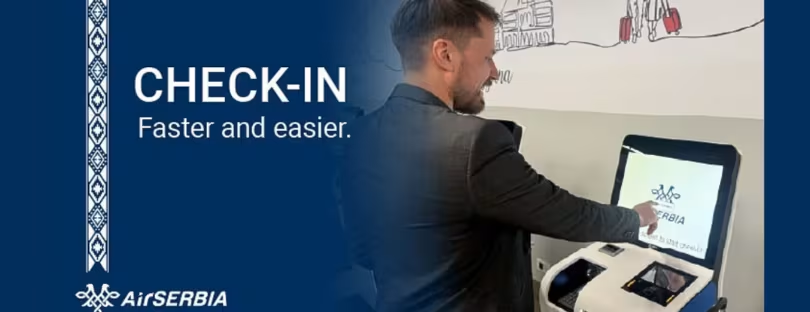
Passengers who prepay online can scan their boarding passes at kiosks, print Express Bag Tags, and head directly to baggage drop. Over the past year, American has installed around 100 new bag kiosks across 16 airports.
This hybrid model, digital prepayment combined with faster physical processing, is where the real impact shows up. It is not just about selling baggage earlier. It is about shortening queues, reducing staffing pressure, and smoothing peak-hour congestion.
Anyone who has stood in a long bag-drop line during a busy holiday weekend knows why that matters.
A broader industry shift
American is not alone in this direction. Major carriers including Delta Air Lines and United Airlines have also invested heavily in app-based ancillary sales, automated refunds, and self-service bag drop infrastructure.
Industry research from organizations such as the International Air Transport Association points to digital self-service as a core priority for airlines seeking to reduce airport congestion and labor costs while improving customer satisfaction.
Ancillary revenue, which includes baggage fees, seat selection, and onboard sales, now represents a substantial share of airline profitability globally. Making these services easier to purchase digitally is not just about convenience. It is about margin control and predictability.
The small $5 online discount for second bags is a classic example. It nudges behavior without dramatically changing headline pricing.
 What this means for travelers
For frequent flyers and digitally savvy travelers, these upgrades are mostly positive. Earlier bag management, automated refunds, and travel credit flexibility remove friction from an already complex travel experience.
For occasional travelers, the message is clear: plan ahead, manage digitally, and avoid last-minute airport transactions.
The risk, of course, is further complexity. Airlines increasingly operate layered pricing models where behavior determines cost. Those who are not paying attention can easily end up paying more.
But the direction is unmistakable.
Conclusion
American Airlines is not simply adding app features. It is reinforcing a structural shift in how airlines want customers to behave.
Pre-trip digital management is becoming the norm. Airport counters are becoming the exception. Pricing incentives are being used to accelerate that transition.
Compared with peers like Delta and United, American’s approach is aligned with broader industry trends toward automation, digital wallet integration, and ancillary optimization. The difference is the explicit linkage between pricing and channel choice.
In the long run, this is less about baggage and more about control. Airlines want predictable passenger flows, predictable ancillary revenue, and fewer unpredictable airport interactions.
For travelers, the takeaway is practical: the earlier you manage your trip digitally, the smoother and often cheaper it becomes.
And if this pattern continues, the airport of the future will feel less like a transaction point and more like a final checkpoint in a journey that has already been digitally orchestrated long before you arrive. American Airlines baggage fee