airBaltic Skynet: Starlink WiFi Meets Travel Shopping
Something interesting is happening at 30,000 feet, and it has less to do with seats or snacks and more to do with how airlines are starting to think about digital space inside the aircraft.
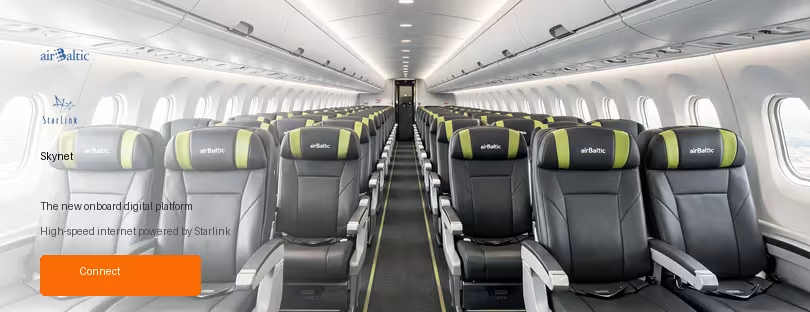
Latvian carrier airBaltic is the latest to move in that direction. As of March 2026, the airline has rolled out Skynet, a new onboard digital platform designed to centralize the in-flight experience into one place, accessible directly from passengers’ own devices.
At first glance, this might sound like another in-flight portal. But the context matters. This is not being built on legacy onboard Wi-Fi. It is powered by Starlink.
That changes the equation.
Starlink is enabling a different type of in-flight product
For years, onboard connectivity has been limited, slow, and often frustrating. Most airline portals were built around those limitations. Static content, basic maps, maybe a duty-free catalogue.
Starlink is removing those constraints.
With high-speed, low-latency internet now available on a growing number of aircraft, airlines suddenly have the infrastructure to treat onboard connectivity as a real digital environment, not just a utility.
Skynet is one of the first examples in Europe of what that shift looks like in practice.
Once connected to Starlink, passengers can access the platform instantly. No app download. No registration. Just open the portal and start using it.
That simplicity is not accidental. It reflects a broader shift toward frictionless digital access, something the travel industry has been trying to get right for years.
What Skynet actually does in-flight
The idea behind Skynet is straightforward. Bring everything a passenger might need during a flight into a single interface.
That includes real-time flight tracking, with details like duration, departure and arrival times, and even connecting flight information at Riga Airport. It also extends into content and commerce.
Passengers can browse the digital airCafe menu, explore destination content, or read airBaltic’s own blog. Beyond that, the platform opens into a wider partner ecosystem.
Key features inside Skynet
- Real-time flight information and journey tracking
- Digital onboard menu with potential for in-seat ordering
- Destination guides and travel inspiration
- Access to partner services like Booking.com, GetYourGuide, and SIXT
- Integrated shopping via AirMall, powered by InterLnkd
- Loyalty integration with airBaltic Club, including point earning
This is where things get more interesting.
Skynet is not just about information. It is about turning the onboard moment into a connected commercial environment.
Passengers can book accommodation, rent cars, or browse experiences before they even land. They can shop from retail partners mid-flight. And importantly, those actions are tied into the airline’s loyalty ecosystem.
That creates a feedback loop that airlines have been trying to build for years.


A platform, not just a feature
Thomas Alexander Ramdahl, Chief Commercial Officer at airBaltic, framed it clearly:
“Skynet marks an important step in how we are redefining the on-board digital journey. By bringing services, real-time flight information and carefully selected partner offers into one seamless platform powered by Starlink, we are making the travel experience more convenient, entertaining and personalized for our passengers, especially to our airBaltic Club loyalty members. We will continue enhancing the platform by introducing more tailored onboard offers, including convenient in-seat ordering and payment options directly from our menu.”
There are two important signals in that statement.
First, this is positioned as a “platform,” not a one-off feature. That implies continuous expansion. More services, more partners, more personalization.
Second, the focus on in-seat ordering and payments points toward something airlines have historically struggled with: onboard monetization beyond tickets.
If Skynet evolves as planned, it could become a meaningful revenue layer.
Why this matters beyond airBaltic
airBaltic is not the only airline experimenting with connected onboard ecosystems.
Carriers like Delta, Qatar Airways, and United have been investing heavily in onboard connectivity, digital portals, and personalized experiences. Lufthansa Group has also been expanding its digital travel ecosystem, particularly around ancillary services and partnerships.
What makes airBaltic interesting is timing.
The airline is deploying this while still scaling Starlink across its Airbus A220-300 fleet, with more than half already equipped. That puts it ahead of many European competitors in terms of connectivity infrastructure.
And infrastructure is the keyword here.
Without reliable, fast internet, none of this works. With it, the onboard experience starts to look less like a disconnected gap in the journey and more like a continuation of the digital travel flow.

The bigger shift: from transport to platform
If you zoom out, Skynet is part of a much larger trend.
Airlines are gradually moving from being transport providers to becoming digital platforms layered on top of travel.
The logic is simple. The flight is one of the few moments where airlines have a captive audience with time, attention, and increasingly, connectivity.
Turning that moment into a monetizable, personalized digital environment is the next step.
And this is where partnerships come in.
By integrating services like Booking.com, GetYourGuide, and SIXT, airBaltic is not trying to build everything itself. It is positioning the aircraft as a distribution channel.
That aligns with what we are seeing across travel and telecom. Distribution is becoming more valuable than the product itself.
What still needs to be proven
There are still open questions.
Will passengers actually use these platforms beyond checking flight details?
Will in-flight commerce convert at meaningful levels?
And how will airlines balance user experience with monetization pressure?
These are not trivial challenges.
Many previous attempts at onboard digital ecosystems failed because they were clunky, slow, or simply not relevant enough.
The difference now is that the technology barrier is finally being removed.
Conclusion: the real competition is not onboard anymore
What airBaltic is building with Skynet is not just an inflight feature. It is an early version of something bigger.
A connected layer that sits between travel, telecom, and digital commerce.
Compared to traditional airline models, this moves closer to what we already see in other parts of the travel ecosystem. Platforms that own the customer relationship and extend it across the journey.
And this is where the real competition is shifting.
It is no longer just airline versus airline. It is airline versus platforms like Booking.com, versus fintech travel apps, versus even telecom players enabling connectivity layers.
Starlink is simply accelerating that transition by removing one of the last physical constraints of the aircraft.
Reliable sources like Airline Ratings, Skytrax, and APEX have already highlighted how airlines are competing more on experience and digital innovation than ever before. Skynet fits directly into that trajectory.
The interesting part is not that airBaltic launched a portal.
It is that airlines are starting to understand that connectivity is not a feature.
It is infrastructure for an entirely new business model.