Air Serbia Adds eCheck-In at Belgrade Airport
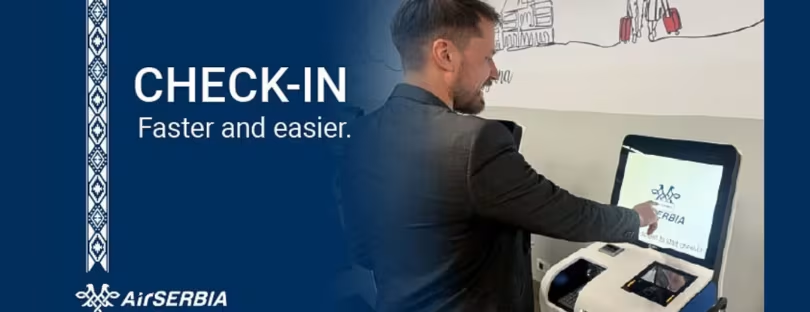
Belgrade Nikola Tesla Airport just got a little less stressful. Air Serbia has deployed 10 self-service check-in kiosks and 10 automated baggage drop-off stations at its home hub, developed in partnership with technology vendors SITA and IER. The rollout is modest in scale but meaningful in context — it signals that one of Southeast Europe’s busiest carriers is finally catching up to infrastructure standards that airlines in Western Europe have treated as table stakes for years.
The kiosks handle check-in and travel document validation. Once done, passengers with checked bags can hand them off independently at the bag drop stations, positioned near the Premium counter and available exclusively to Air Serbia passengers. The operational logic is straightforward: reduce agent dependency at peak hours, compress dwell time, and free up staff for higher-touch interactions.
Uroš Bijelić, Head of PSS and Distribution at Air Serbia, framed it clearly:
“The new self-service check-in kiosks and baggage drop-off stations will further reduce waiting times and enable higher flexibility during travel. This step is part of a wider digital transformation of Air Serbia, which entails modernization of services and improvement of all points of contact with passengers, on land and in the air, with the aim of providing a fast, simple, and pleasant travel experience.”
Why SITA and IER Matter Here
The choice of vendors isn’t incidental. SITA is the dominant airport IT infrastructure provider globally — its Common Use Self-Service (CUSS) platform powers kiosks at hundreds of airports worldwide, and its 2024 Air Transport IT Insights report consistently shows that self-service adoption correlates directly with higher passenger satisfaction scores. IER, a French tech company with deep roots in boarding pass and baggage automation, has been a key partner to European and Middle Eastern carriers building out fast-bag infrastructure.
Together, they give Air Serbia a solution that’s been battle-tested at scale — not a bespoke build that will need years of iteration.

The Bigger Picture
Ten kiosks at one airport won’t redefine the passenger experience overnight. But this deployment sits within a pattern worth watching across the region. Balkan and Eastern European carriers have historically lagged behind peers in Western Europe and the Gulf on ground automation — partly due to infrastructure investment cycles, partly due to lower traffic volumes that made the unit economics harder to justify.
That calculation is shifting. Belgrade Airport handled over 6 million passengers in 2023 — a record — and Air Serbia has been expanding its network aggressively, including seasonal routes and new European city pairs. More passengers means more congestion at check-in, and congestion at check-in is a direct drag on NPS scores and missed connections.
What This Looks Like Compared to the Field
To put it in perspective: Wizz Air and Ryanair have operated near-fully automated check-in flows for years, effectively forcing app-based check-in by charging for airport alternatives. Legacy European carriers like Lufthansa and KLM went further, deploying biometric bag drop systems integrated with facial recognition. Even regional low-cost carrier easyJet has trialled CUSS biometric kiosks at Gatwick.
Air Serbia isn’t competing directly with those operators on price or volume, but it is competing for the same business and leisure traveler who now moves between carriers fluidly. The expectation of frictionless check-in doesn’t reset when someone books a full-service carrier. If anything, it rises.
What differentiates this rollout from a purely cosmetic upgrade is the integration angle: SITA’s platform is built for interoperability, meaning Air Serbia can layer additional functionality — biometrics, IATA ONE Order compatibility, mobile ID verification — without ripping and replacing. That’s a foundation, not a finish line.
Looking Ahead
The harder question is how quickly Air Serbia moves from 10 kiosks to a genuinely end-to-end digital ground experience. Self-service check-in and bag drop are phase one of a longer journey that typically includes biometric boarding gates, remote check-in via app with real-time bag tracking, and eventually lounge and ancillary services managed through a single passenger profile. IATA’s 2023 Digital Innovation Report tracks this trajectory across member airlines, and carriers that invest early in the underlying data infrastructure tend to unlock the downstream value faster.
Air Serbia has the vendor partnerships and the stated intent. The next 18 months will show whether this is a one-off modernization effort or the beginning of a more systematic transformation — one that positions Belgrade Nikola Tesla not just as a regional hub, but as a genuinely modern airport experience.