YouTrip Moves Into eSIMs, Bringing Mobile Data to 140+ Countries
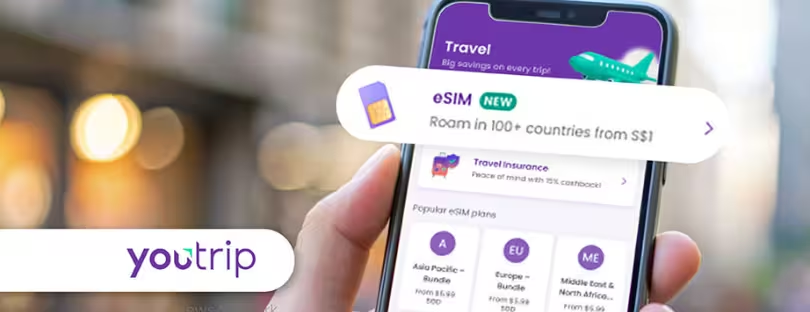
After years of helping travellers dodge painful FX fees, YouTrip is making a very natural next move. The company has officially launched a global eSIM service inside its app, giving users access to mobile data in more than 140 countries.
If that sounds familiar, it should. Payments and connectivity are quickly becoming two sides of the same travel-tech coin. Travellers no longer want to juggle airport SIM kiosks, roaming surprises, or yet another standalone app just to get online. YouTrip is betting that if you already trust them with your money abroad, you might as well trust them with your data too.
How the YouTrip eSIM works
The mechanics are intentionally simple. Users can browse, buy, activate and manage their eSIM directly within the YouTrip app, under the Travel section. No QR codes buried in emails. No confusing activation steps. Once installed, data usage is tracked in real time, with clear visibility on remaining balance and costs.
Pricing starts from just S$1, with upfront rates shown before purchase. That matters more than it sounds. In roaming and connectivity, transparency is often the biggest differentiator. Travellers are less price-sensitive when they feel in control, and YouTrip is clearly leaning into that psychology.
The service supports single-country plans as well as regional bundles, including Asia Pacific and Europe, which saw a noticeable spike in demand during the year-end travel period.
From early access to full launch
This is not a rushed release. YouTrip quietly rolled out early access in November 2025, just in time for peak holiday travel. According to the company, uptake during this trial phase was strong enough to greenlight a full public launch.
China, Japan and Malaysia emerged as the most popular destinations, which says a lot about real-world travel behaviour. These are high-frequency routes for Southeast Asian travellers, where short trips and weekend getaways are common.
One in six early users bought an eSIM specifically for Malaysia, including quick hops to Johor Bahru. That detail is telling. It suggests YouTrip is not only targeting long-haul holidays but also everyday cross-border travel, where convenience matters more than anything else.

Why connectivity fits YouTrip’s DNA
YouTrip’s positioning has always been about friction removal. First, it was a foreign exchange. Now, it is connectivity.
Kelvin Lam, Chief Operating Officer of YouTrip, framed the move clearly:
“At YouTrip, we continuously strive to make travel experiences more seamless and convenient for everyone.
After transforming how travellers manage cross-border payments, we are now extending that same value-driven approach to mobile connectivity—giving users a simple and cost-effective way to stay connected wherever their journeys take them.”
The quote lands because it is consistent with YouTrip’s broader product story. This is not a pivot. It is an extension.
Launch promos to drive first-time trials
To kickstart adoption, YouTrip is leaning heavily on incentives. First-time eSIM buyers can get 50 percent cashback on purchases made between 28 January and 10 February 2026. The cashback is capped at S$5 per user and limited to the first 2,500 participants, with registration required via the in-app Promo banner.
There is also a social layer to the launch. From 29 January to 5 February 2026, YouTrip is running an Instagram giveaway tied to an in-app game. Top-ranked participants can win up to S$500 in YouTrip credits, while selected users who share their results can score S$100.
It is a classic fintech playbook move. Reduce friction, add gamification, and let users market the product for you.
Where YouTrip sits in the eSIM landscape
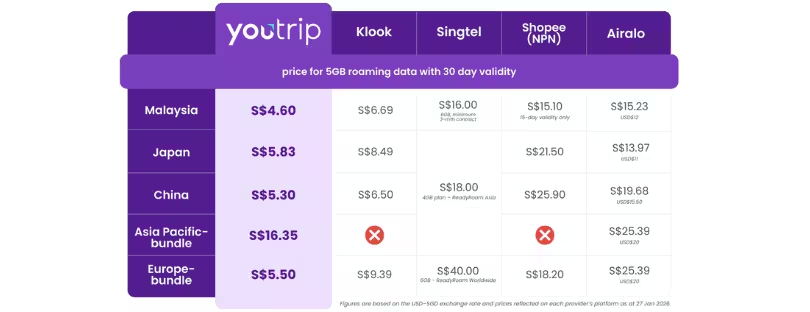
The global eSIM market is already crowded. Standalone players like Airalo, Nomad eSIM and GigSky built their businesses entirely around international data. Meanwhile, super-apps and fintechs are increasingly bundling connectivity into broader ecosystems.
Revolut and Wise have both experimented with travel connectivity features, recognising that users prefer fewer apps that do more. YouTrip’s advantage is focus. Its user base is already travel-heavy, and its app experience is designed around spending abroad.
What YouTrip does not yet offer, at least publicly, is ultra-customisation. Power users who want niche plans, multi-SIM management, or advanced enterprise features may still gravitate toward specialist eSIM platforms. But for the mass market traveller, convenience often beats configurability.
A signal of a bigger trend
Zooming out, this launch fits neatly into a broader industry shift. Travel tech is converging. Payments, insurance, connectivity, and even airport services are increasingly bundled into single platforms.
According to GSMA and industry research from firms like Kaleido Intelligence, global eSIM adoption is accelerating, driven by smartphone compatibility, rising roaming costs, and traveller awareness. What is changing now is distribution. eSIMs are no longer only sold by telecom brands. They are becoming a feature inside apps people already use.
YouTrip’s move reinforces that trend. Connectivity is no longer a standalone product. It is becoming a utility layer within travel ecosystems.
Conclusion: What this really means for travellers
YouTrip’s eSIM launch is less about competing head-on with specialist providers and more about redefining expectations. Travellers are being trained to expect mobile data to be as easy as tapping a button, just like exchanging currency or paying overseas.
For frequent travellers who already rely on YouTrip, the value proposition is obvious. One app, one balance, one less thing to think about before boarding. For the wider market, it raises the bar. If fintech apps can offer transparent, low-friction connectivity, traditional roaming models and clunky SIM purchases will feel increasingly outdated.
The real test will come next. Pricing consistency, network quality, and post-launch support will determine whether YouTrip’s eSIM becomes a default choice or a convenient backup. But as part of a wider shift toward all-in-one travel platforms, this launch feels less like an experiment and more like an inevitability.
Sources worth watching include GSMA eSIM reports, Kaleido Intelligence travel connectivity forecasts, and operator data from Asia-Pacific markets, where short-haul travel continues to drive some of the fastest eSIM adoption globally.