Why Operators Are Finally Launching Travel eSIMs in 2026
In the last few years, travel eSIMs have gone from a niche hack beloved by digital nomads to a mainstream essential that everyday travellers now rely on. What was once a fringe alternative to pricey roaming has bloomed into a multi-billion-dollar market with dozens of new players, aggressive pricing, and a massive shift in consumer behaviour.

But the shift happening in 2026 is even bigger: mobile operators themselves are joining the party. And they aren’t dipping a toe—they’re arriving with full strategic intent, new commercial models, and a clear message: travel eSIMs are too big to ignore.
Juniper Research forecasts travel eSIM revenue hitting $1.8 billion in 2025, up 85% year-on-year. By 2030, more than 5.6 billion smartphones will support eSIM. This isn’t a trend. It’s the new normal.
So why are operators—historically reliant on roaming as a profit engine—now embracing a product that directly competes with their own roaming fees? And why 2026?
Let’s unpack the forces behind the shift, the emerging strategies, and what this means for the future of global connectivity.
The Perfect Storm: eSIM Adoption, Device Shifts, and Consumer Behaviour
Travel eSIMs were inevitable the moment major smartphone manufacturers committed to eSIM-only devices. Apple fired the starting gun in the US with the eSIM-only iPhone 14. In 2025, it doubled down with iPhone Air, available as eSIM-only in 85+ markets, and expanded the same approach with iPhone 17 models in the Middle East, Japan, Canada, and others.
Google followed in 2025 with Pixel 10 eSIM-only in the US, and Android manufacturers—from Samsung to Honor to TCL—have been rolling out eSIM-capable models since 2022. With eSIM compatibility doubling to 5.6 billion smartphones by 2030, the addressable market is exploding.
Travellers now expect instant, app-based connectivity. They don’t want to hunt for SIM cards, decipher roaming pricing tables, or risk accidental €200 data bills. eSIMs solve that in two clicks.
And here’s the kicker:
A giant wave of travellers has quietly stopped roaming entirely. These “silent roamers” simply rely on Wi-Fi or offline maps. They represent lost revenue for operators—and travel eSIMs are the first product that gives them a reason to spend again.
This is the moment operators realized:
If they don’t offer travel eSIMs, someone else will.
Travel eSIM Providers Created a New Market Operators Can’t Ignore
Independent travel eSIM brands—Airalo, Holafly, Nomad, Yesim, Airhub, Truely, Ubigi and dozens more—didn’t just build a product. They built a category.
And they did it fast.
They leveraged Connectivity-as-a-Service infrastructure, which massively lowered barriers to entering the telecom space. A lifestyle brand, airline, travel agency, or fintech can now spin up a global mobile service in weeks without ever touching network infrastructure.
This is how the eSIM hype wave spread across industries—hotels offering eSIMs as loyalty perks, airlines bundling them into check-in emails, banks using them as “digital travel kits.” Every new player indirectly educates consumers.
Operators watched millions of travellers choose these third-party solutions over roaming. And 2026 is the year they push back.

Why Operators Are Launching Travel eSIMs in 2026
Mobile operators historically viewed travel eSIMs as a threat. But the economics have changed—and so has the competitive landscape.
Here are the real reasons 2026 is the inflection point:
Loss of Roaming Revenue
Roaming has always been a high-margin product, but inter-operator fees, currency fluctuations, and stricter regulations have made pricing messy. Travellers are choosing alternatives.
Travel eSIMs price data at a fraction of traditional roaming—and still remain profitable.
Massive Consumer Awareness Shift
With Apple and Google expanding eSIM-only smartphone availability into Europe, Asia, and the Middle East, consumer understanding is accelerating. Operators no longer need to educate customers from scratch.
The hardware is doing the marketing for them.
Competitive Pressure From Non-Telecom Players
Airlines, hotels, retail chains, fintech apps—everyone is launching travel eSIMs. Operators risk becoming just another option on the device rather than the default option.
The Need to Reclaim the Customer Relationship
Third-party providers own the customer moment at the exact time operators historically monetized: arrival abroad.
If an Airalo or Nomad push notification connects a user before the operator’s roaming SMS arrives, the battle is lost.
Regulatory Dynamics
While India and Turkey have implemented restrictions on travel eSIM apps, the broader global trend is toward formalizing, not blocking, international eSIM usage. Operators see this as their chance to launch compliant, local-partnered alternatives.
The Market Trends Shaping Operator Strategies in 2026
Operators aren’t simply replicating independent travel eSIM providers—they’re bringing their own strengths, data, and customer intelligence to the table.
Here are the trends defining their 2026 playbook.

Offering Travel eSIMs as Subscription Add-Ons
The operator strategy is clear:
Use travel eSIMs to make premium mobile plans more attractive.
Some examples operators are exploring:
- lower-tier plans include a small, fixed travel eSIM allowance
- higher-tier plans bundle regional or global packages
- subscribers get reduced rates on top-ups while travelling
This is a subtle but powerful shift: roaming becomes just one of several travel options, not the only one.
Targeting Silent Roamers at the Airport Gate
Operators have a unique advantage: they know when you land.
That “Welcome to Spain!” message traditionally warned you about roaming fees. In 2026, operators will redirect you to:
- a travel eSIM promo landing page
- a prepaid data bundle tailored to your destination
- a one-click activation link based on your past usage
This turns a cost-avoidance moment into a revenue-recovery moment.
Personalised Pricing Based on Real Usage
Operators know how much data you usually consume on weekends, during holidays, even during last year’s trip.
That data becomes the backbone of personalised travel eSIM recommendations:
- “You usually use around 2GB during a 4-day trip. Here’s a €7 package.”
- “You stream video often—here’s a 10GB option.”
Third-party eSIM brands simply don’t have this insight.
Increased Use of RCS (Rich Communication Services)
Operators will bring travel eSIM offers into RCS—a far richer channel than SMS.
Expect:
- interactive eSIM quizzes
- destination-based data recommendations
- customer support embedded directly in the message
This improves activation rates and reduces churn.

The Challenges Operators Must Navigate
Not everything is smooth sailing in the travel eSIM boom. Operators face many of the same challenges as third-party eSIM brands.
Regulatory Uncertainty
Countries like India and Turkey already added extra layers of compliance, banning apps or requiring localized data storage. Expect more markets to follow.
Operators will need:
- local data centers
- streamlined KYC
- compliance-ready provisioning partners
This is why partnerships with established platforms—many of which Alertify tracks—will matter more than ever.
Margin Pressure
As competition increases, data margins shrink.
Operators must differentiate through:
- bundles
- loyalty tie-ins
- value-added services
- customer experience
Expect more creative models: 1GB free, eSIMs bundled with travel insurance, or eSIMs embedded in frequent-flyer perks.
Limited Distribution Channels (for now)
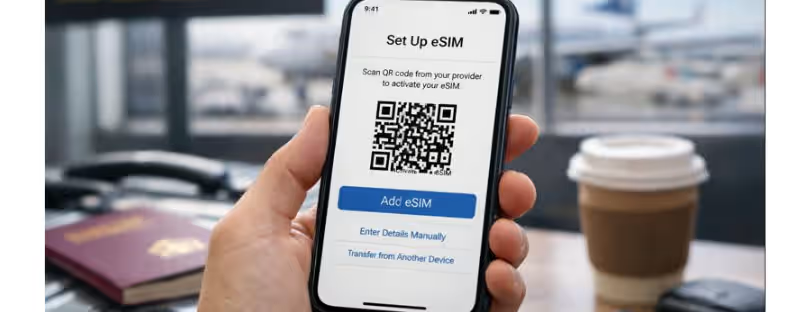
Apps and QR codes work, but the future is more conversational:
- WhatsApp eSIM delivery (already huge in Brazil)
- RCS provisioning in the US
- airline app integrations
- embedded eSIMs in digital wallets
Operators that fail to expand beyond email risk losing share.

What B2C Travel eSIM Providers Will Do Next
Independent eSIM brands won’t sit quietly while operators muscle in. Expect sharper differentiation.
A push for extreme personalisation
Think:
- build-your-own data bundles
- intelligent recommendations
- usage-aware top-ups
- family and group plans
This is where innovators like Yesim, Airhub, Truely and Nomad already outperform operators—they iterate faster.
Freemium becomes mainstream
Offering 500MB or 1GB free is an acquisition strategy borrowed from fintech and gaming.
Expect:
- “free starter eSIM” campaigns
- loyalty-reward eSIMs
- top-up upsells
Bundling with other services
Travel insurance, airport lounges, premium customer support, VPNs, or hotel perks—the future of travel eSIMs is bundled, not standalone.
What 2026 Means for the Travel eSIM Landscape
2026 is shaping up to be the most transformative year in international mobile connectivity since roaming was introduced. The shift no longer revolves around whether eSIM adoption will increase—that’s guaranteed. The real story is the competitive rebalancing happening between operators and the fast-moving independent players who took the early lead.

Operators vs. eSIM Providers: Who’s Better Positioned?
Operators bring:
- subscriber data
- established billing relationships
- regulatory protection
- RCS and SMS reach
Travel eSIM providers bring:
- agility
- global-first thinking
- better UX
- innovative bundling
- aggressive pricing
The future likely won’t crown a single winner. Instead, the market will split between:
- operators targeting their existing base
- eSIM specialists winning new, global-minded travellers
- enterprises bundling eSIMs into broader travel experiences
This dynamic mirrors what happened in fintech: banks still exist, but challenger apps set the pace.
Reliable research from Juniper, GSMA Intelligence, and Omnia all point to the same conclusion: international mobile connectivity is fragmenting—and travellers are the winners.
Conclusion: The Real Reason Operators Are Entering the Travel eSIM Market
The key isn’t that operators suddenly love eSIM technology. It’s that the ecosystem around them changed so dramatically that staying out of the travel eSIM space is now a strategic risk.
Independent eSIM providers proved there’s a massive appetite for low-cost, flexible, app-based connectivity. Device makers removed the friction. Consumers embraced the freedom. And roaming—once a guaranteed revenue stream—became optional.
Operators entering this market in 2026 aren’t a pivot. It’s survival.
But it’s also an opportunity. If they combine their powerful subscriber insights with modern digital experiences—something travel eSIM providers already excel at—the market can evolve into a more competitive, innovative, and traveller-friendly landscape.
The brands that win will be those that deliver:
- transparent pricing
- simple activation
- personalised offers
- global reliability
- and real added value beyond data
Alertify will be tracking every major operator launch through 2026—and the responses from innovators like Yesim, Airhub, Nomad, Airalo, Ubigi and others shaping the next era of travel connectivity.