Ubiquiti Unveils UniFi 5G Max Modems With Dual-SIM & eSIM
Ubiquiti is officially joining the 5G modem race with two new devices that feel purpose-built for modern networks: the UniFi 5G Max and its rugged sibling, the UniFi 5G Max Outdoor. Both slot neatly into the UniFi ecosystem and are aimed at IT teams, property owners, hospitality operators, and businesses that want a stable, carrier-flexible internet backup or even a primary connectivity option.

The headline? Dual-SIM redundancy, PoE support, 2.5GbE networking, and eSIM compatibility — all in compact hardware that fits directly into the UniFi management workflow. It’s a notable move for a brand best known for Wi-Fi, switching, and security appliances, not cellular gear. And that’s exactly why these two launches matter: they bring carrier-grade connectivity into a system many companies already trust.
Designed for Simple Integration Into UniFi Networks
Ubiquiti kept the setup as UniFi-friendly as possible. Both new modems can be powered directly from a PoE switch, meaning no scrambling for power sockets on rooftops, remote rooms, or tricky mounting spots. With 2.5GbE on board, they’re ready for multi-gig environments, positioning them as a serious upgrade over older LTE failover routers that often max out at 1GbE or less.
For anyone managing distributed sites — hotels, rural offices, solar farms, construction sites, even yachts — the hardware feels intentionally engineered for “set it once, manage it from everywhere.”
One caveat: the UniFi 5G Max requires a UniFi cloud gateway to operate, so it’s not a standalone router. It’s more of a cellular modem that feeds into a UniFi-managed network.

Dual SIM, eSIM, and Backup Features Built for Reliability
Both models support two physical nano SIMs, but the real surprise is eSIM support — a feature still rare in enterprise-grade routers.
The UniFi 5G Max uses Dual SIM Single Standby (DSSS) mode, which means one SIM remains active while the second acts as an instant fallback if a network goes down. Users can mix and match SIM types: a physical SIM paired with an eSIM, or two physical SIMs.
Installing an eSIM requires entering a manual activation code — QR activation isn’t supported — and Ubiquiti does mention one US-specific quirk: T-Mobile may show the modem as “incompatible” due to a database issue. Ubiquiti claims this is a carrier-side error, and users simply need to tell support that the device is compatible.
In practice, this friction isn’t surprising. eSIM on routers is still new territory for many mobile operators, even though smartphone eSIM adoption is now mainstream. But the upside is huge: remote provisioning, no physical swapping of SIM cards, and the ability to rotate between carriers without downtime.
Promising 5G Performance, With Trade-Offs Between NSA and SA
Ubiquiti estimates maximum download speeds of up to 3.4 Gbps on non-standalone (NSA) 5G networks, with uploads around 560 Mbps. On standalone (SA) networks, expected download performance drops to roughly half, but upload speeds rise toward 650 Mbps.
These kinds of uplink boosts matter more than most people realize. Hotels syncing cloud systems, construction teams uploading site data, security firms streaming multi-camera feeds — enterprise workloads increasingly push data up just as much as down.
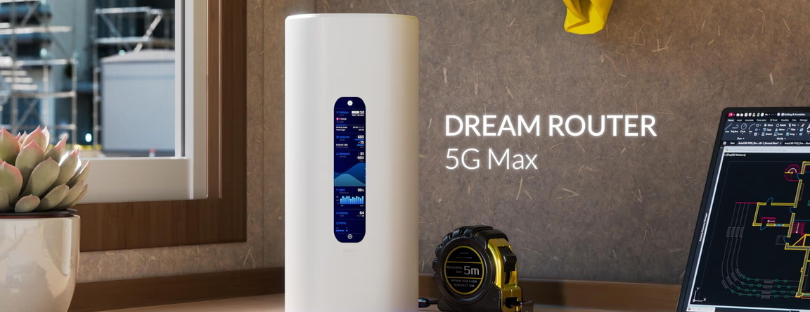
A small built-in display shows network stats, and fallback to LTE and even UMTS is supported. Full-band compatibility depends on the region and operator, so international deployments should check the spec sheet before ordering.

A Rugged Outdoor Model for Harsh Conditions
The UniFi 5G Max Outdoor is simply the tougher version. With an IP67 rating, it’s meant for rooftops, masts, exterior walls, industrial zones, or even vehicles. Ubiquiti suggests it can be mounted directly near a cellular tower’s line of sight to significantly improve signal quality.
For the hospitality and tourism sectors — remote lodges, marinas, glamping sites, mobile offices — outdoor-grade modems usually require specialist brands. Bringing this into the UniFi universe is a practical shift that simplifies both procurement and management.
Pricing and Availability
Ubiquiti lists the UniFi 5G Max at $399, while the UniFi 5G Max Outdoor lands at $459 and is set to begin shipping in January 2026. Both are already live on the company’s online store.
For enterprise buyers accustomed to $700–$1,200 5G failover routers from Peplink, Teltonika, Zyxel, or Cradlepoint, Ubiquiti’s pricing is notably aggressive. And that positioning is intentional: UniFi often undercuts traditional enterprise networking and wins through ease of use.
How These Devices Fit Into the Market H5
Ubiquiti’s entrance into 5G isn’t happening in a vacuum. The market for business-grade cellular modems is heating up as companies diversify connectivity away from single providers. Travel and hospitality operations especially rely on steady uptime — and 5G has become a go-to backup for fiber, with some businesses even running hybrid WAN setups as standard.
Compared with major competitors:
Peplink and Cradlepoint still lead in advanced multi-modem bonding and deep carrier integrations.
Teltonika remains strong on industrial deployments with rich band support and custom configurations.
Zyxel offers competitively priced 5G CPEs but lacks the ecosystem integration Ubiquiti provides.
This is where Ubiquiti stands out: not in raw cellular innovation, but in ecosystem simplicity. Millions of deployments already use UniFi switches, gateways, and APs. Adding 5G as a native component means easier monitoring, easier updates, and less vendor fragmentation — a key trend in enterprise networking, according to reliable sources such as Gartner and IDC, which have both highlighted the shift toward unified network management platforms in 2024–2025.
The takeaway: Ubiquiti isn’t trying to beat the specialist 5G router vendors feature-for-feature. Instead, it’s making cellular connectivity accessible and practical for the huge UniFi user base. For most small businesses, hotels, cafés, and distributed operators, that’s exactly what they’ve been waiting for.