From City Breaks to Nomad Life: The Travellers Who Benefit Most from Ubigi eSIMs
If you’ve ever travelled enough to collect a handful of old SIM cards, you’ve probably come across Ubigi—the eSIM brand owned by Transatel, part of NTT DATA. Ubigi has earned a reputation for reliability and clarity: straightforward data plans, global coverage, and zero gimmicks. Whether you’re travelling for a weekend or working abroad for months, Ubigi’s flexible structure—one-off regional plans, monthly options, and even unlimited tiers—fits a surprising range of traveller profiles.

Below, we map out which types of travellers get the most out of Ubigi’s eSIMs, how to use each plan smartly, and where Ubigi stands among its biggest competitors.
Short-holiday traveller (3–7 days)
For a quick getaway—say, four days in Paris or a week in Lisbon—all you really want is seamless connectivity without surprise charges. Ubigi’s one-off prepaid plans hit that perfectly. You can grab, for instance, a Europe 10 GB / 30-day plan for around US$35 (at time of writing), scan the QR code, and connect instantly upon landing.
The best part? You don’t need to swap or reinstall the eSIM every time you travel. You can simply top up on the same eSIM profile when you revisit Europe next season. And since most of these packs cover multiple European countries, there’s no roaming anxiety when you hop from Spain to Italy.
It’s the low-stress choice for weekend travellers who want coverage that “just works” without subscriptions or contracts.
Business traveller (frequent flyer, recurring trips)
For business travellers who spend as much time in airport lounges as at home, Ubigi’s monthly recurring plans are a clear win. These allow consistent data usage across a region or globally — without the hassle of buying new data packs for each trip.
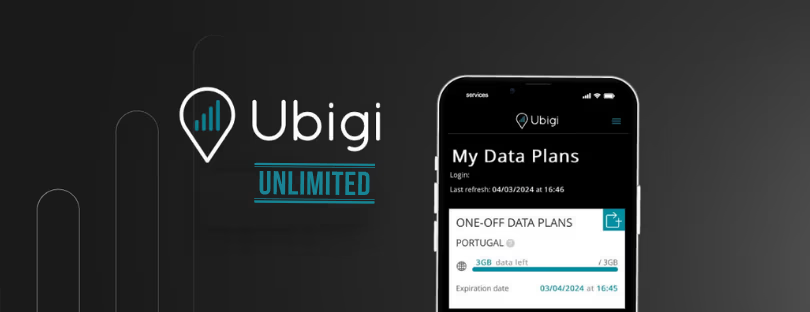
You can activate and manage plans through the Ubigi app on smartphones or through ubigi.me for laptops and tablets. Some areas even offer unlimited monthly options, including a World Unlimited Plan (US$240/month, cancellable after three months) — ideal for executives or consultants who travel constantly and expense their connectivity.
For teams, Ubigi for Business offers centralised billing and pooled data across 200+ destinations, simplifying connectivity management for corporate travel departments.
Digital nomad (long stays, high data use)
If you live on video calls, tether your laptop daily, or switch cities every month, Ubigi’s larger regional or world plans are made for you. Backed by Transatel’s Tier-1 network partnerships, Ubigi provides 5G where available and steady performance across hotspots.
Tethering generally works on Ubigi, though it depends on the local operator and device. (Ubigi’s help pages explicitly describe how to enable it.) For comparison:
- Nomad openly supports hotspot sharing.
- Airalo allows it in most regions, device-dependent.
- Holafly markets unlimited data but restricts hotspot use under fair-use rules (typically 500 MB–1 GB per day).
That makes Ubigi’s openness to hotspot use a practical edge for freelancers and digital nomads who rely on stable data for work.
If you stay longer in one region (say, Southeast Asia or the EU), go for a recurring regional plan. You’ll pay once a month, always know your data limit, and skip the constant top-up cycle.
Family traveller (one planner, multiple devices)
Families face a different challenge: multiple phones, tablets, and streaming-hungry kids. Ubigi’s larger regional data packs offer an easy workaround. Instead of buying four small eSIMs, get a bigger plan—for example, 20 or 30 GB for a month—on one device and share it via hotspot during outings.
Because Ubigi’s regional pricing is competitive (around €15–€25 for generous bundles), this “one plan, shared connection” approach often costs less than managing several eSIMs. It’s also less confusing for less tech-savvy family members.
Just remember to check the hotspot details for your destination—Ubigi typically supports it, but local networks may impose speed or usage limits.

Multi-country trip (interrailing, cruise, or world tour)
If your itinerary spans multiple borders — e.g., interrailing through Europe or hopping continents — Ubigi’s regional and world plans are the stress-free route.
Install the eSIM once, activate a Europe Regional Plan (valid across Schengen countries), or opt for the World Unlimited monthly plan if your trip covers several regions. You’ll maintain connectivity without juggling SIM cards or hunting for new QR codes mid-journey.
For hybrid trips (e.g., EU + North Africa), compare costs between a global monthly plan versus two regional bundles. The global option often wins when you’re on the move for several weeks.
How Ubigi’s plans line up with real-life travel
| Plan Type | Ideal for | Key Benefits |
|---|---|---|
| One-off prepaid (country/region) | Short trips, single-region holidays | Predictable cost, no contract, quick setup |
| Monthly / recurring | Business travellers, digital nomads | Ongoing coverage, no reinstallation |
| Unlimited monthly | Frequent flyers, world travellers | One plan, global reach, stable billing |
| Business plans | Teams, companies | Centralised billing, multi-user control |
Where Ubigi stands strong
- Global reach: Over 200 destinations, including 5G in many major markets, via NTT DATA’s global carrier network.
- Simple user flow: Quick install, clean app interface, transparent top-ups.
- Versatile structure: Both pay-once and subscription-style plans are easy to switch between.
- Credible backing: As part of NTT DATA, Ubigi benefits from enterprise-level network reliability.

Where to compare
- Airalo—unmatched breadth of local country packs; best for chasing the lowest single-country price.
- Nomad eSIM—strong on hotspot policy and transparent pricing; great for digital nomads.
- Holafly—unlimited data and broad marketing appeal, but often limited hotspot access and fair-use caps.
Each has its niche. Ubigi sits comfortably between affordability and network reliability—perfect for travellers who want predictability and global coverage rather than the absolute cheapest per-GB deal.
Market context and trends
The eSIM market is expanding fast. GSMA Intelligence forecasts that by 2030, over 1 billion consumer eSIM connections will be active worldwide. As more phones become eSIM-only, travel-focused brands like Ubigi, Airalo, and Nomad are competing to offer flexible, high-speed global data without roaming shock.
Industry analysts at Juniper Research and Telecoms.com expect travel eSIM usage to grow by over 300% by 2028, fuelled by the rising number of eSIM-enabled iPhones, Galaxy devices, and laptops. In that environment, trust, stability, and clear usage policies matter more than gimmicks—and that’s exactly where Ubigi positions itself.
Conclusion: When Ubigi makes the most sense
If your travel style leans toward flexibility, simplicity, and coverage reliability, Ubigi is hard to beat.
For short trips, it’s one of the easiest prepaid setups available. For frequent or long-term travellers, its monthly and unlimited plans remove the repetitive admin that plagues cheaper, single-country eSIMs. And for business users, its corporate backbone through NTT DATA gives confidence in service continuity and data quality.
Ubigi lands right in the professional middle—premium-practical, transparent, and built for travellers who want their connectivity sorted before they pack.
As eSIM adoption accelerates, brands with carrier-grade reliability and user-first design—like Ubigi—are shaping what travel connectivity looks like for the next decade.