Grab Indonesia Adds Tunz eSIM Inside App for Global Travel
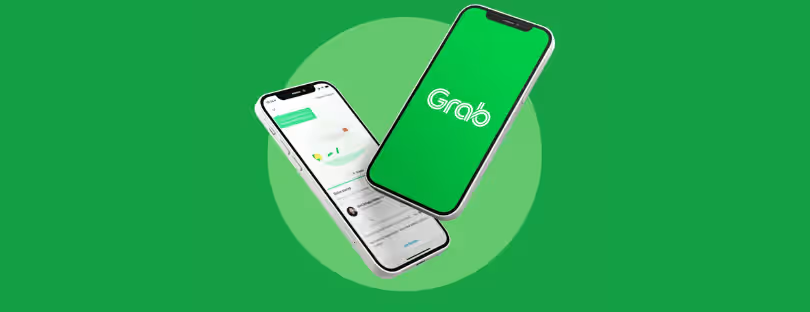
If you have ever landed in a new country juggling airport Wi-Fi, SIM kiosks, and ominous roaming warnings, this will sound very familiar. DT One has officially launched Tunz eSIM inside Grab Indonesia, allowing Indonesian travellers to buy and activate global mobile data directly within the Grab app, either before departure or moments after landing.
No new app. No physical SIM. No telecom counter. Just a few taps in an app millions of Indonesians already use every day.
This is the first time eSIM connectivity has been embedded into Grab in Indonesia. It is not a quiet beta or a regional experiment. The rollout is exclusive to Indonesia and designed specifically for Indonesians travelling abroad, which makes the move far more strategic than it might appear at first glance.
It is also worth noting a branding shift many users may not yet realise. The Dent app is now Tunz eSIM, a rebrand that positions the product more clearly as a global connectivity layer rather than a niche crypto-telecom experiment. Inside Grab, it simply shows up as a practical travel utility, which is exactly the point.
Why this matters for Indonesian travellers
Connectivity remains one of the most fragile parts of international travel. Flights are smoother, payments are increasingly digital, and navigation is effortless, yet mobile data abroad still feels outdated. Tunz eSIM tackles that friction head-on.
With Tunz eSIM, Grab Indonesia users can purchase mobile data before departure or immediately upon arrival overseas, activate it in seconds, and connect instantly. There is no SIM swapping, no shop visits, and no need to gamble on expensive roaming bundles.
For travellers, this means maps load instantly, ride-hailing works the moment they step outside the airport, and messaging apps stay online without stress. For business travellers and digital nomads, it removes the awkward offline gap between landing and getting connected, a gap many frequent travellers have simply learned to tolerate.
This is not a nice-to-have feature. It solves a real, persistent travel problem at exactly the right moment.

A super app taking the idea seriously
Grab has long positioned itself as more than transport. In Indonesia, it has evolved into a true super app spanning mobility, payments, food delivery, and lifestyle services. Adding international mobile data fits neatly into that ecosystem.
Instead of pushing users elsewhere for connectivity, Grab keeps the entire travel journey inside one platform. That is powerful.
Rivana Mezaya, Director of Digital and Sustainability, Grab Indonesia said:
“Connectivity is essential when people travel, yet it’s often inconvenient to arrange. With Tunz eSIM now available directly in the Grab app, our users can stay connected abroad easily and instantly. This partnership allows us to extend practical, everyday services that support users beyond borders.”
That last sentence matters. Grab is no longer positioning itself as useful only at home. It is steadily becoming a travel companion that works beyond Indonesia’s borders.
DT One’s quiet but strategic role
DT One is not a consumer brand most travellers recognise immediately, but it plays a crucial role behind the scenes. The company enables digital platforms to offer cross-border services by connecting them to a global network of mobile operators and partners.
Through Tunz eSIM, DT One already supports on-demand mobile data access in more than 140 countries. That scale is what makes an integration like this possible without friction or complex user education.
Peter De Caluwe, Chief Executive Officer of DT One said:
“Staying connected when travelling is still more complicated than it should be. By launching Tunz eSIM on Grab Indonesia, we’re removing friction from international connectivity and making it available instantly, through a platform millions already use every day. This is about solving a real travel problem at scale.”
This is an infrastructure meeting distribution. DT One brings the telecom backbone. Grab brings reach, trust, and daily usage.
The second eSIM move inside Grab
This is not Grab’s first step into embedded connectivity. Earlier, Grab users gained access to global eSIM connectivity from Firsty and Knowroaming directly through the Grab app.
The pattern is becoming clear. Grab is not experimenting randomly. It is building a connectivity layer inside its ecosystem, testing different partners, and normalising the idea that mobile data should be as accessible as transport or payments.
For travellers, that means less planning. For the industry, it signals where distribution power is shifting.
How does this compare to standalone eSIM players?
The global eSIM market has exploded over the last two years. Consumer-facing brands like Airalo, Airhub, and GigSky have educated travellers and proven demand. Telecom-led offerings from operators and device manufacturers are expanding in parallel.
What makes the Grab and Tunz launch different is context.
Most eSIM players still live in standalone apps or websites. Users must search, compare, download, and trust a new brand before travelling. Grab removes that entire decision layer. The eSIM becomes a built-in utility rather than a separate product.
This reflects a broader industry shift. Connectivity is moving from a standalone purchase to an embedded service. Airlines bundle data with tickets. Banks add travel eSIMs to premium cards. Super apps integrate connectivity alongside payments and mobility.
According to GSMA reports and multiple telecom analysts, embedded connectivity and eSIM-enabled services are becoming a core layer of the digital travel stack, not an add-on. DT One’s approach aligns neatly with that trajectory.
Why Indonesia is a smart starting point
Indonesia is one of the most mobile-first markets globally. App adoption is high, outbound travel is growing, and Grab already enjoys massive daily engagement. That combination makes Indonesia an ideal testbed for embedded connectivity.
By launching exclusively in Indonesia, DT One and Grab can refine user experience, pricing models, and usage patterns before expanding elsewhere. It also sends a clear signal that Southeast Asia is not simply following global eSIM trends, but actively shaping them.
For Indonesian travellers, the benefit is immediate. Global connectivity without relying on unfamiliar foreign apps or providers.
Conclusion
This launch is not really about eSIM technology. It is about where connectivity belongs in the travel journey.
Compared with standalone eSIM brands, embedded players like Grab operate closer to the moment of need. They remove friction, reduce choice paralysis, and turn mobile data into invisible infrastructure. That is a powerful advantage as the market matures.
We are moving toward a world where travellers should not think about SIM cards at all. They should simply be connected. Super apps, banks, airlines, and platforms with daily engagement are increasingly the ones delivering that experience, while telecom enablers like DT One operate quietly in the background.
For the industry, the message is clear. Distribution and context now matter as much as coverage and price. The winners will not always be the loudest consumer brands, but the ones that integrate seamlessly into how people already travel, pay, and move.
For Indonesian travellers, the impact is immediate and practical. For the global travel connectivity market, this is another strong signal that the future of roaming is not sold separately. It is embedded, invisible, and expected.