RateHawk Targets Major U.S. Expansion for Travel Advisors in 2026
RateHawk is making a serious play for the U.S. travel advisor market. The B2B booking platform has confirmed plans to significantly expand its U.S. footprint in 2026, backed by a fully dedicated commercial team of 25 specialists now operating nationwide.

For a market that has historically been fragmented across multiple systems, suppliers, and host networks, this move signals more than just growth. It signals intent.
U.S. momentum that is hard to ignore
RateHawk’s U.S. expansion is not speculative. It is driven by numbers that stand out even in a strong post-pandemic travel market. In Q3 alone, the company recorded a 70 percent year-over-year increase in net transaction value. At the same time, its U.S. partner base grew by 37 percent, reaching 15,500 travel professionals nationwide.
That growth is being fueled by adoption across some of the most influential host networks and agency groups in the country. While RateHawk has long been well established in Europe, the Middle East, and Latin America, the U.S. is now clearly moving from a secondary growth market to a strategic priority.
Globally, more than 110,000 travel professionals already use RateHawk. The U.S. share of that total is still relatively small, which explains why the company sees so much upside heading into 2026.
Why U.S. advisors are paying attention
For U.S. travel advisors, RateHawk’s appeal is practical rather than flashy. The platform is designed to solve problems that agents deal with every day.
One of the biggest draws is margin control. RateHawk allows advisors to customize commissions, giving them more flexibility to price itineraries in a way that reflects their value and service level. This is especially relevant in the U.S. market, where advisors increasingly operate as consultants rather than pure resellers.
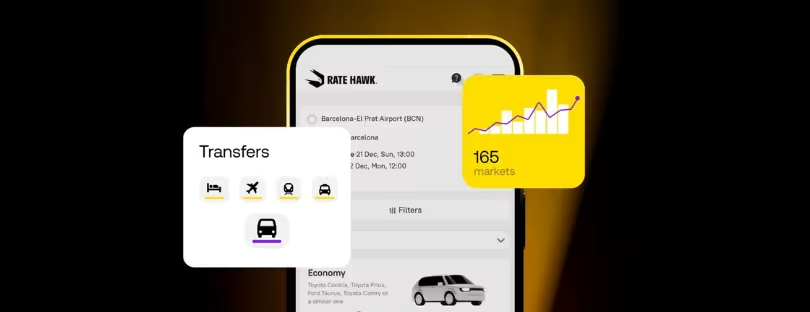
Speed is another factor. Advisors can search hotels, flights, transfers, and car rentals in a single platform, reducing the need to jump between multiple systems. For agents building complex or multi-city itineraries, that time saving adds up quickly.
The scale of supply also matters. RateHawk offers access to 2.9 million properties worldwide, including more than 220,000 hotels under direct contract. That direct supply is what allows the platform to compete on pricing while still supporting advisor margins.
What U.S. travelers are booking through advisors
RateHawk’s U.S. data reflects broader booking trends seen across the industry. Europe, Mexico, and the Caribbean continue to dominate demand, but there is also a noticeable rise in multi-city itineraries and experience-driven trips.
Distinctive accommodation types are a strong growth area. Bookings for cottages, glamping properties, and ryokans grew by 41 percent over the past 12 months. This aligns with findings from Phocuswright and Skift, both of which have highlighted growing consumer interest in unique stays and local experiences rather than standardized hotels.
For advisors, having this type of inventory in one place is becoming essential. Clients are asking for more customized trips, and platforms that only offer traditional hotel content risk falling behind.
 Technology as a differentiator, not a buzzword
 Technology as a differentiator, not a buzzword
Behind the scenes, RateHawk is positioning itself as a technology-first platform rather than just another bedbank. The company processes around 10 billion rates daily and uses a recommendation system designed to surface the most relevant options quickly.https://alertify.eu/?s=ratehawk
This focus on efficiency is particularly relevant in the U.S., where advisor time is often the most limited resource. According to U.S. Travel Association and ASTA data, demand for personalized travel planning continues to rise, even as travelers expect faster responses and more transparency.
RateHawk also offers API connectivity for large networks, tour operators, and travel tech platforms. That makes it easier for enterprise-level players to integrate RateHawk supply into their own ecosystems, something competitors like Hotelbeds and WebBeds have long leaned on.
The mobile factor
RateHawk’s mobile app is another piece of the puzzle. Available for both Android and iOS, it mirrors the full functionality of the desktop platform. Advisors can search, book, and manage reservations on the go.
While mobile tools are not unique in B2B travel anymore, adoption still varies widely by platform. As more advisors operate remotely or outside traditional office setups, mobile access is shifting from a nice-to-have to a baseline expectation.
Where RateHawk fits in a crowded B2B landscape
The U.S. B2B travel tech market is already competitive. Players like Travelport, Sabre, Amadeus, Hotelbeds, and newer integrated platforms all compete for advisor attention. What differentiates RateHawk is its blend of broad supply, direct contracts, flexible commissions, and a deliberately advisor-centric positioning.
Unlike traditional GDS platforms, RateHawk is not trying to be everything to everyone. And unlike pure accommodation wholesalers, it is building a more complete itinerary-focused workflow. That middle ground is increasingly attractive as advisors look to consolidate tools without sacrificing choice.
According to multiple industry forecasts, including those from Statista and Phocuswright, the U.S. travel agency market is projected to reach around USD 172 billion by 2035. Growth will be driven less by volume and more by complexity, customization, and service value. Platforms that help advisors work smarter rather than harder are likely to win.
Conclusion: why this matters for the next phase of U.S. travel advising
RateHawk’s U.S. expansion is not just about headcount or market share. It reflects a broader shift in how travel advisors choose technology partners. The days of tolerating slow systems, rigid commissions, and fragmented workflows are fading.
By investing early in local teams, listening closely to advisor demand, and aligning its product roadmap with real booking behavior, RateHawk is positioning itself as a serious long-term player in the U.S. market. It will still need to prove it can scale support and education at the same pace as growth. But if current momentum continues, 2026 could mark the point where RateHawk moves from being an emerging option to a default consideration for U.S. travel professionals.
For advisors navigating an increasingly complex landscape, that kind of competition is ultimately a good thing.