O2 Spain Offers 3 Free Days of Travel eSIM
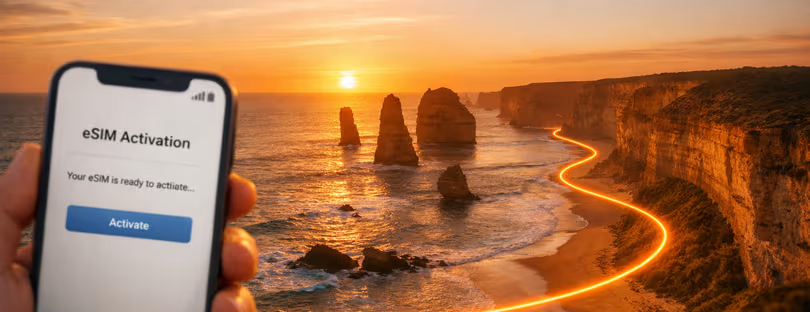
Something interesting is happening in Spain. O2 Spain has launched a promotion that gives customers three days of travel eSIM service for free. Anyone who signs up through the My O2 app by 17 April 2026 can try out eSIMFlag at no cost, as long as they are new to the service.
On the surface, this looks like a simple customer perk. A nice little bonus for O2 users heading abroad.
But if you zoom out, it tells a much bigger story about how traditional telecom brands are adapting to the eSIM era.
Why this matters more than it sounds
For years, travel eSIMs have lived mostly outside the operator ecosystem.
Consumers discovered them through Google searches, travel blogs, airport QR codes, or word of mouth. Independent providers built global data marketplaces. Meanwhile, operators watched roaming revenues slowly erode.
Now we are seeing something different.
Instead of competing directly on roaming bundles, O2 Spain is effectively saying: let’s integrate the travel eSIM experience inside our own app environment. Let’s keep the customer relationship, even when they leave the country.
Three free days is not random. It is long enough to:
- Cover a short city break
- Test the onboarding experience
- Reduce first-trip friction
- Show customers that alternative roaming models exist
And crucially, it lowers the psychological barrier to trying eSIM for the first time.
That matters in a market where adoption is growing steadily but still not universal.
Who is eSIMFlag?
eSIMFlag positions itself as a global travel eSIM provider offering prepaid data packages across multiple destinations. Like many players in this space, it focuses on instant activation, QR-based setup, and avoiding traditional roaming charges.
The partnership with O2 Spain is interesting because it blends two worlds:
- The established telco brand with a loyal domestic base
- The agile travel eSIM platform is built for cross-border use
This hybrid model is becoming more common. Operators do not necessarily want to build global travel eSIM infrastructure from scratch. It is faster to partner.
The bigger roaming tension
The eSIM market has grown rapidly in the past few years. According to forecasts from industry analysts such as IDC and GSMA Intelligence, eSIM adoption in smartphones is accelerating, with a significant portion of global connections expected to be eSIM-enabled by the end of the decade.
At the same time, roaming economics are under pressure.
European customers already enjoy “Roam Like at Home” within the EU. Outside Europe, price sensitivity is rising. Travelers are increasingly aware that:
- Roaming bundles can be expensive
- “Unlimited” often has fine print
- Airport SIM cards are rarely the cheapest option
Travel eSIM providers filled that gap.
Now operators are experimenting with different responses:
- Building their own branded travel eSIM platforms
- Partnering with aggregators
- Offering white-label solutions inside their apps
- O2 Spain’s three-day giveaway sits squarely in that third category.

Trial as an acquisition strategy
Free trials are powerful.
In the consumer eSIM market, we have seen similar tactics before. Some global players offer small data allowances for free to encourage first-time installation. Others run limited-time campaigns tied to events or travel seasons.
The difference here is distribution.
O2 is not pushing this via search ads or influencer campaigns. It is leveraging its existing app user base. That changes the economics completely. Customer acquisition cost is dramatically lower when the relationship already exists.
It also reframes the narrative. Instead of positioning travel eSIMs as a disruptive alternative to telcos, this approach embeds them into the telco experience.
What this says about the market
From an industry perspective, this is not just a promotion. It is a signal.
Operators are starting to accept that travel connectivity is no longer purely a roaming upsell. It is a digital service layer.
By partnering with providers like eSIMFlag, O2 Spain acknowledges that customers expect flexibility, instant activation, and app-based control.
The next question is scale.
Will this remain a short-term campaign? Or will we see permanent travel eSIM marketplaces inside operator apps across Europe?
We are already watching similar experiments in other regions, where carriers integrate global data options into digital wallets and self-care platforms.
If these models gain traction, independent travel eSIM brands will face a new kind of competition: not from roaming tariffs, but from embedded operator ecosystems.
Conclusion: integration beats resistance
For years, the narrative was simple. Travel eSIMs versus traditional roaming.
What O2 Spain is doing suggests a more nuanced future.
Instead of fighting the trend, operators may increasingly integrate it. Rather than losing customers to external apps, they can keep them inside their own digital environment while outsourcing the global layer to specialist providers.
Compared to purely standalone eSIM marketplaces, this model benefits from trust and distribution. Compared to traditional roaming bundles, it benefits from flexibility and cost transparency.
Industry data from GSMA and IDC consistently shows that digital-first connectivity models are reshaping user expectations. The winners will not necessarily be those with the cheapest gigabyte. They will be those who control the customer interface.
O2 Spain’s three free days might look small.
But strategically, it reflects a much bigger shift in how travel connectivity is being positioned inside the telecom stack.