O2 Slovakia Expands eSIM Support for Samsung Galaxy Phones
If you’re using a Samsung Galaxy phone in Slovakia, there’s some genuinely good news coming out of O2. The operator has been gradually widening its eSIM support, and Samsung users—especially those on newer models—are finally seeing smoother, faster onboarding with digital SIMs. But as always with Samsung, there’s a twist: regional software variations still matter, and they can make or break your eSIM experience.

For anyone trying to avoid the old SIM-card shuffle or set up connectivity instantly from the couch, here’s what’s changing and what you need to check before considering the switch.
O2 Slovakia’s eSIM rollout: what’s actually available now
O2 Slovakia now offers eSIM activation for both new and existing customers, and the experience is getting much more streamlined than it was even a year ago. If you’re signing up for a new flat-rate plan through the O2 app, you can activate your plan with an eSIM immediately—no store visit, no physical pickup, and no waiting for a courier. It is essentially the frictionless setup that European operators have been promising for years.
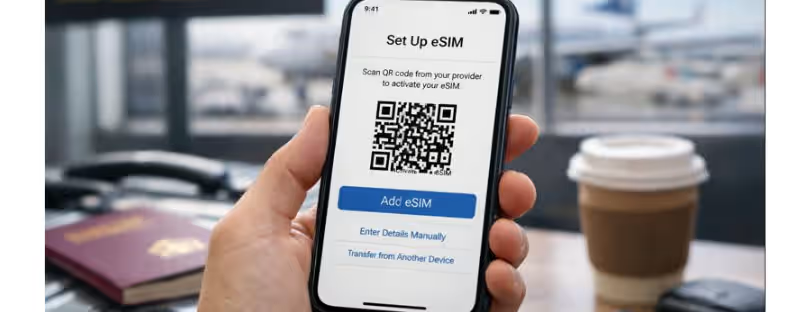
For existing customers, the operator also allows conversion from a physical SIM to an eSIM. This usually involves requesting the switch through customer support or via the app, after which you receive a QR code. Scan it in your phone’s SIM manager, and your profile installs within minutes.
Activation itself follows a now-standard workflow: you scan O2’s QR code, the phone downloads your eSIM profile, and you confirm installation inside your Samsung settings. It’s not groundbreaking, but it finally brings O2’s process in line with international operator practices.
Samsung Galaxy compatibility: mostly yes… unless yours comes from the wrong region
If you own a recent Samsung Galaxy handset—think Galaxy S20 and newer, the Note series from the Note 20 generation, or any of the Z Flip and Z Fold devices—you should technically have eSIM support. Samsung has included the hardware for years.
But here’s the catch that continues to frustrate European users: Samsung sometimes disables eSIM functionality at a regional firmware level. This means you might have a perfectly capable flagship device, but if it was originally purchased in a market where eSIM wasn’t enabled at launch, the toggle may simply not appear.
Users in Slovakia have reported this most often on older S20/S21 FE models and a handful of units originally purchased in Canada or Slovakia at a time when carriers weren’t actively pushing eSIM. Some variants shipped without the feature activated, and software updates haven’t always resolved it.
The most reliable way to check is inside your phone’s settings—not via spec sheets or retailer listings.

How to confirm if your Samsung Galaxy supports eSIM
Checking takes 10 seconds:
Go to Settings → Connections → SIM manager → Look for Add eSIM.
If that option appears, you’re good to go with O2 Slovakia. If it doesn’t, your device likely has region-restricted firmware, even if the hardware itself is capable.
What this shift means for Samsung users on O2
For years, Slovak operators lagged behind Western Europe in making eSIM mainstream—especially for Android users. Apple forced rapid adoption thanks to its iPhone 14 eSIM-only move in the US, but Samsung users have often had to deal with uncertainty, carrier-by-carrier whitelists, or device-specific limitations.
O2 Slovakia normalizing instant eSIM activation for Samsung customers signals that the operator is finally aligning with broader European trends: digital-first onboarding, app-based customer journeys, and reduced reliance on physical stores.
It’s part of a quiet but important shift across the industry. Operators want fewer physical SIM logistics. Customers want faster setup and remote provisioning. Device makers want to eliminate SIM trays entirely. O2’s move fits neatly into this ecosystem.
How O2 compares with other players in the Slovak market
Among Slovak operators, eSIM support has historically been inconsistent. Telekom and Orange were quicker to market with eSIM offerings, especially for smartwatches and premium smartphones. Where O2 is catching up now is in ease of activation—instant activation through the app is something not all regional players execute equally well.
What’s interesting is how this mirrors broader CEE market dynamics. Operators in neighboring Czechia and Austria leaned into eSIM early for postpaid users, and roaming-heavy markets like Hungary have seen rising consumer demand. The trend is clear: as eSIM adoption accelerates globally—GSMA Intelligence reports that more than 260 mobile operators now support consumer eSIM—Smaller and mid-size European carriers are stepping up to avoid being left behind.
O2 Slovakia’s improvements aren’t happening in isolation; they’re part of a regional push to modernize onboarding and reduce churn. When onboarding is as simple as scanning a QR code, switching becomes easier—and operators know it. So enabling seamless eSIM activation is both a customer-experience upgrade and a competitive survival strategy.


Broader Samsung trends reinforcing the shift
Another factor at play: Samsung itself is moving toward stronger eSIM standardization. With the Galaxy S24 series shipping with dual eSIM capability in many markets, and the company rolling out firmware updates enabling eSIM on midrange devices like certain A-series models, pressure is growing on carriers to support Android eSIM just as fully as they support Apple’s.
The region-lock issue will continue to complicate user experience—especially in Europe, where cross-border device buying is common—but the direction of travel is clear: universal eSIM support is becoming the baseline, not the exception.
Conclusion: O2’s eSIM support puts Samsung users on firmer digital footing
O2 Slovakia’s upgraded eSIM support is more than a technical footnote—it brings the operator closer to what consumers expect in 2025: fast digital activation, no stores, no plastic, and no friction. Samsung users benefit the most, finally gaining parity with iPhone owners in terms of onboarding simplicity. But the regional firmware trap still lingers, so device-level checks remain essential.
Compared with competitors like Telekom and Orange, O2 is narrowing the gap, particularly in user experience and app-based activation. And in the bigger picture, this aligns with global momentum: GSMA, device makers, and operators worldwide see eSIM as a critical step toward the fully digital mobile ecosystem.
If anything, O2’s move signals that Slovakia is catching up to European leaders—and for Samsung Galaxy users, that shift is long overdue.