In-Factory eSIM Provisioning Takes Stage at MWC
Most IoT strategies still treat connectivity as something that happens after the device is built.
The hardware rolls off the line. Then someone figures out which operator to use. Then profiles are provisioned. Then logistics tries to untangle regional SKUs. Then, finance asks why roaming costs are unpredictable.
It works. Until it doesn’t.
At scale, that downstream approach becomes friction. And that is exactly the friction Acceleronix, IDEMIA Secure Transactions, and Tele2 IoT are targeting with the launch of their In-Factory Profile Provisioning Early Access Program at MWC Barcelona in less than 2 weeks.
This is not just another eSIM announcement. It is an architectural statement.
The Hidden Cost of “We’ll Fix It Later”
For years, IoT connectivity has been handled downstream. Devices are built. Then connectivity is figured out.
Regional SKUs. Local carrier swaps. Post-production profile downloads. Manual staging. Emergency re-provisioning when something breaks. Finance teams trying to reconcile roaming invoices that were never forecast properly.
It works. Until it scales.
As IoT deployments grow, the friction moves from coverage to control. The question is no longer “Can this device connect?” It is “Can we manage connectivity at an industrial scale without creating operational chaos?”
That is the context in which In-Factory Profile Provisioning matters.
What IFPP Actually Changes
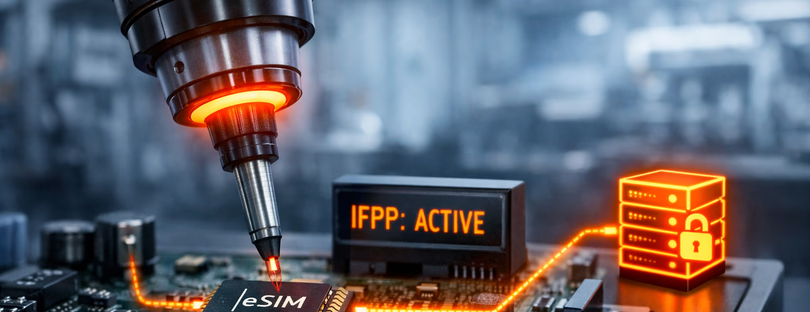
The IFPP Early Access Program allows OEMs to preload mobile network operator profiles onto eSIMs during the manufacturing process.
One eSIM part number. One SKU.
Instead of building separate hardware batches per region or negotiating connectivity after devices leave the production line, profiles are securely bound in the factory.
Devices ship ready to connect.
This is not just about convenience. It is about collapsing complexity. Inventory becomes simpler. Deployment timelines shorten. Activation friction drops. And most importantly, connectivity becomes part of production architecture rather than a patch applied later.
At MWC Barcelona, visitors will see live demonstrations of this workflow. Not slides. Not theory. Factory-time provisioning in action.

The Stack Behind the Announcement
What makes this announcement interesting is not just the idea of IFPP. It is the collaboration model.
Acceleronix contributes orchestration, SIM lifecycle control, and factory tooling. IDEMIA Secure Transactions provides IFPP-ready IoT eSIM technology and quantum-safe cryptographic binding and delivery of MNO profiles. Tele2 IoT delivers managed global IoT connectivity and operator profiles.
In other words, provisioning logic, secure profile technology, and operator connectivity are integrated rather than stitched together.
Gal Olshinka, Acceleronix Director, framed it this way:
“Acceleronix is leading the industry with our IFPP- and SGP.32-enabled solution, our SIM orchestration, and our pan-regional IoT connectivity. This new IFPP Early Access Program demonstrates our commitment to eSIM technology and reflects our focus on streamlining the IoT device and connectivity lifecycle to support scalable IoT solutions. We’re delighted to have collaborated with IDEMIA Secure Transactions and Tele2 IoT to create this partnership, and we’re proud to bring it to MWC26 to showcase how IFPP simplifies device provisioning at scale, reduces operational risk, and enables out-of-the-box connectivity as devices leave the production line.”
The phrase operational risk reduction is not marketing filler. In large deployments, provisioning errors, mismatched profiles, and region-locked stock create real financial exposure.
Why Quantum-Safe Is Not Just a Buzzword
One of the more strategic elements here is the quantum-safe design.
Factories are often offline or air-gapped for security reasons. Provisioning connectivity profiles in those environments requires high cryptographic integrity. IDEMIA Secure Transactions is embedding post-quantum cryptographic principles into the IFPP binding process.
Philippe De Oliveira, Senior VP Auto/IoT Connectivity Services at IDEMIA Secure Transactions, explained:
“IFPP marks a turning point for OEMs to significantly simplify and optimize the manufacturing process for connected devices. By bringing together our expertise in connectivity solutions, in particular eSIM SGP.32, and our quantum-safe cryptography, along with Acceleronix’s factory orchestration capabilities and Tele2 IoT’s IoT connectivity leadership, we are proving – in-factory provisioning – which is not theoretical — it is live, scalable, and ready for industrial adoption today.”
The reference to SGP.32 matters. GSMA’s IoT eSIM framework is evolving, and alignment with emerging specifications such as SGP.42 signals that this is built for where the standards are heading, not where they were five years ago.
Tele2 IoT’s Role in the Equation
Provisioning is meaningless without connectivity depth. Tele2 IoT adds managed global IoT connectivity and operator profile distribution to the stack.
Onur Kasaba, Managing Director of Tele2 IoT, put it simply:
“Tele2 IoT is proud to collaborate with Acceleronix and IDEMIA Secure Transactions to bring this IFPP Early Access Program to life. By combining our managed global IoT connectivity and provisioning capabilities with in-factory profile provisioning, we’re enabling OEMs to ship devices that are ready to connect straight from the factory. This approach significantly simplifies the IoT lifecycle, reduces operational complexity, and supports scalable, secure deployments worldwide.”
That lifecycle simplification is the core value proposition. Not coverage. Not price. Control.

How This Compares to the Market
In-factory eSIM strategies are not unique to one vendor. Thales, Giesecke+Devrient, and Kigen have all been pushing secure eSIM and remote provisioning frameworks. What differentiates this initiative is the emphasis on orchestration at manufacturing time and the explicit integration of quantum-safe cryptography with managed operator profiles.
The IoT connectivity market is shifting from raw connectivity resale to orchestration and governance layers. According to GSMA Intelligence and IDC research, scale challenges in IoT deployments increasingly stem from lifecycle complexity rather than radio access limitations.
That is the structural tension this program addresses.
Instead of solving connectivity at the network edge, it embeds it at the production origin.
What To Watch at MWC
The real question at MWC will not be whether IFPP works technically. It will be whether OEMs view factory-time provisioning as a competitive necessity.
If the industry continues to move toward large, distributed, cross-border IoT deployments, then the cost of post-production connectivity chaos becomes harder to justify.
Embedding provisioning upstream compresses time-to-market, reduces SKU sprawl, and introduces traceability from day one.
Conclusion
Connectivity is moving closer to the source.
The IFPP Early Access Program is less about a feature launch and more about redefining where connectivity belongs in the value chain. While other players focus on remote provisioning flexibility after deployment, Acceleronix, IDEMIA Secure Transactions, and Tele2 IoT are pushing provisioning into the factory itself, wrapped in orchestration logic and quantum-safe design.
If GSMA’s evolving eSIM specifications continue to mature and if IoT deployments keep scaling across borders and regulatory zones, factory-level control may shift from innovation to expectation.
The battleground for IoT connectivity is no longer only the network. It is the production line. And at MWC Barcelona in 13 days, that shift will be on display.