Roamless – Global Travel Connectivity Startup – Raises $12M to Fix Broken Roaming
Raising money is never just about the number. But when a travel connectivity company raises $12 million and openly says it wants to become the world’s first truly global mobile operator, it is worth paying attention.

This week, the company announced a $12 million Series A round, bringing total funding to $18 million in under three years since its founding in 2023. The round was led by Rasmal Ventures, with strong participation from Shorooq and Revo Capital. Finberg and JIMCO, part of Abdul Latif Jameel’s investment arm, also joined the round.
Funding announcements often come wrapped in big words. What makes this one interesting is the timing and the problem it claims to solve. Cross-border mobile connectivity remains one of the most frustrating parts of modern travel, despite years of progress in eSIMs, global data plans, and roaming reform.
This company is betting that the problem is not just pricing or coverage, but fragmentation.
Why Cross-Border Connectivity Still Feels Broken
Most travelers recognize the pain instantly. You can stream a movie at 35,000 feet using onboard Wi-Fi, land in a major international airport, and suddenly struggle to get affordable, reliable mobile data.
Despite eSIM adoption growing fast, connectivity is still split across local SIMs, regional eSIM plans, roaming bundles, airline Wi-Fi, and inconsistent network handoffs. Even frequent travelers often juggle multiple providers or apps.
The core issue is structural. Traditional mobile operators are national by design. Roaming agreements are layered on top, often expensive, slow to innovate, and not built for modern usage patterns like remote work, real-time navigation, or always-on messaging.
This is the gap global connectivity startups are racing to fill.
What the Company Is Actually Building
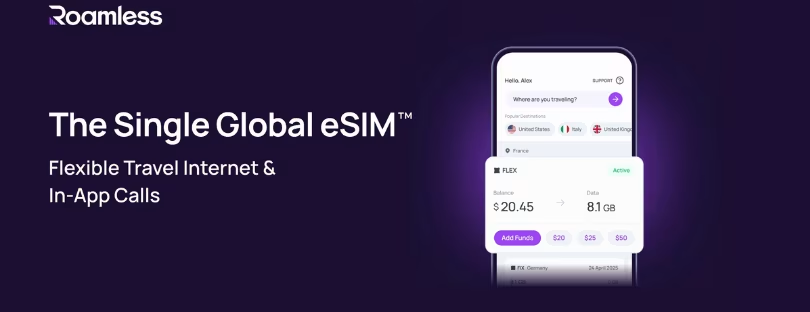
Rather than positioning itself as just another travel eSIM provider, Roamless describes itself as a global mobile operator built for travel from day one.
Today, it serves more than one million travelers across 200+ countries and territories. According to the company, revenue and usage have grown nearly five times year over year, a strong signal in a crowded market where many smaller players struggle to scale beyond early adopters.
The product vision goes beyond selling data packages. The goal is an all-in-one travel connectivity app that combines global network access, mobile service management, and seamless cross-border usage under a single identity.
In simple terms, the company wants travelers to stop thinking about SIMs, roaming zones, or country plans entirely.

Where the $12M Will Go Next
According to the company, the new capital will be focused on four main areas.
Network expansion
The priority is deeper and more consistent coverage, especially in regions where handoffs between networks still cause drops in speed or reliability. This means more direct relationships with local operators and better orchestration across networks.
Global go-to-market scaling
So far, much of the growth has been organic or driven by early adopters. The next phase includes expanding partnerships with airlines, travel platforms, and enterprise travel programs.
Customer support as a differentiator
Connectivity issues are stressful when you are abroad. The company says it plans to raise the bar on customer support, moving faster than competitors that rely heavily on self-service or delayed ticket systems.
Stronger customer and supplier partnerships
This includes deeper integration with suppliers and more tailored solutions for frequent travelers, digital nomads, and business users.
How This Fits Into the Wider eSIM and Travel Tech Market
This funding round lands at a critical moment for the eSIM industry.
According to GSMA, more than half of smartphones shipped globally now support eSIM, and that number continues to rise. Apple’s move to eSIM-only devices in the US accelerated consumer awareness, while Android manufacturers followed quickly.
At the same time, the market is becoming more competitive. Players like Airalo, Nomad, GigSky, Yesim Truely, and regional specialists have helped normalize buying data before travel. Traditional operators are also launching travel-focused eSIM products, often tied to existing roaming brands.
What separates the more ambitious startups is not coverage alone, but control.
Companies aiming to become global mobile operators are trying to own more of the connectivity stack rather than reselling fragmented plans. This requires capital, strong operator relationships, and long-term patience.
That is where this Series A matters.
 cialists
Investors Are Betting on Scale, Not Just Growth
The investor lineup is telling. Rasmal Ventures and Shorooq have been increasingly active in infrastructure-adjacent technology, while Revo Capital has a strong track record in scaling regional tech companies internationally.
JIMCO’s involvement adds another layer of credibility, especially for partnerships across emerging markets where connectivity demand is growing fastest.
This is not a bet on a quick flip. It is a bet that global mobility will increasingly require global operators built outside the traditional telecom model.
Why “Truly Global” Is a High Bar
Many companies use the word global loosely. In connectivity, it is one of the hardest promises to deliver.
Being truly global means consistent user experience across borders, predictable pricing, stable performance, and support that works regardless of location. It also means surviving regulatory complexity, spectrum limitations, and reliance on local partners.
Few companies have managed this well so far. Even well-known travel eSIM brands still rely heavily on regional routing or variable quality depending on destination.
If this company succeeds, it will not just compete with eSIM providers, but also challenge how travelers think about mobile service altogether.
Conclusion: A Sign of Where Travel Connectivity Is Heading
This $12 million Series A is not just another funding headline. It reflects a broader shift in how investors and travelers view mobile connectivity.
The travel tech market is moving away from patchwork solutions toward platforms that promise continuity. eSIMs were the first step. Global mobile operators built for travel may be the next.
Compared with established players like Airalo or GigSky, this company is positioning itself closer to a mobile-first infrastructure layer rather than a marketplace of plans. That approach is riskier, more capital-intensive, and harder to execute, but also potentially more defensible long term.
Industry data from GSMA, Statista, and Juniper Research consistently points to rising demand for seamless, always-on connectivity as remote work, multi-country travel, and digital nomadism become mainstream. The winners will likely be those who reduce complexity rather than add more choice.
Whether this company can truly become the world’s first global mobile operator remains to be seen. But with $18 million raised, over a million users, and strong year-over-year growth, it has moved well beyond the experimentation phase.
For travelers, this is good news. Competition at this level pushes the entire market forward. And for an industry that still makes getting online abroad harder than it should be, that progress cannot come fast enough.