FairPlay Enters the eSIM Market With a Bold Take on Unlimited Data
If you have been around travel eSIMs for more than five minutes, you already know the word “unlimited” is usually followed by an invisible asterisk. Sometimes it means “unlimited… at low speed after a daily cap”. Sometimes it means “unlimited… unless you use it like you actually travel and work online”.

FairPlay is trying to flip that script with a sport-first brand story and a pricing model that is unusually transparent for roaming. The product is positioned as “the world’s fairest global mobile data product”, built by Footballerista Mobile (Suisse) AG, a Switzerland-based company founded by sports legends, with a mission around fan closeness and giving back.
And yes, the positioning is loud. But the mechanics under the hood are what make this worth your attention.
The basics: one eSIM, one territory, 135+ destinations
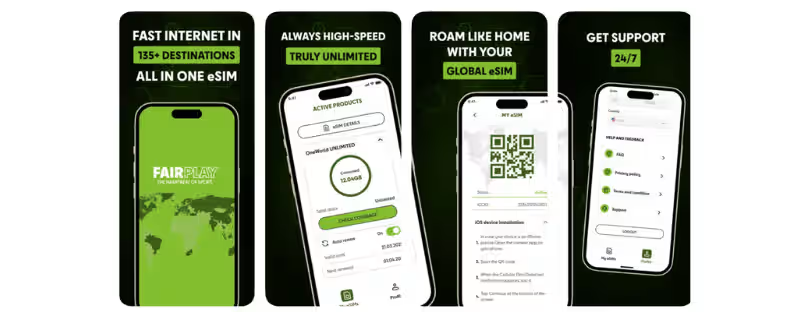
FairPlay’s headline promise is simple: one global eSIM that works across 135+ destinations in its “OneWorld” territory, with 5G premium connectivity and “highest available speed only”.
That “single eSIM across borders” angle is not new in travel eSIM land, but FairPlay pushes it hard because it pairs it with two product tracks:
Two products, two travel realities: subscriptions for heavy users, passes for short trips
FairPlay Flex for frequent travellers (subscription with a monthly cost cap)
FairPlay Flex is aimed at people who travel often (or live on planes). It starts at:
- €25/month on a 24-month subscription
- €30/month on a 12-month subscription
- €35/month on a 6-month subscription
The standout part is the step-up billing logic:
- You start at 5 GB/month
- As you use more, it automatically switches to the next tier
- After you pass 50 GB (in three 15 GB steps), the month becomes a flat “unlimited” price at €85 / €90 / €95 (depending on your subscription) until the month ends
- Next month, it resets back to the lowest tier again
In plain language, it is a controlled “unlimited if needed” model, with a ceiling designed to prevent roaming bill shock.
FairPlay Unlimited Day Passes for short trips (fixed time, “unlimited highspeed”)
For holidays and short trips, FairPlay sells time-based passes starting at €25:
- 3 days: €25
- 7 days: €50
- 14 days: €75
The pitch is “unlimited data at maximum available speeds” for a predefined time, with no hidden cost.

Why FairPlay’s “unlimited” claim matters in a market full of fair use policies
Here is the uncomfortable truth: most “unlimited” travel eSIMs are really “unlimited access” with speed throttling after you hit a fair use threshold. Even providers openly explain that fair usage often means a cap within a timeframe (commonly daily), after which speed drops.
That is why FairPlay’s messaging (including a claim that regular users can enjoy “up to 10x more high-speed data” versus typical industry standards) is a direct shot at the category’s biggest trust problem.
Now, as always, the real test is the fine print (network partners, traffic management, hotspot rules, and what happens during congestion). But strategically, FairPlay is leaning into a trend we see everywhere in roaming right now: consumers are done paying premium prices for vague limits.
The sports and fan layer is not just decoration
FairPlay is not launching in a vacuum. The same Footballerista entity is active in bigger sports-tech partnerships, including work tied to Real Madrid’s Madridista Premium programme in India, in collaboration with Tata Communications.
This matters for two reasons:
- Distribution and brand leverage
Travel eSIMs are crowded, and customer acquisition is brutal. Sports fandom gives FairPlay a built-in storytelling engine (and potential partner channels) that many travel eSIM apps simply do not have.
- Where the market is going: eSIMs bundled into ecosystems
The “connectivity + content + community” model is becoming a real playbook. We are seeing more travel eSIM offers launched by MNOs and more branded travel connectivity products trying to live inside bigger platforms. GSMA Intelligence has explicitly highlighted increasing travel eSIM launches as a key market development.
How this stacks up against familiar travel eSIM players
Let’s compare FairPlay’s core proposition with what most travelers are used to from major travel eSIM brands.
“Unlimited” that behaves like unlimited (FairPlay’s bet) vs “unlimited” with daily caps (market reality)
Many popular “unlimited” plans in the market rely on fair use limits that throttle speed after a certain amount of high-speed data. That can still be fine for light users, but it becomes painful for remote work, hotspotting, video calls, uploads, and cloud backups.
FairPlay is clearly trying to win the heavy-user segment by making the pricing ladder and the monthly ceiling visible upfront.
One global footprint and fewer plan decisions
A lot of travel eSIM users still juggle country plans, regional plans, top-ups, and separate eSIM profiles. FairPlay’s “one plan across 135+ destinations” reduces that mental overhead, and their Help Center explicitly says you do not need a new eSIM for each country within the territory.
Pricing logic: predictable ceiling vs “hope you never hit the hidden limit”
FairPlay Flex’s cap under €100-ish (depending on the subscription variant) is not just a pricing feature; it is a positioning statement.
For digital nomads, that predictability can be more valuable than shaving off a few euros on a smaller data bundle. Get your FairPlay eSIM on the App Store for iPhone or on Google Play for Android phones.
The bigger trend: travel eSIM is exploding, and pricing pressure is rising
If you are wondering why so many new brands are popping up with bold claims, the answer is simple: the category is growing fast.
Juniper Research projects global travel eSIM revenue rising from about $1.8B in 2025 to $8.7B by 2030.
At the same time, research and industry coverage point to intensifying competition and falling revenue per GB as the market commoditizes.
In Europe, the context is also shaped by “Roam Like At Home” rules (extended to 2032), which keep roaming predictable inside the EU and push travel eSIMs to compete harder on non-EU travel, premium performance, and simplicity.
FairPlay is basically saying: “Fine. We will compete on trust and on heavy usage, not just on cheap gigabytes.”
Conclusion: FairPlay is a smart answer to the market’s biggest trust gap
FairPlay is interesting because it is not trying to be the cheapest eSIM. It is trying to be the least stressful one for people who actually use data like it is 2026: multi-country, always-on, often for work, and with zero patience for mystery throttling.
The Flex model is the most compelling piece. That visible step-up and monthly ceiling is a cleaner solution than the vague “unlimited” marketing we see across the industry, where fair use policies often turn into surprise slowdowns.
Where you should stay cautious: FairPlay’s promise lives and dies on real-world network performance across its 135+ footprint, and on the exact definition of “truly unlimited” in the terms. If the experience matches the messaging, it is a serious contender for digital nomads and frequent flyers who want one eSIM that just keeps working.
Zooming out, FairPlay also fits the direction travel eSIM is heading: bigger brands, stronger distribution, and products built around ecosystems (in FairPlay’s case, sport and fan engagement). With the travel eSIM market projected to grow rapidly through 2030, the winners will be the ones that make roaming feel predictable, not confusing.