eSIM Before You Fly: The 5-Minute Setup That Saves Airport Stress
If you have ever landed after a long flight, stood in line at an airport kiosk, watched your battery drop to 9 percent, and tried to decide which SIM card salesperson looks the least sketchy, you already understand why travelers are quietly switching to eSIMs.
Not because they love telecom technology. But because they hate airport stress.
This is the part nobody tells you when booking flights or hotels. Connectivity is not a “nice to have” anymore. It is the first thing you need the moment the plane lands. Maps. Uber. Hotel check-in. WhatsApp. Work messages. Boarding passes for your next flight. And yet, this is the one thing many travelers still leave until the last possible minute.
That is where the five-minute eSIM setup changes everything.
The real problem is not roaming. It is timing.
Most travel horror stories around mobile data are not about price. They are about bad timing.
You land tired. The airport WiFi is slow or requires a local phone number. Your roaming is turned off because you do not want a surprise bill. The SIM shop is crowded, cash only, and selling three different plans with unclear terms.
This is not a telecom problem. It is a travel experience problem.
eSIMs solve this only if you activate them before you fly. That is the part many people miss.
What an eSIM actually fixes
An eSIM does not magically make data cheaper everywhere. The market is crowded. Plans look similar. Coverage maps all claim “global.” That is exactly why many travelers feel confused.
But when done right, an eSIM fixes three very specific pain points.
First, there is no physical SIM swapping. Your main number stays active. Your banking apps keep working. Your WhatsApp does not reset.
Second, there is no airport dependency. No kiosks. No queues. No language barriers.
Third, there is peace of mind. You land connected.
That last one is underrated.
Why setting up before flying matters more than which eSIM you choose
Most complaints about eSIMs come from people who install them after landing. When your phone is half dead. When the airport WiFi drops. When you are rushing through passport control.
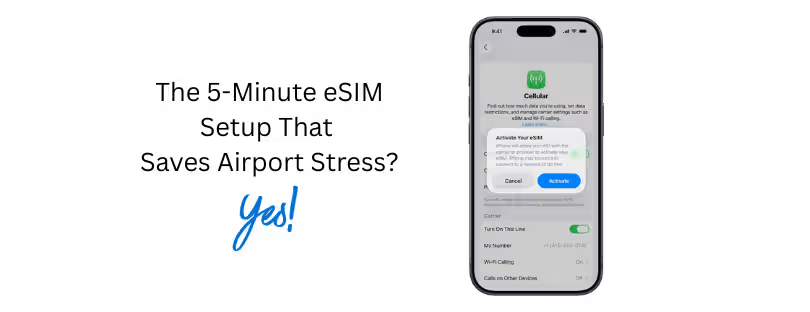
Setting up an eSIM before flying takes less than five minutes. You scan a QR code. You install the profile. You turn it on when you land.
That is it.
No stress. No pressure. No troubleshooting while standing in arrivals.

A quick story every frequent traveler recognizes
Imagine this.
You land in a new country. Taxi apps are surging. Your hotel is messaging you. You promised a client you would be online immediately. You open your phone and everything just works.
Maps load. Messages send. Emails sync.
That moment feels boring. And that is exactly the point.
Good travel tech disappears into the background.
The crowded eSIM market problem
Let us be honest. The eSIM market is noisy.
Everyone claims to be the best. Unlimited plans that are not really unlimited. Global coverage that excludes half the countries people actually visit. Cheap prices that come with unstable speeds.
For travelers, this creates decision fatigue.
For brands, it creates a differentiation problem.
Standing out is no longer about having an eSIM. It is about trust, clarity, and experience.
Where Yesim fits in naturally
This is where Yesim takes a different approach.
Instead of racing to the bottom on price, Yesim positions itself as a premium, reliable option for travelers who value predictability over gimmicks.
That matters when you are traveling for work. It matters when you rely on stable data for navigation, bookings, and communication. And it matters when you do not want to spend your arrival troubleshooting connectivity.
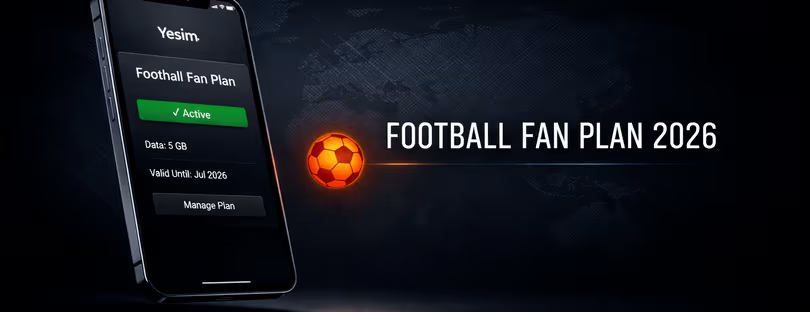
Yesim’s setup flow is straightforward. The app is clean. The instructions are clear. You are not guessing which APN to use or whether your phone is compatible.
For many travelers, that clarity is the product.
 This is not about tech. It is about control.

Travel is full of things you cannot control. Delays. Weather. Crowds.
Connectivity does not have to be one of them.
Installing an eSIM before you fly gives you a small but powerful sense of control. You are prepared. You are connected. You are not dependent on airport infrastructure.
That feeling is addictive.
Native comparisons matter more than feature lists
Most travelers do not want telecom jargon. They want to know one thing.
Will this work when I land?
That is why native reviews and explainers work better than spec sheets. Real use cases. Real scenarios. What happens at arrivals? What happens in taxis. What happens when switching between WiFi and mobile data?
This is where premium eSIM brands win quietly. Not by shouting. But by working consistently.
The lifestyle angle people overlook
eSIMs are not just for digital nomads or business travelers anymore.
They are for couples on city breaks. Parents traveling with kids. Solo travelers who want safety. Content creators who need to upload immediately. Anyone who wants their phone to just function abroad.
When framed correctly, eSIMs become part of the travel lifestyle. Not a technical add-on.
That framing matters for long-term adoption.
SEO pages are not boring if the story is real
Evergreen content around eSIMs does not need to sound robotic.
The best performing pages are the ones that answer real questions in human language. When should I install it? Will it affect my main number? What happens if I land late at night? Is airport WiFi enough?
Campaign-based content works when it connects those questions to real travel moments.
This is where storytelling wins over feature dumping.

The five-minute habit that changes how you travel
Here is the simplest takeaway.
Before your next flight, install your eSIM.
Not at the gate. Not after landing. Before you leave home.
That five-minute habit removes one of the most common travel stress points. It makes your arrival smoother. It makes your trip feel more under control.
And once you do it once, you will never go back to airport SIM cards.
Final thought about eSIM before you fly
Travel tech is only good when you forget it exists.
eSIMs done right feel invisible. You do not think about data. You do not think about roaming. You just arrive and move.
In a crowded market, the winners will be the brands that understand this is not about selling gigabytes. It is about selling calm.
And calm is the most underrated luxury in travel.