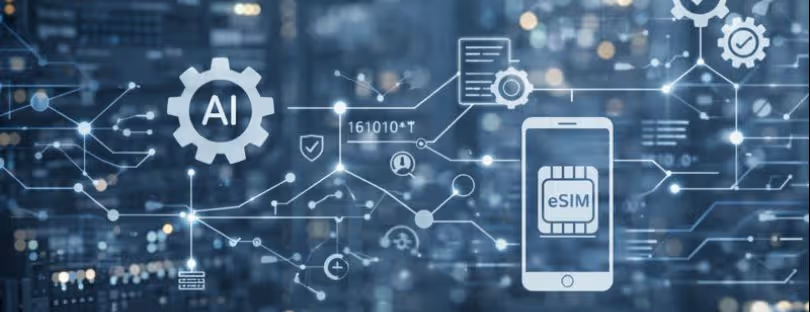
Enterprise Mobility in 2026: Why AI and eSIM Are Now Mandatory
By 2026, enterprise mobility will look very different from what most IT and procurement teams are used to today. The conversation is moving away from devices, tariffs, and coverage maps, and toward something far more operational: performance. enterprise mobility trends 2026
Buyers are no longer impressed by feature checklists or shiny portals. What they want to know is simple and tough at the same time. How fast are issues resolved? How consistently are policies enforced? How smoothly can employees be onboarded, supported, and offboarded across countries, devices, and roles?
This shift is already visible in RFPs and vendor conversations, and two trends are clearly shaping what comes next: AI moving from “assisted support” into real operational automation, and eSIM lifecycle management becoming a baseline expectation rather than a differentiator.
AI in mobility finally grows up
Most AI used in enterprise mobility today still lives in the “assistance” layer. Think chat-style help desks, smarter search across knowledge bases, or partial automation inside IT service workflows. These tools do improve user experience, but they rarely change outcomes in a measurable way.
When something goes wrong, real work still lands on human teams. Device misconfigurations, compliance failures, enrollment issues, or complex connectivity incidents usually escalate. AI speeds up the first steps, but it does not close the loop.
One reason is proof. Many providers talk about AI, but few publish hard operational results. Metrics that matter to enterprises such as reduced contacts per incident, faster mean time to resolution, lower cost per ticket, or consistent SLA improvement are still missing from most marketing decks. When outcomes are mentioned, they tend to be qualitative rather than measurable.
That gap is starting to close, and 2026 is likely to be the year when it becomes impossible to hide behind vague claims. Enterprises are increasingly asking for AI that can act, not just suggest.
From assisted AI to operational automation
The next phase is what many analysts describe as agentic or action-oriented AI. In mobility terms, this means systems that can execute constrained actions under policy control, not just recommend next steps.
In practice, this looks less like a chatbot and more like an operational loop.
What automated mobility loops actually do
Detect issues
Using device telemetry, network signals, and user experience indicators rather than waiting for a ticket.
Diagnose causes
Identifying likely configuration errors, policy violations, or failed profiles automatically.
Remediate safely
Reapplying policies, pushing enrollment profiles, or resetting connectivity within predefined approval boundaries.
Verify outcomes
Confirming resolution before closing incidents or escalating to humans when confidence is low.
For enterprises, this is not about replacing people. It is about reducing disruption. Fewer user interruptions, fewer help desk interactions, and faster recovery of productivity. It also enables providers to improve SLA performance without scaling headcount at the same rate.
Suresim’s positioning in this landscape is pragmatic rather than flashy. Instead of marketing AI as a feature, the focus is on where automation actually removes friction in day-to-day mobility operations. That includes predictable onboarding, faster recovery from device swaps, and fewer manual handoffs between support tiers. This is where AI earns its place.
Governance becomes part of the AI conversation
As AI moves closer to configuration and compliance environments, governance stops being a legal footnote and becomes a buying criterion.
Enterprises now want to know exactly what an automated system can change, under which policies, and with what audit trail. Who approved the action? What data was used? Why was a decision made?
In 2026, AI without explainability and auditability will struggle in regulated industries and large multinational environments. Providers that bundle governance into automation, rather than treating it as an add-on, will have a clear advantage.
eSIM lifecycle management stops being optional
The second major shift is eSIM finally becoming operationally normal.
For years, eSIM has been sold as transformative, and rightly so. Faster provisioning, fewer logistics headaches, better sustainability, and stronger control are all real benefits. But enterprise readiness has been uneven.
Some providers built robust portals and APIs early. Others still rely on country-specific processes and carrier dependencies. For global organizations, the biggest problem has often been fragmentation rather than technology.
The impact is real. Provisioning delays, complex break or fix scenarios, and shipping dependencies still create downtime, especially for distributed teams and high-turnover roles.
By 2026, enterprise buyers will no longer treat eSIM lifecycle management as innovation. It will be expected.
What buyers now expect from eSIM
Self-service and APIs
Provisioning without manual tickets.
Systems integration
Alignment with MDM, ITSM, and HR systems so connectivity follows identity and role.
Policy-driven control
Reliable activation and deactivation for onboarding, offboarding, and temporary workers.
Auditability at scale
Consistent reporting across countries, devices, and user groups.
This is where providers like Suresim are pushing hard. The value of eSIM is not the form factor. It is what happens when eSIM is deeply integrated into enterprise systems and governed by policy. A new hire should be connected in minutes. A departing employee should lose access reliably. A replacement device should not require days of coordination.
Execution will separate winners from noise
As eSIM becomes table stakes, differentiation shifts to execution.
Providers that can industrialize eSIM across multiple countries, with consistent governance and fast provisioning, will win more enterprise deals. Depth of the catalogue matters too. Supporting corporate-liable, BYOD, and hybrid models without operational complexity is no longer optional.
Compared with some global MNO-led platforms that still struggle with regional inconsistencies, or newer eSIM players focused mainly on travel and short-term use cases, Suresim sits in a growing middle ground. Enterprise-focused, automation-led, and designed around operational outcomes rather than consumer-style activation flows.
What enterprise buyers should change in 2026
Procurement and IT leaders will need to adjust how they evaluate mobility partners.
AI claims should be tied to SLA metrics, not demos. eSIM lifecycle automation and integration with core systems should be mandatory, not nice to have. And providers should be assessed on their ability to run mobility as an operational discipline, measured in downtime avoided and friction removed.
Feature lists and tariffs matter less when the real cost is lost productivity.
Conclusion: the quiet shift that changes everything
What makes this moment interesting is not a single breakthrough, but a quiet redefinition of value. Enterprise mobility is becoming invisible when it works well. No tickets, no delays, no escalations. Just connectivity that follows people and roles automatically.
Some players will keep selling innovation narratives. Others will focus on execution. In a market crowded with AI buzzwords and eSIM claims, the providers that stand out in 2026 will be the ones who can prove operational impact with data.
Suresim’s approach reflects that reality. Less noise, more automation where it matters, and a clear understanding that enterprise buyers care about outcomes, not promises.
Industry analysts from Gartner and IDC have been pointing in this direction for years, highlighting automation, lifecycle integration, and governance as the next maturity phase for enterprise mobility. What changes in 2026 is that buyers are no longer waiting. They are asking for it upfront.
Driven by wanderlust and a passion for tech, Sandra is the creative force behind Alertify. Love for exploration and discovery is what sparked the idea for Alertify, a product that likely combines Sandra’s technological expertise with the desire to simplify or enhance travel experiences in some way.