Consumer and Industrial eSIMs: Same Tech, Different Stakes
The term eSIM is used everywhere today. It appears in smartphone launches, travel apps, IoT platforms, automotive specs, and industrial tenders. At first glance, it sounds like a single technology with a single purpose. In reality, consumer eSIMs and industrial eSIMs share a name, but they are built around fundamentally different assumptions. consumer vs industrial eSIM

Understanding that difference matters. For travelers, it explains why some eSIMs are cheap, flexible, and easy to replace. For enterprises, it explains why eSIM decisions are slow, conservative, and heavily risk-driven. For the industry as a whole, it clarifies why comparing consumer and industrial eSIMs on price or coverage alone is misleading.
This article sets out to explain those differences clearly, without marketing language, and without assuming deep telecom knowledge.
What an eSIM actually is
And why the definition already diverges
At a technical level, an eSIM is a programmable SIM embedded into a device. Instead of inserting or swapping a physical card, connectivity profiles are downloaded remotely using standardized provisioning systems.
That definition applies to both smartphones and industrial devices. The divergence begins immediately after.
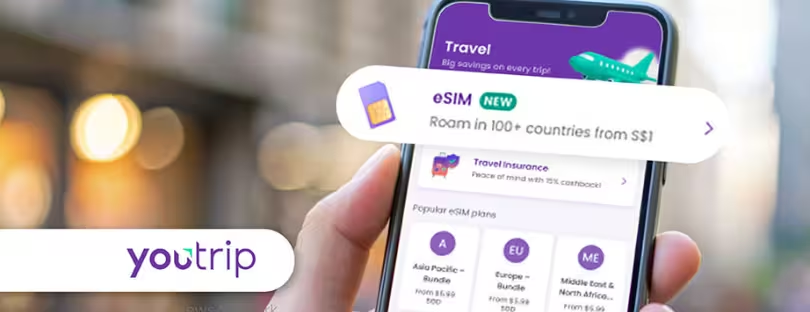
In consumer devices, the eSIM is treated as a feature. It exists to make onboarding easier, to support dual SIM usage, or to enable short-term connectivity such as travel plans. It assumes the device is accessible, replaceable, and frequently upgraded.
In industrial environments, the eSIM is treated as infrastructure. It exists to support long term connectivity in devices that may never be physically accessed again once deployed. It assumes the device must remain operational for many years, often in harsh or regulated conditions.
Same technology. Different intent.
Lifecycle expectations
Short replacement cycles versus decade long commitments
The most important difference between consumer and industrial eSIMs is not performance. It is lifecycle.
Consumer devices follow short replacement cycles. Smartphones are typically replaced every two to four years. If an eSIM profile fails, the user can reset the device, download a new profile, or switch providers with minimal consequences. Downtime is inconvenient, but rarely critical.
Industrial devices follow long lifecycles. Ten to fifteen years is common in sectors such as energy, automotive, logistics, and infrastructure. Devices may be sealed, mounted, buried, or certified in ways that make physical access difficult or impossible. Replacing a failed unit can mean truck rolls, service interruptions, or regulatory reapproval.
Because of this, industrial eSIMs are designed around endurance rather than convenience. Write cycles, memory stability, thermal tolerance, and long term availability matter more than fast onboarding or user experience.

Hardware design
Why form factor and durability are not optional
Consumer eSIMs live inside devices designed for comfort and controlled environments. Smartphones operate within narrow temperature ranges and are rarely exposed to vibration, moisture, or electrical noise for extended periods.
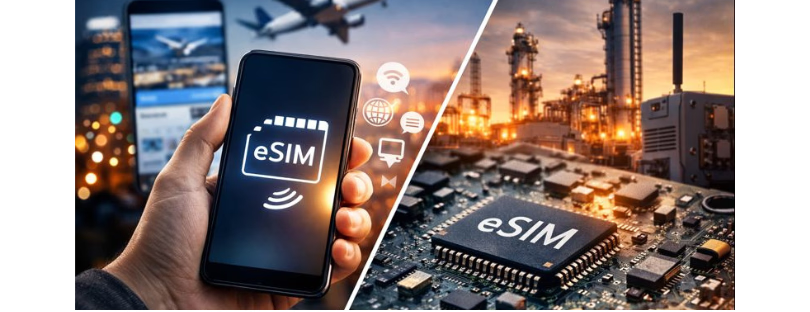
Industrial eSIMs are often implemented as MFF2 form factor chips that are soldered directly onto the device board. They are designed to tolerate extreme temperatures, mechanical stress, and long operating hours. They are tested differently, certified differently, and produced in lower volumes with higher quality thresholds.
This difference is not about superiority. It is about fitness for purpose. A consumer eSIM would be over-engineered and overpriced for a phone. An industrial eSIM would be underspecified and risky in a consumer comparison if evaluated purely on price.
Risk models
Inconvenience versus operational exposure
Risk tolerance is where the two segments truly diverge.
For a consumer, an eSIM failure usually means loss of connectivity, frustration, and potentially unexpected roaming charges. The impact is personal and temporary.
For an industrial operator, an eSIM failure can mean loss of telemetry, loss of control, regulatory non compliance, or breach of service level agreements. The impact can be financial, legal, or safety-related.
This difference shapes every downstream decision. It affects how profiles are managed, how provisioning systems are designed, how vendors are selected, and how contracts are written.
Consumer eSIMs optimize for flexibility. Industrial eSIMs optimize for predictability.
Remote provisioning
Convenience versus governance
Remote SIM provisioning is often presented as the great equalizer. Both consumer and industrial eSIMs rely on it. In practice, they use it very differently.
In consumer contexts, provisioning is event based. A user downloads a profile, activates it, and may delete it later. The process is designed to be fast, intuitive, and forgiving.
In industrial contexts, provisioning is continuous governance. Profiles may be switched at scale, under strict rules, with audit trails and fallback logic. Failures must be detected, retried, and reported automatically. Human intervention is often impossible.
This is why industrial deployments place heavy emphasis on orchestration layers, monitoring, and multi vendor strategies. The eSIM itself is only one component in a much larger system.
Security priorities
Privacy versus continuity
Security is often described as a strength of industrial eSIMs, but the type of security matters.
Consumer eSIM security focuses primarily on user privacy and fraud prevention. The main concern is protecting personal data and preventing unauthorized access.
Industrial eSIM security focuses on continuity and integrity. The main concern is ensuring that devices remain authenticated, connected, and compliant throughout their operational life. Tamper resistance, certificate longevity, and update reliability matter more than user-facing protections.
Both are valid. They are simply designed for different threat models.
Cost structures
Why industrial eSIMs are more expensive by design
Industrial eSIMs cost more than consumer eSIMs, and that difference often causes confusion.
The higher cost is not driven by data pricing or coverage. It is driven by lower production volumes, higher testing standards, longer support obligations, and higher liability. Industrial eSIM providers assume responsibility for connectivity over many years, often across regulatory changes and operator relationships.
In consumer markets, cost efficiency is achieved through scale and churn. In industrial markets, cost efficiency is achieved through stability and risk reduction.
Comparing the two directly misses the point.
Why confusion persists
And why it matters now
The confusion between consumer and industrial eSIMs persists because the same term is used in very different contexts. Marketing materials often blur the lines. Coverage maps look similar. The underlying standards are shared.
But as eSIM adoption expands, the consequences of misunderstanding grow. Enterprises risk choosing solutions designed for travelers. Consumers risk paying for features they do not need. Vendors risk mispositioning their offerings.
Clear separation of use cases is not fragmentation. It is maturity.
Where this leaves the market
Consumer and industrial eSIMs are not competing segments. They are parallel implementations of the same foundational technology, optimized for different realities. consumer vs industrial eSIM
Understanding that distinction allows better decisions, better expectations, and better conversations across the industry.
For travelers, it explains why simplicity matters.
For enterprises, it explains why caution is rational.
For the ecosystem, it explains why one size does not fit all.
That is the context in which every eSIM discussion should begin.