AT&T opens the VIP lane for live event connectivity
Anyone who has tried to send a video from a packed stadium knows the feeling. Five bars on your phone, nothing loads, and the moment is gone. Live events are some of the most connectivity-hostile environments out there, and for years fans have simply accepted that a bad signal comes with the ticket.
That assumption is now being challenged. AT&T has launched Turbo Live, a new product designed specifically to boost mobile connections inside crowded venues. The twist is that it is not limited to AT&T subscribers. Verizon and T-Mobile users are welcome too.
This is not a new data plan or a roaming add-on. It is a venue-specific connectivity layer built for moments when networks typically struggle the most.
What Turbo Live actually is
Turbo Live is positioned as the first VIP wireless connection created purely for live events. The idea is simple. When tens of thousands of people pull out their phones at the same time, networks get congested. Turbo Live applies a special data boost that prioritizes traffic and helps phones perform better in dense environments.
The service works with eligible 5G smartphones and relies on a quick digital sign-up. In some cases, it may require an unlocked device and an available eSIM slot, but there is no long-term contract involved. You activate it for the event, use it where it matters, and that is it.
Crucially, Turbo Live is not tied to your everyday mobile carrier. Even if you use Verizon or T-Mobile, you can still tap into AT&T’s venue infrastructure when Turbo Live is available.
Why this matters right now
Connectivity failures at live events are not a niche problem. They happen during kickoffs, encores, goal celebrations, and game-winning plays. Exactly the moments people want to share, stream, or upload.
For fans, poor connectivity means more than slow Instagram uploads. Ride-sharing apps lag, digital tickets refresh slowly, mobile payments fail, and live streaming becomes impossible. From a user experience perspective, the stadium may be world-class, but the digital layer often feels broken.
AT&T is framing Turbo Live as a direct response to this pain point. The timing is also deliberate. 2026 is shaping up to be packed with major sports tournaments, concerts, and global events across the US. Expectations around instant sharing and real-time streaming are only getting higher.
“2026 is packed with some of the world’s biggest live events and we want to make sure that the people attending are able to connect, stream and share these moments with confidence,” said Cheryl Choy, SVP product management, AT&T. “The last thing people should have to think about is their connection. Turbo Live was built with that in mind, to deliver an exceptional wireless experience at the venue – regardless of what carrier they have for their everyday service.”
Where Turbo Live is launching first
Starting in early February, Turbo Live will be available in more than ten major US stadiums, with rapid expansion planned throughout 2026.
Initial launch venues
- Bryant Denny Stadium, Alabama
- Mercedes-Benz Stadium, Atlanta
- United Center, Chicago
- NRG Stadium, Houston
- Sphere, Las Vegas
- Intuit Dome, Los Angeles
- Hard Rock Stadium, Miami
- MetLife Stadium, New York and New Jersey
- Alamodome, San Antonio
- Levi’s Stadium, San Francisco Bay Area
- Lumen Field, Seattle
Coming soon in 2026
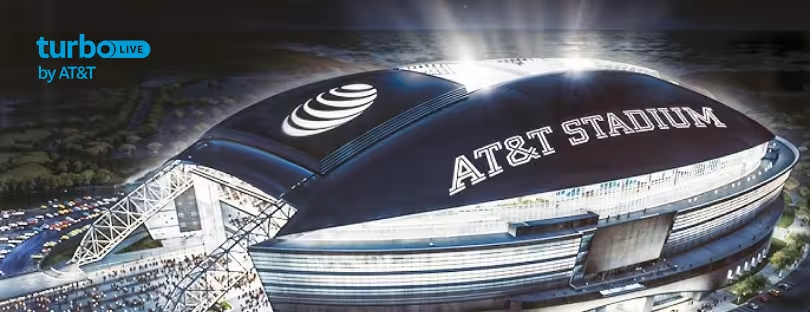
- AT&T Stadium, Dallas
- Gillette Stadium, Foxborough
- SoFi Stadium, Los Angeles
- Additional major venues across the US
The strategy is clear. Focus on high-profile venues first, then scale nationally.

A quiet shift in how carriers compete
What makes Turbo Live especially interesting is not just the technology, but the business model behind it. Telecom operators have traditionally competed by locking customers into ecosystems. Turbo Live does the opposite. It treats connectivity at live events as a shared infrastructure problem rather than a subscriber loyalty tool.
This mirrors trends already visible in other parts of the connectivity market. Neutral host networks, shared small-cell deployments, and venue-owned private networks are becoming more common. Stadiums care about the fan experience first, not which carrier someone uses.
Globally, we have seen similar ideas in premium airport Wi-Fi, temporary private 5G networks for festivals, and enterprise-focused network slicing. What AT&T is doing here is packaging that complexity into a consumer-friendly product with a simple entry point.
How does this compare to the rest of the market
Neither Verizon nor T-Mobile currently offers a comparable consumer-facing, carrier-agnostic boost specifically designed for live events. Both invest heavily in 5G Ultra Wideband and network densification inside stadiums, but access is still tied to being their subscriber.
Outside the US, some European operators and venue operators experiment with private 5G for events, but these are often invisible to consumers or limited to staff and broadcasters. Turbo Live stands out because it is explicit, optional, and monetizable at the moment of need.
From a trend perspective, this aligns with the broader move toward situational connectivity. Instead of one plan trying to cover everything, users activate performance where and when it matters. This is the same logic driving travel eSIMs, short-term data boosts, and on-demand connectivity services.
What to watch next
If Turbo Live proves successful, it opens several doors. We could see similar products for festivals, conventions, and even transportation hubs. It also raises questions about pricing, bundling with tickets, and partnerships with event organizers.
Reliable sources such as GSMA Intelligence and Ookla have consistently highlighted congestion as one of the hardest problems to solve in high-density environments. Solutions that combine network prioritization, local infrastructure, and flexible access models are increasingly seen as the way forward.
Turbo Live feels like an early but meaningful step in that direction.
Conclusion
Turbo Live is not just a clever add-on. It signals a shift in how mobile connectivity is delivered in extreme use cases. By opening its network to non-customers inside stadiums, AT&T is betting that experience matters more than exclusivity. If fans associate a great live moment with reliable connectivity, brand loyalty may follow naturally.
For the wider industry, this is a reminder that the future of connectivity is contextual. Not everywhere, not all the time, but exactly where it counts.