American Airlines App Update Puts Travelers Back in Control
Disruptions are the least glamorous part of flying. Delays, cancellations, missed connections. The industry has trained travelers to expect apology notifications and long lines, not solutions. That is exactly the gap American Airlines is trying to close with a new set of mobile app enhancements designed around one idea: when something goes wrong, travelers should be able to fix it themselves, immediately, in one place.

The airline has rolled out a disruption-focused experience inside its mobile app and on aa.com that gives customers real-time options the moment plans derail. Instead of bouncing between notifications, gate agents, help desks and customer service lines, travelers are guided through next steps directly tied to their booking. It is a subtle shift, but a meaningful one. This is not just about explaining what happened. It is about helping people move forward.
Control Instead of Confusion
Most airline apps are good at pushing alerts. Few are good at resolving problems. American’s update reframes the disruption moment as an active decision point rather than a passive waiting game.
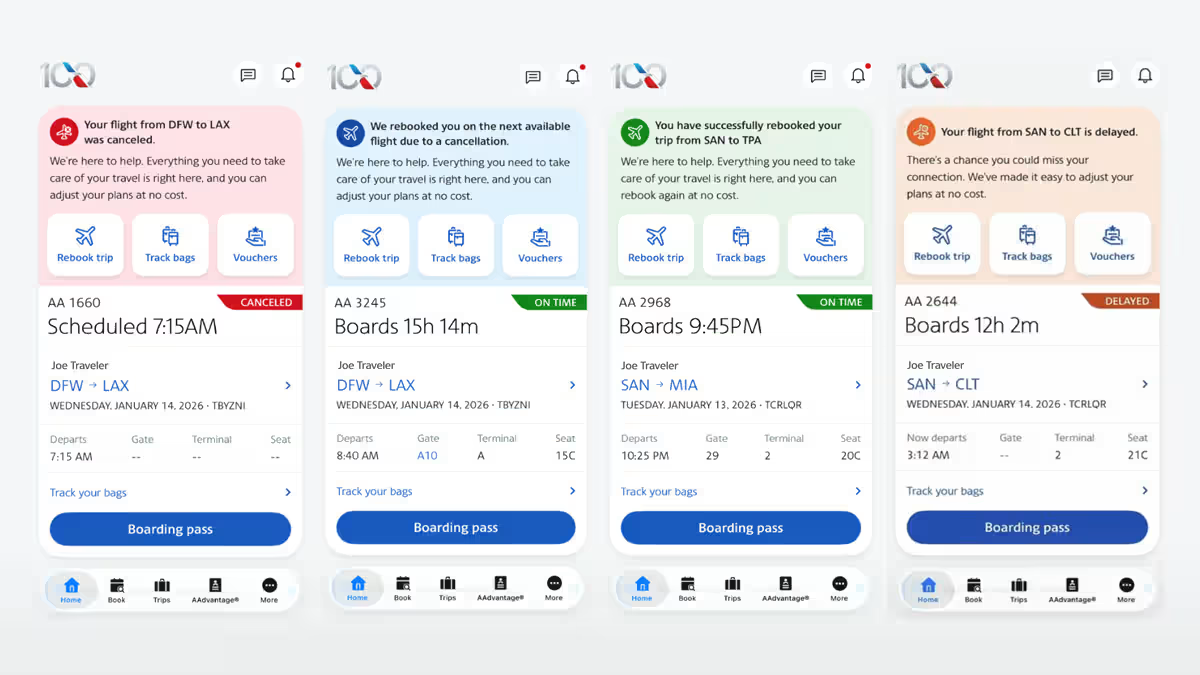
As soon as a disruption occurs, customers see a dedicated screen connected to their reservation. Flight status is clear at a glance, supported by visual cues that explain what is happening and what actions are available. That might mean rebooking instantly, reviewing next steps, or simply knowing that the airline is already working on alternatives.
From there, travelers can act. Rebooking can be completed in seconds through a guided self-service flow. Baggage can be tracked in real time. Hotel, meal, and transportation vouchers are now surfaced directly inside the app and on aa.com instead of being buried in emails or handed out at desks.
Ground transportation integrations with Lyft and Uber are built in, helping customers get beyond the airport without having to juggle multiple apps while already stressed.
This is the kind of functionality travelers assume should exist, yet rarely does in a single, coherent flow.
Less Waiting. More Doing.
American’s approach stands out because it centralizes everything. Most airlines still scatter solutions across channels. Notifications in the app. Rebooking via a separate flow. Vouchers sent by email. Ground transport left entirely to the traveler.
Here, the airline is explicitly acknowledging that when plans change, customers do not need more messages. They need a clear path forward.
Heather Garboden, American’s Chief Customer Officer, framed it clearly in the airline’s announcement.
“We strive to make every customer’s travel as smooth as possible, but we recognize things don’t always go to plan. When that happens, customers deserve transparent information and real-time tools to get their travel back on track,” said Heather Garboden. “Our new app enhancements are unlike anything else in the industry because they don’t just explain why travel was disrupted, they help customers take action.”
That distinction matters. Transparency without action still leaves travelers stuck.
What You Can Actually Do in the App
Self-service actions during disruptions
- Rebook flights instantly through guided flows
- Track checked baggage in real time
- Access hotel, meal, and transportation vouchers without waiting in line
- Connect directly to ground transportation options
- See clear explanations of what is happening and what options are available
It is not flashy innovation. It is operational clarity delivered at exactly the right moment.
This Is Not a One-Off Update
American has made it clear this is not a finished product. Later this year, the airline plans to expand these capabilities further, including self-service standby options, more flexible rebooking choices, and expanded hotel, meal, and transportation support.
That roadmap matters because disruption recovery is not static. It is one of the most emotionally charged moments in the travel journey, and expectations are rising quickly.
These updates sit within a broader app relaunch that aims to connect booking, boarding, inflight experience, and service recovery into one continuous flow. American is betting that the app should be the primary interface for the entire journey, not just a digital boarding pass holder.
A Broader Strategy Behind the Screens
American positions these changes as part of a wider customer experience strategy. That includes investments in its ground experience, onboard amenities, and its loyalty ecosystem through the AAdvantage program.
The airline also continues to lean heavily on its network strength, with one of the most comprehensive U.S. and international route maps supported by global partners. Technology, in this context, is meant to connect those pieces rather than sit on top of them.
What is notable is that American is focusing its tech investments not just on inspiration or upselling, but on the messy middle of travel where trust is either built or broken.

How This Stacks Up Against the Market
Industry context and competitors
- Delta Air Lines has invested heavily in predictive rebooking and proactive notifications, but still relies on multiple flows for vouchers and support
- United Airlines offers strong self-service rebooking, though disruption support often fragments across app, email, and airport staff
- European carriers like Lufthansa are improving digital service recovery, but consistency across markets remains a challenge
Across the industry, the trend is clear. Airlines are moving away from reactive customer service toward proactive, self-managed recovery. American’s execution is notable because it focuses less on prediction and more on immediacy and clarity once disruption hits.
Why This Matters for Travelers and the Industry
From a traveler’s perspective, this reduces friction at one of the most stressful moments of the journey. From an industry perspective, it signals where airline tech is heading.
Airlines face chronic staffing constraints, operational complexity, and rising customer expectations shaped by digital-first services outside aviation. Empowering customers to resolve their own issues is not just better service. It is operationally necessary.
Reliable industry sources like IATA, McKinsey, and Skift have consistently pointed to self-service recovery, real-time personalization, and app-centric journeys as core pillars of future airline experience strategies. Americans’ update aligns tightly with those forecasts.
Conclusion: A Quiet but Important Shift
This is not a revolutionary product launch. There are no buzzwords or futuristic promises. And that is precisely why it matters.
American Airlines is focusing on the moment that defines how travelers remember a brand: when things go wrong. By centralizing disruption management into a single, actionable experience, the airline is raising the bar for what passengers should expect from airline apps.
Competitors are moving in the same direction, but execution varies. If American continues to expand these tools and keeps them reliable at scale, it positions itself not as the flashiest innovator, but as one of the most practical.
In an industry where trust is often rebuilt one disrupted flight at a time, practicality may be the most valuable innovation of all.