Advantage Partners with Hubby eSIM to Fix Travel Roaming
The Advantage Travel Partnership has quietly made a very telling move about where travel retail is heading next. The group has announced a strategic collaboration with Hubby eSIM, giving its members the ability to offer branded, instant mobile data to travellers worldwide.
On the surface, this looks like another tech add-on. In reality, it signals something much bigger. Connectivity is no longer a nice extra. It is becoming part of the core travel product, just like insurance or airport transfers once did.
For Advantage members, this partnership opens the door to offering something travellers increasingly expect without needing to build or manage the technology themselves. For travellers, it removes one of the most annoying friction points of international travel.
Why connectivity is now non-negotiable
If you talk to frequent travellers, business travellers, or digital nomads, one thing comes up again and again. Being connected from the moment you land is no longer optional. Flights, hotels, ride-hailing, navigation, work messages, even border forms all depend on mobile data.
Public WiFi is unreliable and often insecure. Traditional roaming is expensive and unpredictable. Local SIM cards require time, physical stores, and device compatibility. eSIMs solve all of this in one move.
Hubby eSIM operates in over 200 countries and regions, offering mobile data that installs in under three minutes. Travellers receive an eSIM voucher by email, install it before departure, and connect automatically on arrival. No queues. No SIM swapping. No surprise roaming bills.
Prices can be up to 85 percent cheaper than traditional roaming, a number that will instantly resonate with anyone who has ever returned home to a shock phone bill.
What Advantage members actually gain
For travel agents and travel management companies inside the Advantage network, the value is not just about offering cheaper data. It is about control, branding, and relevance.
Instead of sending customers off to figure out connectivity themselves, members can now offer a branded eSIM as part of the booking journey. That keeps the relationship alive beyond the ticket or hotel confirmation email.
This is especially important in a world where post-booking engagement is becoming the real battleground. Once the flight is sold, many travel brands lose visibility. Connectivity changes that.
A plug-and-play product that fits travel retail
One reason this partnership makes sense is simplicity. Hubby eSIM is designed to be plug and play, both for travellers and for travel brands.
The platform supports multi-country plans, which is essential for complex itineraries. Family sharing allows one purchase to cover multiple devices. Around-the-clock multilingual support ensures customers are not left stranded if something goes wrong.
From a retail perspective, this reduces friction for agents while adding a genuinely useful ancillary. It is easy to explain, easy to deliver, and easy for travellers to understand.
 What the leadership is really saying
Andrea Caulfield-Smith, Managing Director Global Business Travel at Advantage, framed the partnership in very practical terms. Connectivity, she said, is now a basic expectation. By offering an affordable, ready-to-use eSIM option, members can improve the customer experience, reduce friction during travel, and unlock a new channel for engagement and ancillary revenue.
That last part is important. This is not just about customer satisfaction. It is also about commercial opportunity in a margin-pressured industry.
From the Hubby eSIM side, CEO and Founder Thijs van der Wijk highlighted something travel brands increasingly care about. The ability to stay connected with customers during the trip itself. Daily in-destination moments, reward-based incentives, and real-time engagement are becoming more valuable than pre-trip marketing alone.
Engagement that continues after takeoff
Early metrics from the partnership show strong user interaction and promotional click-through rates. That matters because many travel ancillaries fail after purchase. They look good on paper but see little real-world usage.
Connectivity is different. It is used daily, sometimes hourly. That creates repeated touchpoints between the traveller and the brand that provided the service.
In a world where loyalty is fragile and switching costs are low, these moments matter. They allow travel brands to remain present without being intrusive.
Where this fits in the wider eSIM market
The Advantage and Hubby eSIM collaboration also reflects broader trends in the travel connectivity market.
Global eSIM adoption has accelerated rapidly over the last two years. According to GSMA and industry analysts, eSIM-enabled smartphones are now the default rather than the exception. Apple, Samsung, Google, and other manufacturers are pushing the technology hard, with some devices already removing physical SIM trays altogether.
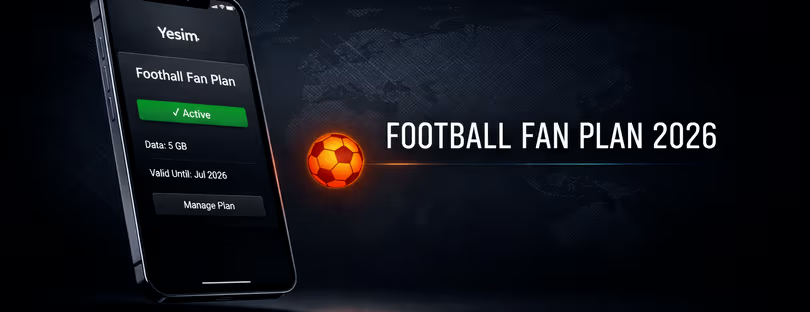
At the same time, competition among travel eSIM providers has intensified. Players like Airalo, Airhub, Nomad, and Yesim have focused heavily on direct-to-consumer sales. What sets Hubby eSIM apart in this case is its emphasis on branded distribution and post-booking engagement for travel companies.
This makes it more comparable to white-label or B2B-focused platforms rather than pure consumer apps. For consortia like Advantage, that distinction matters.
Why travel brands are leaning into connectivity
Travel brands are under pressure to diversify revenue while improving customer experience. Connectivity sits at the intersection of both goals.
Unlike seat upgrades or lounge access, mobile data benefits almost every traveller. Unlike insurance, it is used immediately and repeatedly. And unlike many ancillaries, it does not require complex fulfilment.
As a result, we are seeing more airlines, tour operators, and travel agencies integrating eSIMs directly into their ecosystems. Some bundle it. Some upsell it. Others use it as a loyalty or retention tool.
The Advantage partnership fits neatly into this wider shift.
Conclusion: connectivity as part of the travel product
This collaboration is not about chasing the latest tech trend. It is about recognising that connectivity has become part of the travel experience itself.
Compared with standalone consumer eSIM apps, the Advantage and Hubby eSIM model gives travel brands more ownership of the relationship and more opportunities to stay relevant during the trip. That aligns with broader industry trends identified by sources such as GSMA, McKinsey travel reports, and Skift’s coverage of digital travel retail.
As devices move toward eSIM-only designs and travellers grow less tolerant of friction, connectivity will stop being an optional extra. It will become expected, embedded, and invisible when done well.
For Advantage members, this partnership is a practical way to stay ahead of that curve. For the wider industry, it is another clear signal that the future of travel retail is connected, literally and strategically.