What Do Travelers Really Do with Their Regular SIM While Using an eSIM Abroad?
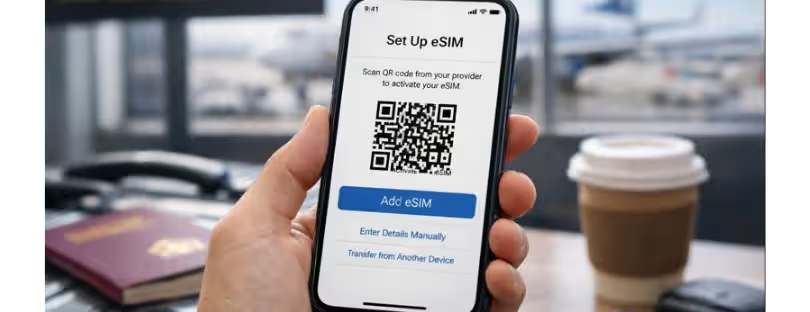
If you’ve ever traveled with an eSIM, you know the joy. No more hunting for a kiosk at the airport, fumbling with tiny SIM trays, or paying whatever your operator decides roaming should cost. Instead, you scan a QR code, activate, and voilà — instant connectivity. using eSIM abroad with regular SIM

But there’s always been one nagging question that never seems to get a straight answer: what should you actually do with your regular SIM card when you’re abroad?
This week, Alertify asked exactly that in our community poll. And the results reveal just how differently travelers approach this very real pain point.
The Poll Results: 551 Votes Later
Here’s how travelers responded when asked: What do you do with your regular SIM while using an eSIM abroad?
- Switch it off entirely – 10%
- No idea — I’ve never tried eSIM – 10%
- Keep it active for calls – 30%
- Turn off data, keep SMS on – 50%
In total, 551 travelers weighed in. What’s striking is that the overwhelming majority (80%) are actively managing their physical SIM rather than abandoning it. Half choose the middle ground (no data, SMS still on), while about a third keep it fully active for calls.
Only a small fraction — 10% — switch it off completely, cutting ties with their home line while abroad.
Why So Many Travelers Keep SMS Active
Let’s start with the most popular option. Turning off data while leaving SMS active is the “belt and suspenders” approach. It avoids runaway data charges but keeps the SIM alive for those critical text messages.
Think about it:
- Two-factor authentication (2FA) codes from banks.
- Verification messages for apps like WhatsApp or Telegram.
- Service alerts from your home carrier.
In a world where everything from your digital wallet to your airline boarding pass can depend on a text code, it’s easy to see why half of our voters took this path.
It’s also a reflection of how sticky SMS remains, even in 2025. Despite secure apps and authenticator tools, SMS is still the default for many services. According to GSMA data, over 5 billion people worldwide still rely on SMS in some form, and many fintechs haven’t fully migrated away from it.


The “Call Me Maybe” Crowd
30% of respondents keep their SIM fully active, calls and all. This tends to be:
- Business travelers who don’t want clients or HQ to hit voicemail.
- People with family obligations who can’t miss calls.
- Users with special roaming bundles that make calls abroad affordable.
This group is shrinking compared to five years ago. A 2019 Juniper Research report showed that around 55% of travelers kept their primary SIM active abroad; today, with eSIM adoption, it’s closer to one-third.
But it still highlights an important point: voice isn’t dead. For certain travelers, the convenience of answering a familiar number is worth the risk of a higher bill.
The Risk-Averse Minimalists
Then there’s the 10% who simply switch their SIM off entirely. These are the hyper-cautious travelers who’d rather not take any chances.
It’s not paranoia without reason. Roaming horror stories are still very real. The EU may cap roaming within Europe, but outside its borders — think Turkey, the Caribbean, or the Middle East — rates can spiral into hundreds of euros quickly. Just last year, a Telecoms.com case study highlighted a UK traveler charged £800 for accidental roaming in the UAE.
For these users, peace of mind comes from a clean break: eSIM on, physical SIM off.
The Curious but Not Yet Converted
Finally, 10% of respondents admitted they haven’t tried eSIM yet. This isn’t surprising: even in 2025, global eSIM adoption is still uneven.
Apple’s decision to remove physical SIM trays from iPhones in the U.S. (starting with the iPhone 14) turbo-charged adoption in North America, but Europe and Asia remain mixed markets. According to Counterpoint Research, eSIM device penetration reached 30% globally in 2024, but only around 20% of active users had set up an eSIM.
So while early adopters swear by the convenience, many travelers are just now dipping their toes into dual-line management.

What the Poll Tells Us About Travel Habits
Looking at the numbers, the lesson is clear: travelers don’t want to abandon their home SIMs completely.
Even among heavy eSIM users, most are hedging their bets:
- SMS security is too important.
- Voice calls still matter for certain groups.
- Roaming risks remain a serious deterrent.
This aligns with industry reports. A 2024 survey by Traveltomorrow showed that 72% of frequent flyers now use some form of dual connectivity setup (physical SIM + eSIM). The ability to mix and match is what gives eSIM its edge over local SIMs alone.
Comparing with Similar Market Trends
Alertify’s poll results actually line up neatly with what other market watchers are reporting.
- Airalo often promotes eSIMs as a “second line,” encouraging users to keep their home SIM for calls/SMS — essentially the same behavior as our 50% SMS-on group.
- BNESIM markets “Global Numbers” to solve the missed-calls problem — targeting the 30% who keep their home SIM active.
- GigSky highlights that eSIM is about avoiding surprise data charges — catering directly to the 10% who switch off their home SIM completely.
In short, the poll reflects the messy reality that no single behavior dominates. Providers are adapting by offering hybrid solutions: virtual numbers, multi-profile eSIMs, and packages designed for SMS continuity.
Where Things Are Headed
If history is a guide, these percentages won’t stay static. The likely trajectory is:
- More travelers will move toward the SMS-only setup (today’s 50%) as awareness of roaming risks spreads.
- Virtual number services will shrink the “keep calls active” group by offering cheaper alternatives.
- The “switch off entirely” group may grow among cautious leisure travelers — especially in markets without strong roaming regulation.
- The “never tried” group will keep shrinking as manufacturers push eSIM-only devices.
By 2030, analysts expect eSIM to be standard in almost all smartphones, wearables, and IoT devices. GSMA forecasts that “over 8 billion eSIM devices will be in use by 2030”. As that happens, managing multiple profiles will become second nature, not an edge case.
Here is this weeks poll:
Conclusion: What This Means for Travelers and Providers
So what’s the big takeaway? Not just that, half of you are leaving SMS on. The real insight is that dual-line management is now the new normal for global travelers.
That creates both opportunities and challenges:
- For travelers, the hack is simple: treat your physical SIM as a security anchor (SMS, calls if necessary) and your eSIM as the data workhorse. That way, you minimize both risks and costs.
- For operators and eSIM providers, the message is urgent: travelers are not yet ready to abandon their physical SIMs. Products that make juggling both lines easier—whether that’s smarter apps, call-forwarding, or bundled SMS solutions — will win.
Alertify’s poll is just one snapshot, but it reflects a bigger truth across the travel tech landscape: connectivity isn’t about choosing one line over the other. It’s about balancing both smartly.
And as eSIM adoption grows, the winners will be those who recognize that balance — not by forcing users into “all-eSIM” or “all-SIM” models, but by embracing the hybrid reality most travelers are already living.