When Travellers Go Dark: The Connectivity Risk TRM Misses
Travel risk management has matured significantly over the past decade. Most organisations now have formal policies, defined escalation paths, duty-of-care tools, and external partners monitoring geopolitical and environmental risks. On paper, many programmes look solid. travel risk management connectivity
Yet one critical dependency is still largely taken for granted: reliable mobile connectivity.
Most TRM plans assume that travellers will be connected when it matters. That assumption underpins everything from location tracking and emergency alerts to secure messaging and check-ins. When connectivity fails, those systems do not degrade gracefully. They stop working.
This is not a theoretical concern. Loss of connectivity is one of the most common points of friction in international travel, and it affects far more than traveller convenience. It directly impacts an organisation’s ability to execute its risk programme.
“Going dark” is not rare, just unlabelled
In practice, travellers “go dark” in very ordinary ways.
Roaming works, but only intermittently. Devices attach to sub-optimal networks. Data is disabled to avoid unexpected costs. Public Wi-Fi becomes the fallback, with all the security and reliability issues that come with it. Local SIMs solve coverage in one country but create new problems elsewhere.
From a traveller’s point of view, this is annoying. From a TRM point of view, it is a silent failure.
Once a device is offline or unstable, organisations lose visibility. Alerts may not be delivered. Location data may stop updating. Secure communication channels may be unavailable precisely when they are needed.
The reason this risk often goes unnoticed is simple: connectivity loss does not look like an incident. There is no single moment when it “happens”. It unfolds quietly, in the background, until teams realise they are operating with partial or outdated information.
Why connectivity rarely appears in risk assessments
Most travel risk assessments focus on external threats: crime, unrest, health risks, weather, and infrastructure. Connectivity is usually categorised as an IT or travel logistics issue, not a risk vector in its own right.
This separation made sense when mobile connectivity was relatively simple. Today, it no longer does.
Modern TRM programmes are heavily digital. They depend on apps, platforms, and real-time data flows. When connectivity is unreliable, the risk is not just technical. It is organisational. Decision-makers are forced to act with incomplete information, leading to longer response times.
Despite this, connectivity is still rarely stress-tested in the same way as evacuation plans or crisis communications.
The security dimension is often underestimated
There is also a security angle that deserves more attention.
When travellers lack reliable mobile data, they default to whatever connectivity they can find. That often means unsecured public Wi-Fi, shared networks, or ad-hoc hotspots. From an enterprise perspective, this increases exposure to data interception, credential theft, and device compromise.
In regulated industries or organisations handling sensitive data, this is not a minor concern. Connectivity decisions directly affect cybersecurity posture on the move, yet mobile data strategy is still frequently left outside formal security planning.
eSIM adoption is changing the conversation
This is where the growing adoption of eSIM technology becomes relevant, not just for travel convenience but for risk and security management.
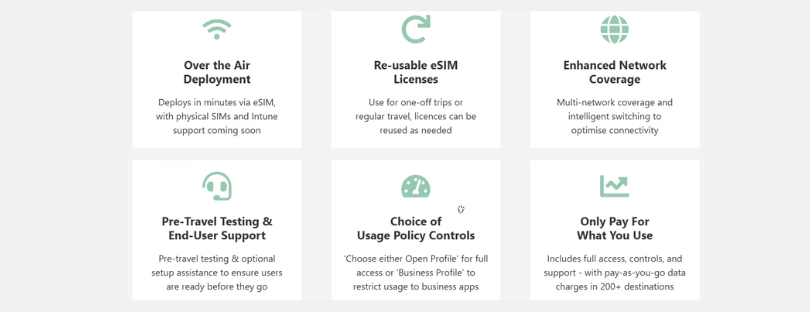
eSIMs allow organisations to provision connectivity remotely, manage profiles centrally, and avoid dependence on a single physical SIM or local carrier. For businesses operating across multiple countries, this provides a level of flexibility and control that traditional roaming or local SIM strategies cannot offer.
More importantly, eSIMs enable multi-network access. Devices are not locked into one carrier’s coverage or performance. When one network degrades, another can be used automatically.
This capability turns connectivity into something that can be actively managed, rather than passively hoped for.
SureSIM and the shift toward enterprise-grade connectivity
Platforms like SureSIM reflect this shift.
Rather than positioning connectivity as a travel add-on, SureSIM treats it as core business infrastructure. Its platform is designed for organisations of all sizes that need consistent, secure mobile data across borders, whether for travellers, remote workers, logistics teams, or distributed operations.
From a TRM perspective, the relevance is clear. Centralised visibility into connectivity status, usage, and network performance reduces blind spots. Multi-network access improves resilience. Policy controls help prevent cost-driven behaviour that leads travellers to disable data altogether.
This is not about replacing existing TRM tools. It is about ensuring those tools continue to function in real-world conditions.
 Comparing approaches in the wider market
Many organisations still rely on a mix of consumer roaming plans, local SIMs, and Wi-Fi as their default connectivity strategy. This approach may appear cost-effective, but it introduces variability that is difficult to manage at scale.
Consumer eSIM providers improve the traveller experience, but they are rarely designed with enterprise visibility, security, or policy control in mind. On the other end of the spectrum, traditional telecom contracts can be rigid, expensive, and slow to adapt to changing travel patterns.
Enterprise-focused platforms sit in the middle. They combine the flexibility of eSIM technology with the governance features organisations need. As travel programmes become more distributed and dynamic, this model is gaining traction.
What this means for TRM teams today
The key question for TRM professionals is no longer whether connectivity matters. It is whether their current approach treats connectivity as a controllable risk or an implicit assumption.
Asking a few basic questions can reveal gaps quickly:
Do we know when travellers lose mobile data?
Do we have redundancy across networks and regions?
Can we enforce secure connectivity policies globally?
Can our risk systems function without reliable mobile data?
If the answer to these questions is unclear, connectivity is already a weak point.
Conclusion: naming the risk is the first step
Loss of connectivity has long existed in the background of travel risk management, acknowledged informally but rarely addressed directly. As TRM becomes more digital and more tightly linked to real-time decision-making, that gap is becoming harder to justify.
Treating connectivity as a first-class component of risk strategy does not require reinventing TRM programmes. It requires recognising that without reliable, secure mobile data, even the best-designed plans struggle to operate as intended.
eSIM-based, enterprise-grade connectivity solutions are part of that evolution. Not because they are new or fashionable, but because they align better with how organisations actually operate today.
For TRM teams, raising awareness around connectivity is not about adding another tool. It is about removing a silent point of failure that has been there all along. Book the Suresim demo today and see what managed connectivity looks like in practice.