Thales, eSIMs, and the Infrastructure Behind Always-On Devices
If you have been following the evolution of eSIMs beyond smartphones, one name keeps resurfacing quietly but consistently: Thales. Not because it is launching flashy consumer products, but because it sits underneath much of the infrastructure that makes modern connectivity possible. Thales connectivity solutions
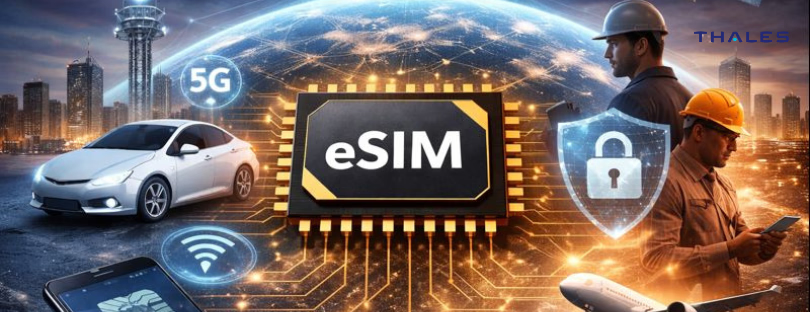
Thales operates at the intersection of secure hardware, digital identity, and embedded connectivity. That positioning matters as eSIM technology becomes foundational to how devices stay connected across borders, networks, and lifecycles. Smartphones were only the starting point. Today, eSIMs underpin wearables, connected cars, industrial sensors, logistics hardware, and a growing universe of IoT devices that are expected to stay online for years without manual intervention.
For Alertify readers tracking connectivity trends, the eSIM story is less about convenience and more about control, security, and long-term commercial relationships. This is exactly where Thales has built its reputation.
eSIMs as infrastructure, not a consumer feature
The broader eSIM market is being shaped by three overlapping forces. First, the rapid expansion of IoT across industries, from automotive and logistics to utilities and manufacturing. Second, automation in transport, where vehicles are becoming software platforms on wheels. Third, the rollout of 5G networks that support always-connected hardware with higher reliability and lower latency.
In this context, eSIMs are not just replacing plastic SIM cards. They enable remote provisioning, dynamic network switching, lifecycle management, and secure authentication at scale. For car manufacturers, this means managing connectivity across entire fleets. For enterprises, it means deploying thousands of devices globally without physical SIM logistics. For telecom operators, it reshapes how customer relationships and contracts are structured.
Thales plays in the layer where security and identity are embedded directly into the hardware. That is a subtle but powerful role. It means being involved early, often before a device ever reaches the market.
Where Thales fits in the eSIM value chain
Thales’ growing role in eSIMs positions the company within a core layer of digital infrastructure. Its technology helps device makers and automakers manage secure, carrier-agnostic connectivity across large fleets of hardware. Unlike consumer-facing eSIM brands, Thales does not compete for end users. Instead, it enables the systems that others build on top of.
This approach aligns closely with its historical strengths in secure elements, encryption, and identity management. For smartphones and wearables, that translates into trusted embedded components. For connected cars, it means secure credentials that can be updated remotely over a decade or more. For industrial IoT, it supports long deployment cycles where physical access may be limited or impossible.
From a market perspective, eSIMs sit adjacent to Thales’ existing digital identity and cybersecurity businesses. That proximity creates opportunities for cross-selling and bundled solutions across sectors that already rely on the company for security-critical infrastructure.

How does this fit into the wider Thales narrative?
The eSIM push does not exist in isolation. It sits alongside a broader strategic shift where Thales has leaned more heavily into digital identity, cybersecurity, and secure communications. Analysts already frame Thales as a hybrid player that spans defense, aerospace, and civilian digital infrastructure.
What eSIMs add is a commercially scalable use case where the same security know-how and R&D investment can be reused across consumer electronics, automotive platforms, and industrial deployments. That matters when comparing Thales with peers like Safran, Airbus, or Infineon, all of which touch connected hardware in different ways.
Unlike pure chipmakers or platform providers, Thales operates across hardware, software, and security governance. That breadth can be a strength in markets where trust, compliance, and long-term support matter as much as performance.
Competitive pressure is real, but so is differentiation
The eSIM ecosystem is becoming increasingly crowded. On one end, chipset and platform giants like Qualcomm are pushing deeper into integrated connectivity solutions. On the other hand, established security and identity specialists such as Giesecke+Devrient continue to expand their footprint in embedded SIMs and digital credentials.
Telecom operators and large OEMs are also exploring greater vertical integration, sometimes developing their own eSIM management platforms or favoring strategic partners that give them more control over customer relationships.
For Thales, the differentiation rests on trust, certification, and experience operating in regulated, security-sensitive environments. That heritage can help defend pricing and position the company as a long-term partner rather than a commodity supplier. But it also requires constant execution, especially as standards evolve and customers demand more flexibility.
Risks and rewards around eSIM exposure
Opportunities worth watching
🎁 eSIM demand in consumer electronics and automotive markets creates recurring touchpoints with OEMs, supporting long term service and software-style revenue streams rather than one-off hardware sales.
🎁 Thales’ security and identity background may help it maintain differentiation as connectivity becomes more commoditized, especially in regulated markets and critical infrastructure.
Challenges that should not be ignored
⚠️ Execution risk remains if large device makers or telecom groups push proprietary standards or prioritize alternative suppliers, limiting Thales’ share of new deployments.
⚠️ Regulatory scrutiny and security incidents related to digital identity or remote provisioning could slow adoption or increase compliance costs across the industry.

Signals to watch in the months ahead
From an industry perspective, the most meaningful signals will not come from marketing announcements but from partnerships and contracts. Large scale eSIM or IoT connectivity deals with global automakers, smartphone manufacturers, or multinational carriers will indicate how central Thales remains in future deployments.
It is also worth tracking how eSIM standards evolve within automotive and industrial IoT bodies, and whether security requirements tighten further. In those scenarios, players with deep certification experience tend to gain an advantage.
Conclusion: where Thales stands as eSIMs mature
The eSIM market is moving from early adoption to the infrastructure phase. As connectivity becomes a built-in assumption rather than a feature, the winners are likely to be companies that combine scale, security, and long-term credibility. Thales fits that profile more closely than many consumer-facing connectivity brands, even if it attracts less attention.
Compared with chip-centric players like Qualcomm or platform-focused providers, Thales operates closer to the trust layer of the stack. That may limit headline-grabbing growth, but it can support durable, high-value relationships with OEMs and governments alike. At the same time, competition from established identity specialists such as Giesecke+Devrient ensures that no position is guaranteed. Thales connectivity solutions
Reliable industry sources, including GSMA working groups, automotive connectivity forums, and cybersecurity research from ENISA and Gartner, consistently highlight security and lifecycle management as decisive factors in future eSIM deployments. If those trends hold, Thales’ approach looks less like a side bet and more like a logical extension of its core business.
For Alertify readers, the takeaway is simple. eSIMs are no longer just about roaming convenience. They are becoming the backbone of how devices authenticate, connect, and operate globally. Thales is one of the companies shaping that backbone, quietly, but with long-term consequences for the entire connectivity ecosystem.