TEAL Unveils Chameleon eSIM at CES 2026
When most connectivity announcements still revolved around bigger data bundles or marginally better coverage maps, TEAL showed up at CES 2026 with something far more structural. Instead of selling another flavor of roaming, the company introduced what it calls the most adaptive eSIM ever built: the SGP.32 Chameleon eSIM.

This is not consumer eSIM hype. It is an infrastructure-level play aimed squarely at enterprises, OEMs, and operators that are tired of rigid connectivity models that no longer match how global devices actually operate.
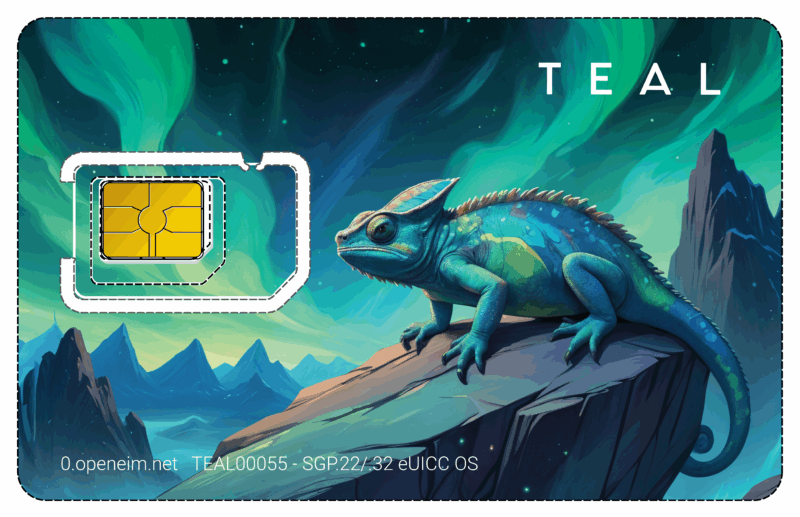
Chameleon is not a SIM; it is a behavior
The name Chameleon is not marketing fluff. The eSIM is designed to dynamically adapt to changing network conditions, geographies, and deployment requirements without physical swaps, renegotiated contracts, or painful carrier migrations.
At the heart of this flexibility is TEAL’s Network Orchestration Service, or NOS. Instead of locking devices to a single carrier or a narrow MVNO footprint, NOS acts as a control layer that decides how, when, and where a device connects.
In practical terms, this means a device deployed in logistics, robotics, energy, or healthcare can move across borders, radio environments, or regulatory zones while remaining centrally controlled. No SIM replacements. No roaming surprises. No vendor lock-in.
TEAL’s CEO Robby Hamblet summed it up clearly during the announcement. Mission-critical connectivity cannot be static. Networks evolve, conditions change, and requirements shift. Chameleon is built for that reality, not the one carriers designed fifteen years ago.
Why traditional connectivity models are breaking
Single-carrier contracts made sense when devices stayed in one country and roaming was an edge case. MVNOs simplified procurement but often replaced one form of lock-in with another.
What has changed is scale and autonomy. Fleets now span continents. Drones cross borders. EV chargers, rail infrastructure, and industrial sensors operate for years without human intervention. Static connectivity does not scale in those environments.
This is where NOS positions itself differently. It does not replace carriers. It orchestrates them.
Instead of asking enterprises to abandon existing agreements, TEAL lets them keep those relationships intact while adding a global control layer on top.
Bring Your Own Carrier is the real disruptor
One of the most consequential features behind the Chameleon launch is BYOC, or Bring Your Own Carrier.
Rather than forcing customers onto predefined roaming bundles, BYOC allows enterprises to bring their existing carrier contracts directly into TEAL’s platform. Pricing, terms, and commercial agreements remain untouched.
Those carrier profiles are uploaded into Aurora, TEAL’s management platform, as Network Apps. From there, they behave just like any other network option inside the orchestration layer.
This changes onboarding dramatically.
What once required custom integrations, long certification cycles, and manual provisioning is now handled through self-serve workflows or APIs. For enterprises managing thousands or millions of devices, that shift alone can cut deployment timelines by months.
Preserve carrier economics
Customers keep their negotiated pricing while gaining orchestration, automation, and global reach.
Faster and repeatable onboarding
Carrier integrations become scalable workflows instead of one-off technical projects.

Aurora becomes the control tower
All of this is managed through Aurora, TEAL’s single-pane-of-glass platform for network orchestration and eSIM lifecycle management.
Aurora includes OpenEIM, TEAL’s open and SGP.32-compatible IoT remote manager. That openness matters. Much of today’s IoT connectivity market is still built on proprietary stacks that limit interoperability and slow innovation.
By aligning with SGP.32 and removing restrictive carrier tooling, TEAL positions Aurora as a neutral control layer rather than another closed ecosystem.
For teams running global deployments, this means fewer integrations, more visibility, and the ability to adapt connectivity strategies without renegotiating infrastructure every time requirements change.
OneChip eSIMs fit real-world deployments
The Chameleon eSIM is part of TEAL’s OneChip portfolio, which supports removable and embedded form factors. From traditional 2FF and 3FF SIMs to embedded MFF2 chips, the idea is simple: no deployment should be blocked by hardware constraints.
This matters more than it sounds. Many industrial and infrastructure projects are constrained by hardware decisions made years ago. TEAL’s approach allows those deployments to evolve without full device redesigns.
Where this fits in the broader market
TEAL is not alone in talking about orchestration, but it is early in operationalizing it at this level.
Players like Cisco, floLIVE, 1NCE, and Soracom have all made moves toward multi-network IoT connectivity. Hyperscalers are also circling the space with cloud-native SIM management and private network integrations.
What distinguishes TEAL’s approach is the emphasis on preserving carrier relationships rather than abstracting them away. BYOC is not just a feature. It is a recognition that enterprises want control without burning bridges.
At the same time, the shift to SGP.32 reflects a broader industry trend toward more standardized, interoperable IoT eSIM management. GSMA’s push in this direction is accelerating, and vendors that remain tied to proprietary systems risk being left behind.
Conclusion: orchestration is becoming the default, not the upgrade
The launch of Chameleon at CES is less about a new eSIM card and more about a signal. Connectivity is moving from static contracts to adaptive systems.
As devices become more autonomous and deployments more global, orchestration will not be a premium feature. It will be table stakes.
TEAL’s model aligns closely with where the market is heading. Flexible control layers, open standards, and the ability to integrate existing carrier economics rather than replace them. That puts it in line with the direction outlined by GSMA working groups, enterprise IoT analysts, and infrastructure-focused research from firms like Gartner and ABI Research.
The real test will be execution at scale. If TEAL can continue expanding carrier integrations while maintaining openness and performance, Chameleon may end up being less of a product launch and more of a reference point for how next-generation cellular connectivity is supposed to work.
For enterprises building systems that cannot afford downtime, lock-in, or rigidity, that shift cannot come soon enough.