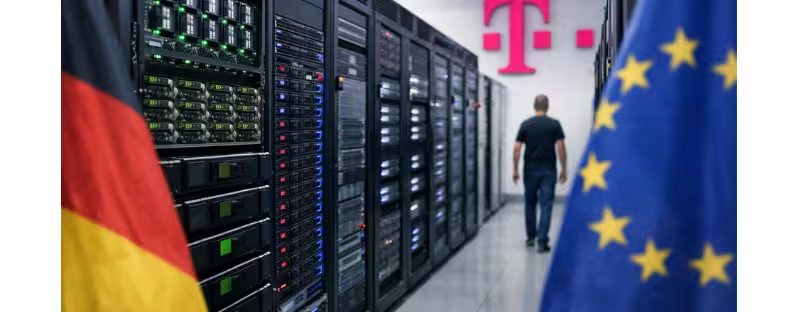
T Cloud Public: Europe’s Sovereign Cloud Takes on Hyperscalers
For years, Europe’s cloud conversation has circled the same uncomfortable dilemma: choose world-class cloud functionality from US hyperscalers or accept reduced capabilities in exchange for data sovereignty. With the expansion of Deutsche Telekom’s T Cloud Public, that trade-off is finally starting to dissolve.
T Cloud Public is being scaled into a fully fledged, sovereign high-tech cloud platform built explicitly for Europe. By the end of 2026, Deutsche Telekom says it will close most of the remaining feature gaps with US hyperscalers in core cloud capabilities while delivering scalable infrastructure and specialized AI services at a genuinely competitive level. That timeline matters. European companies are no longer planning AI strategies “someday”. They are deploying them now, under growing regulatory pressure and with increasing geopolitical risk in mind.
From migration pain to production backbone
One of the quiet blockers of cloud sovereignty has never been ideology. It has been migration friction. Deutsche Telekom is directly addressing this by pairing T Cloud Public with automated migration tooling and professional services designed to move existing workloads without months of re-architecture.
The message is clear: this is not a sandbox cloud for compliance presentations. It is positioned as a production-grade backbone for enterprises that want to run AI workloads efficiently, securely, and without structural dependencies on non-European providers.
In practical terms, T Cloud Public already offers compute, storage, managed databases, and preconfigured developer tools through a self-service model that will feel familiar to anyone coming from AWS, Azure, or Google Cloud. Services can be spun up with a click, scaled on demand, and combined modularly depending on workload complexity.
Why ISG’s assessment matters
Independent validation is where this story gets interesting. According to Information Services Group (ISG), T Cloud Public does not just outperform most European cloud alternatives. In some areas, it is already more competitive than selected offerings from Big Tech providers.
That is a strong statement in a market where “European cloud” has often been shorthand for compromise. ISG’s assessment signals that the platform has moved beyond national-infrastructure positioning into credible hyperscaler territory, at least for a growing set of enterprise use cases.
Industrial AI Cloud changes the scale equation
T Cloud Public’s most strategic differentiator may be its tight integration with the Industrial AI Cloud. Officially going live on February 4, the Industrial AI Cloud increases Germany’s available GPU capacity by 50 percent and is positioned as Europe’s largest sovereign AI infrastructure.
This matters because access to GPUs has quietly become one of the most constrained resources in enterprise IT. Instead of forcing companies to invest in proprietary on-prem AI hardware or compete in global GPU queues, Deutsche Telekom is offering direct, combinable access to high-performance GPU resources within a sovereign European framework.
For AI-heavy industries like manufacturing, automotive, logistics, and energy, this is not a theoretical value. It determines whether AI pilots stay stuck in labs or make it into production.

A modular cloud that scales with ambition
Architecturally, T Cloud Public follows a modular approach. Companies can start with basic networking and compute services or scale all the way up to complete AI pipelines. This flexibility is critical for mid-sized enterprises that want hyperscaler-level capabilities without hyperscaler complexity.
The platform’s design allows organizations to select exactly what they need and nothing they do not. That reduces both cost and operational overhead, two areas where European CIOs have become increasingly cautious after years of cloud sprawl.
Sovereignty by design, not by marketing
The word “sovereign” is heavily overused in European tech marketing. T Cloud Public backs it with concrete architectural and legal commitments.
The platform is built on a security-by-design principle, certified to high standards such as C5, and follows a modern zero-trust architecture. Data is processed exclusively in European data centers and protected against access by third countries. Crucially, this promise extends beyond software controls into legal and operational governance under European law.
For regulated industries, this distinction matters more than performance benchmarks.
Enterprise adoption is already real
With more than 4,000 enterprise customers, including numerous DAX corporations, mid-sized businesses, and public sector organizations, T Cloud Public is not starting from zero. The upcoming functional expansion positions it as what Deutsche Telekom describes as the first truly European alternative operating at global hyperscaler level.
Another important angle is vendor lock-in. Through open standards and active migration support, T Cloud Public is explicitly designed to reduce long-term dependency. That is a notable shift from the dominant cloud playbooks of the last decade.
The platform also stands out in certification density. According to Deutsche Telekom, its compliance coverage is roughly three times higher than that of comparable providers, significantly reducing audit effort for customers in finance, healthcare, and public administration.
What Deutsche Telekom’s leadership is really saying
Dr. Ferri Abolhassan, CEO of T-Systems and member of the Board of Management of Deutsche Telekom AG, frames the move as a structural shift rather than a product launch:
“We are ending the era of either-or decisions. Until now, companies had to choose between maximum functionality from overseas or European sovereignty. With T Cloud Public, we now deliver the best of both worlds. We are not just building a sovereign cloud; we are building the digital foundation for a competitive and free Europe. The platform automates many background processes, already delivers 80 percent of the familiar core hyperscaler features and significantly reduces IT administration effort. By the end of 2026, we will reach full core feature parity”
Dr. Christine Knackfuss, Chief Sovereignty Office and member of the board at T-Systems, adds a regulatory perspective rooted in telecom DNA:
“We continuously challenge our own level of sovereignty, using our telecommunication industry regulations as a key benchmark, and are exploring ways to become even more independent”
Those statements matter because they anchor cloud sovereignty in operational discipline rather than political aspiration.

How this compares to other “sovereign cloud” players
Across Europe, several initiatives claim sovereign cloud positioning. Projects like GAIA-X aim to define standards and interoperability, while providers such as OVHcloud, Aruba Cloud, and Orange Business offer regional alternatives. However, most still struggle with one or more of three issues: limited GPU access, incomplete hyperscaler feature sets, or fragmented service ecosystems.
What differentiates T Cloud Public is scale combined with integration. The ability to pair a full public cloud stack with Europe’s largest sovereign AI infrastructure under one operational and legal umbrella is currently rare. This places Deutsche Telekom closer to a “fourth hyperscaler” model for Europe than a niche compliance provider.
Where the market is heading next
The broader trend is clear. Enterprises are moving from cloud enthusiasm to cloud selectivity. Regulatory pressure, geopolitical uncertainty, and AI compute constraints are reshaping buying decisions. According to analysts at ISG, Gartner, and IDC, hybrid and sovereign cloud strategies are becoming default architectures for European enterprises rather than exceptions.
In that context, T Cloud Public arrives at a critical moment. Not because it replaces US hyperscalers overnight, but because it gives European organizations credible leverage, architectural choice, and negotiating power they previously lacked.
Conclusion: sovereignty becomes a competitive advantage
The real significance of T Cloud Public’s expansion is not that Europe now has “its own hyperscaler”. It is that sovereignty is shifting from a defensive requirement into a strategic asset.
Compared with other European providers, Deutsche Telekom’s approach stands out for its combination of scale, AI readiness, and regulatory depth. Compared with US hyperscalers, it offers something increasingly valuable in Europe: legal certainty without functional sacrifice.
If Deutsche Telekom delivers on its 2026 feature-parity roadmap, T Cloud Public could become the default cloud layer for regulated European industries and a serious benchmark for future sovereign cloud initiatives. For the first time in years, Europe’s cloud debate is no longer about what it cannot do. It is about how fast it can execute.