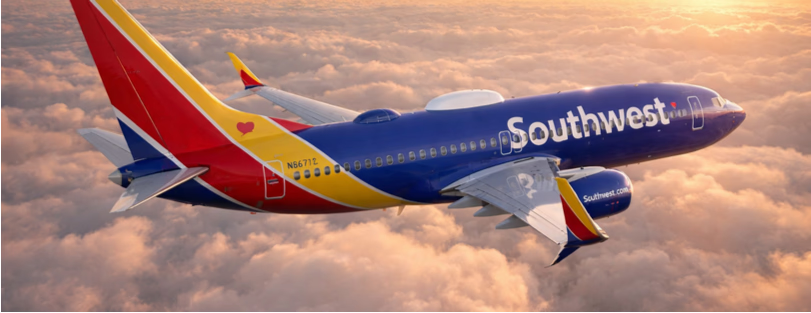
Southwest Airlines just signaled something bigger than “better internet on planes.” The carrier says it plans to rapidly equip its fleet with in-flight Wi-Fi powered by Starlink satellite service, with the goal of having Starlink available on more than 300 jets by the end of 2026. The first Starlink-equipped aircraft is expected to enter service this summer. So
That’s a fast rollout in airline terms, and it’s Southwest openly joining a shift that’s been building for a while: connectivity is no longer a “nice-to-have.” It’s moving into the category of table stakes, right next to seat power and onboard payment reliability.
Why Starlink is winning the airline Wi-Fi race
Traditional in-flight Wi-Fi has two core problems: performance and consistency. You might get a decent connection for 15 minutes, then hit buffering, dead zones, or the “connected but nothing loads” limbo that makes passengers give up.
Starlink’s advantage comes from its low-Earth orbit (LEO) constellation. Shorter distance between aircraft and satellites usually translates to lower latency and better responsiveness, which is exactly what you feel when you’re trying to send a file, join a call, or upload anything larger than a meme.
And the market is noticing. Analysts and industry watchers have pointed out that Starlink is pressuring incumbents in in-flight connectivity, with airlines increasingly prioritizing the experience passengers can actually feel, not the “up to” marketing numbers.
Southwest’s move is also a loyalty play
Southwest has been leaning into the idea that Wi-Fi should be simple, accessible, and part of the overall value proposition (not a small checkout funnel at 35,000 feet). If you zoom out, this fits the direction of the US market: airlines are turning connectivity into a loyalty perk and a retention tool.
American Airlines, for example, announced it would begin offering free in-flight Wi-Fi starting January 2026 in partnership with AT&T, available to frequent flyer members.
Delta has been pushing free Wi-Fi to loyalty members as well, and United has been publicly tied to Starlink for onboard internet in its own strategy mix.
So Southwest upgrading the underlying tech is not just about speed. It’s about staying competitive in a world where “free, fast Wi-Fi” is becoming an expectation, especially for frequent travelers.
What “better Wi-Fi” really changes for travelers
If Starlink performs the way it has on early airline rollouts, the biggest change isn’t that you can watch Netflix. It’s that the internet becomes boring again.
That’s the gold standard. Connectivity that disappears into the background.
For business travelers, that means fewer “I’ll send it when I land” moments. For families, it’s fewer mid-flight meltdowns. For digital nomads, it’s the difference between being productive and burning a half day because a login won’t complete.
And it’s not only about passengers. Airlines benefit operationally too: better connectivity can support more reliable crew tools, real-time updates, and smoother service workflows. Not glamorous, but hugely valuable.
Southwest is following a proven pattern globally
Southwest isn’t pioneering the concept. It’s joining a club that’s getting bigger fast.
Starlink has already been adopted by airlines like Hawaiian and airBaltic, and performance rankings have repeatedly highlighted Starlink-equipped fleets as leaders in speed and reliability.
In the Middle East, Qatar Airways has been one of the most visible examples of rapid Starlink deployment.
The direction is clear: airlines that can deliver consistent, high-quality Wi-Fi are using it as a differentiator, and airlines that can’t are increasingly exposed.
The real story: airline Wi-Fi is turning into infrastructure
For years, in-flight Wi-Fi lived in the “optional add-on” bucket. Buy it if you must, tolerate it if you’re desperate.
That era is ending.
Now, connectivity is being treated like infrastructure. Like baggage systems. Like turnaround reliability. Like fuel hedging. It’s part of the product, and it shapes brand perception more than airlines want to admit.
When Southwest says “300+ aircraft by year-end,” it’s effectively saying: we’re not waiting. We’re not doing a five-year slow retrofit. We’re going to compress the timeline and catch up to where the market is heading.
Where this goes next
Starlink’s momentum doesn’t mean every airline instantly becomes a flawless “office in the sky.” Coverage, peak congestion, aircraft-by-aircraft rollout, and the onboard network setup still matter. Southwest Starlink WiFi
But the trend line is obvious: airlines are competing on reliability, not just price. And connectivity is becoming one of the most visible proofs of that.
Southwest’s Starlink rollout is a bet that passengers won’t tolerate “maybe internet” much longer, especially when competitors are normalizing free access and better performance as part of the fare. The winners in the next phase won’t be the airlines that advertise Wi-Fi. They’ll be the ones where you stop thinking about it at all.
Driven by wanderlust and a passion for tech, Sandra is the creative force behind Alertify. Love for exploration and discovery is what sparked the idea for Alertify, a product that likely combines Sandra’s technological expertise with the desire to simplify or enhance travel experiences in some way.