The Big Mobility Shift: RateHawk Doubles Transfers and Rides 2025 Trends
RateHawk is closing out 2025 with a major milestone: a full 100% jump in transfer bookings and equally strong momentum in car rentals across key global markets. The B2B booking platform, known for hotels, flights, and ground services, reports that the first ten months of the year brought a 130% year-on-year increase in gross booking value for transfers alone — a signal that ground mobility has officially moved into the mainstream of travel planning.

What’s driving it? A mix of shifting traveller expectations, higher demand across Europe and North America, and a new wave of interest in Asian destinations, where structured transportation services are increasingly preferred over local taxis or ride-hailing apps.
And agents are leaning into this behavioural shift. RateHawk says one in three hotel bookings on the platform is now paired with a transfer, suggesting that the traditional add-on is quickly becoming a core part of the itinerary rather than an optional extra.
Where travellers are booking the most
RateHawk’s top markets for transfers this year paint a familiar picture of global demand, with Italy, Spain, the United States, France and the United Kingdom leading the pack. But what’s more interesting is how quickly Asia is catching up.
The company highlights Japan, Vietnam, China and Singapore as the fastest-growing destinations in its transfer portfolio. Meanwhile, long-time favourites Egypt and Qatar continue to expand their share, fuelled by increasing arrivals and large-scale tourism investments.
This mix of mature and emerging destinations aligns with broader industry analyses: travellers are favouring structured, predictable, fixed-price transport options — especially in regions where taxi pricing or availability can vary widely.
How RateHawk is positioning transfers as the new standard
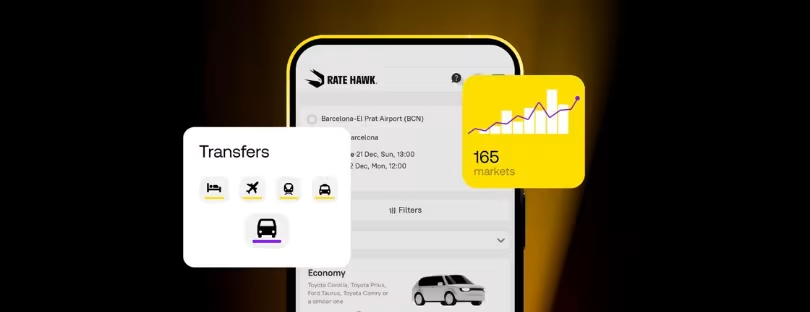
With transfers now available from 19 suppliers in 165 countries, RateHawk’s goal is pretty straightforward: make the first step of every trip smoother.
“In many locations, transfers are a more convenient and cost-effective alternative to taxis,”
explains Fredrik Bonnalt, Head of Non-Accommodation Supply at Emerging Travel Group. He points out that pre-booked transfers provide certainty — fixed pricing, scheduled pick-ups, no need for travellers to negotiate or chase down drivers in unfamiliar airports.
For agents, this convenience translates into value. RateHawk is nudging the industry toward a more integrated booking journey where hotels, flights, and ground mobility sit under one umbrella instead of being pieced together across multiple tools.

Car rentals double with seasonal peaks
Transfers aren’t the only service experiencing a boom. Car rentals have doubled since January, showing consistently strong performance throughout the year and a clear surge in July, which remains the peak month for self-drive travel.
Travellers are renting cars most often in the United States, Italy, Spain, Germany and France, destinations known for road trip culture, national parks, and sprawling rural regions where mobility is essential.
What’s particularly notable is how quickly RateHawk’s rental business grew after moving online in January. Through its supplier network, the platform now works with more than 400 rental companies across 160+ countries, offering a sizable range of price points and vehicle classes.
For travellers navigating rising airfares and more dynamic trip planning, a rental car is, as Bonnalt notes, “a cost-effective option that aligns with the trend toward more flexible, adventure-oriented travel.”
Why this growth matters beyond RateHawk
These numbers aren’t happening in a vacuum — they’re part of a wider shift in how the industry views ground services. Competitors like Booking.com, Expedia Group, Trip.com, GetTransfer, Hoppa and HolidayTaxis have also expanded mobility offerings in the past two years, recognising that ground transport is one of the most under-optimised links in the travel chain.
Several recent reports back this trend. Data from Phocuswright shows a steady rise in pre-booked ground transportation, particularly among long-haul travellers who prefer assurance and transparency on arrival. Meanwhile, Skift’s mobility insights highlight that ground transport is increasingly sold as part of package travel, not a standalone service.
RateHawk’s results reflect this industry momentum — but also show that agents are particularly receptive to platforms offering everything in one place, especially in the B2B space, where time savings and reliability are critical.
The takeaway for 2026 and beyond
RateHawk’s surge in transfers and car rentals is a sign of something bigger: ground transport is finally getting the strategic attention it deserves. While consumer-facing giants like Booking.com and Expedia have poured resources into mobility for years, B2B players were slower to adapt. RateHawk is now closing that gap quickly — and the numbers suggest the timing couldn’t be better.
Travellers want certainty after landing. Agents want bundled tools. And suppliers want access to global demand without high distribution costs. Platforms that can merge these three needs — with transparent pricing, wide geographic coverage and reliable partnerships — will shape the next phase of travel mobility.
If 2025 was the year transfers became mainstream for agents, 2026 is likely to be the year mobility becomes a non-negotiable pillar of full-trip booking strategies. RateHawk’s performance isn’t just impressive — it’s a preview of where the entire market is heading.