
New Ofcom Consultation Aims to Safeguard Fair Pricing in UK Call Services
Ofcom has launched a major consultation outlining its proposed regulations for the UK’s wholesale voice call markets from April 2026 to March 2031. The aim is to ensure that services enabling landline and mobile calls remain fair, competitive, and resilient — even as usage patterns shift toward online communication platforms like WhatsApp and Zoom. UK telecom regulation 2026

The proposed framework includes maintaining caps on call termination charges, updating access rules, and potentially removing legacy regulations such as the End-to-End Connectivity Condition. At the same time, Ofcom’s latest research highlights a significant decline in landline use and a surge in digital voice services, raising fresh questions about the future of voice connectivity and market oversight in the UK.
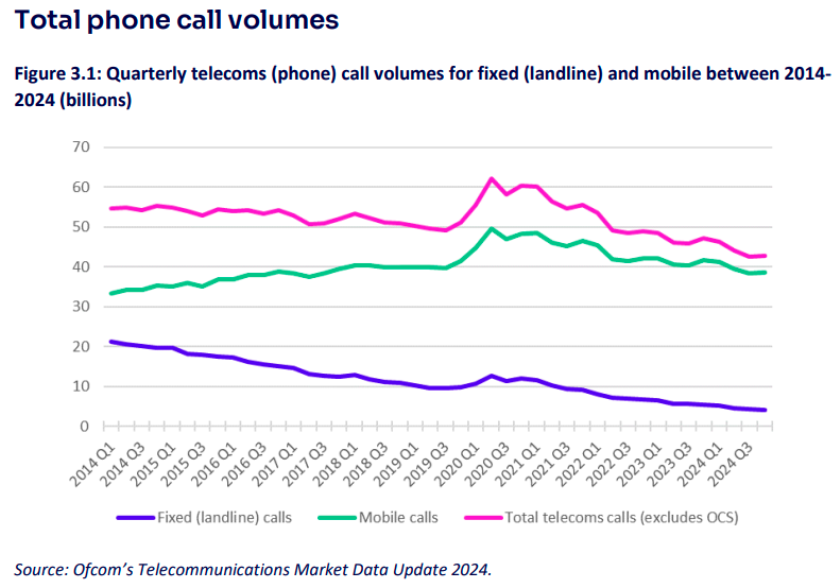
Ofcom’s consultation proposes new regulations for call termination markets and the End-to-End Connectivity Condition, covering the period from April 2026 to March 2031. Call termination enables calls from one network to be completed on another and is essential to the telecoms ecosystem. Ofcom aims to continue regulating these services to maintain effective competition and prevent providers from exploiting their market power through excessive charges, Ofcom report indicated.
Under the proposed framework, Ofcom plans to retain the current caps on termination charges —0.0365 pence per minute for fixed calls and 0.487 pence for mobile — through to March 2031. These caps will not be adjusted for inflation, aligning with cost expectations and reducing operational complexity for telecom providers. The same rate will apply to calls made to 070 personal numbers, helping to safeguard consumers from unfair pricing and fraud.
The consultation also recommends continued network access obligations for all fixed and mobile call termination providers. Additional measures on BT will remain in place, reflecting its position as the UK’s largest fixed termination provider and a key interconnection partner. However, conditions related to legacy technologies will be removed, acknowledging BT’s migration to digital infrastructure.


UK Call Rules Face Update: BT Obligations and 080 Numbers Reviewed
A key proposal is to revoke the End-to-End Connectivity Condition from April 2026. This condition currently requires BT to purchase termination services from other providers on reasonable terms. Ofcom believes that market developments — such as the availability of digital networks and third-party transit services — have reduced the risk of connectivity issues. Residual risks are expected to be addressed through other regulatory mechanisms.
The consultation is open for responses until 10 October 2025, with final decisions anticipated in early 2026.
Ofcom has launched a consultation reviewing the wholesale regulations for free-to-caller numbers (080 and 116) to ensure that the voice market continues to operate efficiently and sustainably. These numbers are used for important public, social, and commercial services and are free to consumers. Since the caller does not pay, the originating phone company is compensated by the terminating provider. To prevent market imbalances, Ofcom introduced access conditions in 2013 requiring fair and reasonable wholesale charges. This prevented disputes and ensured stable connections.
The current review, required by law, assesses the effectiveness of these conditions and whether they should be retained, modified, or revoked. Ofcom’s provisional conclusion is to retain the rules, as they continue to support service provision and avoid interconnection issues. Minor updates are proposed to reflect changes in market participants. Ofcom notes that while traffic to 080 numbers has declined due to shifts in communication habits, usage remains significant, particularly for socially vital services. The consultation is open until 26 September 2025, with final decisions expected by the end of the year.
New research by Ofcom reveals changing patterns in how people and businesses use mobile, landline, and online voice services. Mobile calls remain the most commonly used form of communication among consumers and SMEs, while landline usage continues to decline, though it remains important for certain groups, especially older people and those in rural areas. In 2024, there were still around 24 million landline connections in the UK.
At the same time, online communication services (OCS) such as WhatsApp, Microsoft Teams, and Zoom are increasingly being used for voice and video calls. In fact, in 2024, total OCS voice and video call minutes (415 billion) surpassed the combined total for mobile and landline calls (176 billion). Despite this growth, OCSs are typically closed systems, only allowing communication between users of the same platform, unlike mobile and landline services that support universal connectivity.
The research found that 88 percent of SMEs still rely on mobile calls, and 52 percent use landlines, while 81 percent use WhatsApp for voice or video calls. Among consumers, mobile calls remain the dominant form of personal communication, and 64 percent of those making international calls use WhatsApp. While landline use has declined, it remains essential for certain segments — 60 percent of people over 65 still use landlines, and 21 percent rely on them for all their calls.

Final thoughts about UK telecom regulation 2026
While Ofcom’s proposed regulatory framework largely reflects continuity and caution, it also underscores the broader challenge regulators face in keeping pace with a rapidly evolving communications ecosystem. The decision to retain termination charge caps and network access obligations maintains the UK’s alignment with established European regulatory principles — similar to approaches taken by BEREC and regulators in markets like Germany (BNetzA) and France (ARCEP), where competitive safeguards remain in place despite declining voice traffic.
Yet, the UK telecom landscape is clearly shifting. With online communication services (OCS) now accounting for the majority of voice and video minutes, platforms like WhatsApp, Zoom, and Microsoft Teams are reshaping user expectations — particularly among younger demographics and SMEs. However, these services often operate as walled gardens, limiting interoperability and sidestepping traditional telecom regulations. The consultation’s acknowledgment of this fragmentation, paired with the planned revocation of the End-to-End Connectivity Condition, raises critical questions about the long-term viability of universal voice connectivity without proactive inter-platform regulation.
Meanwhile, Ofcom’s emphasis on maintaining stability for socially important services like 080 numbers is timely, given growing concerns around digital exclusion. It also echoes recent guidance from the ITU and OECD, which warn against regulatory blind spots as legacy infrastructure is phased out.
In essence, Ofcom is attempting to strike a delicate balance: preserving competition and consumer protection in the traditional voice market while gradually withdrawing from areas where market dynamics and digital innovation may offer more efficient outcomes. Whether this transitional model proves sustainable—especially as AI-powered communication tools and cross-platform voice services become mainstream — will depend not just on domestic regulation but on broader international coordination and the sector’s ability to future-proof voice connectivity itself.