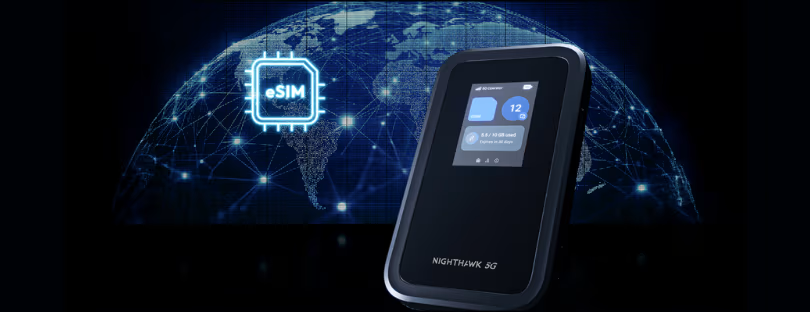
NETGEAR M7 WiFi 7 Hotspot Launches With Global eSIM
NETGEAR is making a serious play for global travelers again. With the announcement of the Nighthawk 5G M7 Portable WiFi 7 Hotspot (MH7150), the company is not just launching a faster hotspot; it is pushing hard into the growing intersection of WiFi 7, 5G mobility, and embedded eSIM marketplaces. Pre-orders are now live, with global shipping and retail availability starting January 27, 2026.

For frequent travelers, remote workers, and digital nomads, this launch signals something important. Portable connectivity is no longer about just having a backup internet option. It is becoming a primary, flexible, and borderless way to stay online.
What makes the M7 especially interesting is not one single feature, but how everything comes together in one device.
What NETGEAR is launching and why it matters
The M7 is the first NETGEAR portable hotspot to combine WiFi 7, 5G multi-gig performance, and a built-in eSIM marketplace under one roof. According to NETGEAR, the goal is simple. Give users instant, reliable connectivity anywhere, without relying on hotel WiFi, local SIM shops, or expensive roaming plans.
Out of the box, the device supports speeds of up to 3.6 Gbps and can connect up to 32 devices at once. That makes it suitable not just for solo travelers, but for families, small teams, content creators, or business travelers running multiple devices at the same time.
The M7 is also fully unlocked. Users can insert a physical SIM, activate third-party eSIMs, or buy data directly from NETGEAR’s own eSIM marketplace through the app. This level of flexibility is quickly becoming the baseline expectation in the travel connectivity market.
Built for mobility, not just speed
Specs alone do not tell the full story. NETGEAR has clearly designed the M7 around real-world mobility.
The device is compact, lightweight, and powered by a high-capacity battery that delivers up to 10 hours of continuous use. That is a full workday for most travelers. It charges via USB-C and can also be used as a wired connection if needed.
For anyone who has tried to tether a phone all day while traveling, this matters. Offloading connectivity to a dedicated hotspot preserves phone battery life, reduces thermal throttling, and provides a far more stable connection.
Supporting up to 32 devices also makes the M7 practical in shared environments like apartments, co-working spaces, or even small events on the move.
 WiFi 7 and the Qualcomm backbone
 WiFi 7 and the Qualcomm backbone
Under the hood, the M7 is powered by the Qualcomm Dragonwing SDX72 chipset, Qualcomm’s fifth-generation 5G modem-to-antenna platform. Qualcomm positions this chipset as a major step forward in Sub-6 GHz carrier aggregation, enabling more consistent multi-gig speeds across different networks.
This is important because headline speed numbers rarely reflect reality when traveling. Network congestion, spectrum availability, and local infrastructure all play a role. Better aggregation and smarter radio management translate into more stable performance in real-world conditions, not just lab tests.
Combined with WiFi 7, users benefit from lower latency, improved multi-device handling, and better performance in crowded environments. Airports, hotels, conferences, and city centers are exactly where WiFi 7 starts to show its value.
The eSIM marketplace angle
One of the most strategic elements of the M7 launch is the integrated eSIM marketplace. Through the NETGEAR app, users can purchase and activate data plans in over 140 countries, without contracts or traditional roaming fees.
This mirrors a broader industry trend. Hardware companies are increasingly becoming distribution channels for connectivity, not just devices. We have seen similar moves from smartphone manufacturers, laptop makers, and even car brands.
What NETGEAR is doing differently is positioning the hotspot itself as the central connectivity hub, independent of any single mobile operator. The M7 supports NETGEAR’s own marketplace, third-party eSIMs, and physical SIM cards from major carriers.
In the US, the device is certified with AT&T, T-Mobile, and Verizon. Internationally, its value comes from being operator-agnostic.
For travelers, this means choice. For NETGEAR, it creates recurring revenue opportunities beyond hardware sales.


Security and wired flexibility
Security is another area where the M7 goes beyond consumer-grade hotspots. The device includes WPA3 encryption, built-in firewall protection, advanced router security features, and automatic firmware updates.
This matters for business travelers and remote workers who regularly handle sensitive data on public networks. A dedicated hotspot with enterprise-grade security features is simply safer than open WiFi or phone tethering.
For wired scenarios, users can connect directly via USB-C or add an Ethernet adapter for even faster and more stable speeds. This makes the M7 usable as a temporary home router or backup internet solution, not just a travel gadget.
Pricing and availability
NETGEAR has priced the M7 at $499.99 MSRP. Pre-orders are already open on netgear.com, with global shipping and retail rollout starting January 27, 2026.
This puts the device firmly in the premium category. It is not competing with budget hotspots or entry-level travel routers. Instead, it targets power users who value performance, flexibility, and long-term usability.
Conclusion: Where the M7 fits in the travel connectivity market
The launch of the Nighthawk M7 highlights where the travel connectivity market is heading. Devices are no longer just pipes to the internet. They are platforms.
Compared to existing portable hotspots from players like Inseego, GlocalMe, or even operator-branded 5G routers, NETGEAR’s advantage lies in three areas: WiFi 7 readiness, true eSIM openness, and brand trust built over decades in networking. Many competing devices still rely on older WiFi standards or lock users into proprietary data ecosystems.
At the same time, the M7 reflects a broader shift seen across the industry. According to GSMA and OpenSignal reports, eSIM adoption and multi-device connectivity are accelerating rapidly, especially among frequent travelers and remote professionals. Hardware brands that control both the device and the connectivity experience are better positioned to capture long-term value.
For Alertify readers, the takeaway is clear. Portable connectivity is becoming smarter, faster, and more modular. The NETGEAR M7 is not just another hotspot launch. It is a signal that premium, flexible, global internet access is becoming a standard expectation, not a luxury.
As WiFi 7 networks expand and eSIM marketplaces mature, devices like the M7 are likely to become the backbone of how people stay connected across borders. NETGEAR is betting that travelers are ready for that shift, and based on current trends, it is a bet that makes a lot of sense.